

Back to articles
When Lyme Disease Evades the Immune System
MR
Mia Rozenbaum
05/06/2020
3 min read
0 comments
Share:
New findings shed light on the immune evasion mechanisms of the bacteria that cause Lyme disease, which can have serious consequences for both animals and humans. A key molecule acts as a shield.
 In France, the number of cases of Lyme disease, or Lyme borreliosis, continues to rise every year. And it is not the only disease in this situation. Lyme disease is the leading tick-borne illness
in temperate European countries.
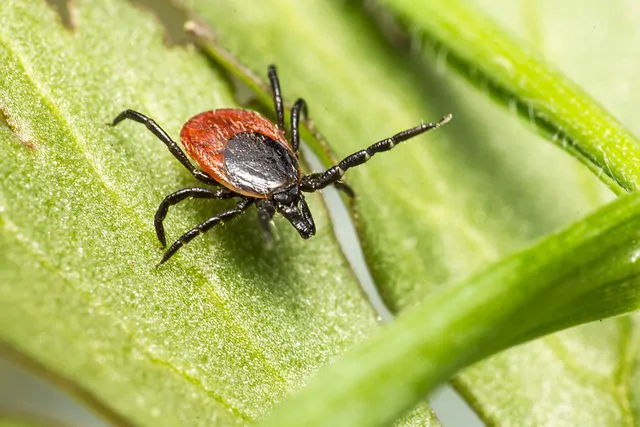
This disease, which remains relatively unknown and is often misdiagnosed, affects both animals and humans bitten by ticks of the genus Ixodes
. The bacteria Borrelia burgdorferi
, present in the tick, then infects mammals and multiplies within them.
Symptoms may be limited to a characteristic redness around the bite site, but in some cases progress to debilitating and painful conditions, particularly neurological, joint, and muscular disorders.
In the United States, nearly 60% of patients with
advanced Lyme disease develop arthritis as a result of complications. The culprit is the bacterial protein Arp, a surface lipoprotein that is overexpressed at the time of infection in the host.
In mice, Arp causes joint swelling and the onset of arthritis. However, while anti-Arp antibodies can counteract the induction of osteoarthritis in immunocompromised mice, they cannot eliminate or prevent infection by B. burgdorferi under normal conditions. This is despite the fact that Arp can elicit a strong humoral response.
In France, the number of cases of Lyme disease, or Lyme borreliosis, continues to rise every year. And it is not the only disease in this situation. Lyme disease is the leading tick-borne illness
in temperate European countries.
This disease, which remains relatively unknown and is often misdiagnosed, affects both animals and humans bitten by ticks of the genus Ixodes
. The bacteria Borrelia burgdorferi
, present in the tick, then infects mammals and multiplies within them.
Symptoms may be limited to a characteristic redness around the bite site, but in some cases progress to debilitating and painful conditions, particularly neurological, joint, and muscular disorders.
In the United States, nearly 60% of patients with
advanced Lyme disease develop arthritis as a result of complications. The culprit is the bacterial protein Arp, a surface lipoprotein that is overexpressed at the time of infection in the host.
In mice, Arp causes joint swelling and the onset of arthritis. However, while anti-Arp antibodies can counteract the induction of osteoarthritis in immunocompromised mice, they cannot eliminate or prevent infection by B. burgdorferi under normal conditions. This is despite the fact that Arp can elicit a strong humoral response.
 The bacteria is therefore able to evade the immune system thanks to another protein that protects Arp from antibodies: VlsE
. Also overexpressed upon infection of mammals, this molecule is essential for the survival and persistence of B. burgdorferi in the face of the host’s humoral response.
Numerous studies have demonstrated the importance of VlsE’s antigenic variation in facilitating this immune evasion during the pathogen’s infection of the host. Without this molecule, the bacteria are quickly overwhelmed by the infected host’s immune response.
However, researchers have long been skeptical. How could the antigenic variation of a single protein confer protection against the multitude of antibodies generated against a large number of proteins—such as Arp—on the surface of these bacteria?
Researchers at Washington State University have demonstrated that VlsE does indeed prevent Arp-specific antibodies from binding to Arp, thereby protecting Arp from the host’s antibodies.
VlsE defends Arp by exhibiting antigenic variation that allows it to evade the immune response and antibodies. By providing protection against epitopes, VlsE acts as a shield.
However, VlsE is not a universal protector against all anti-Borrelia antibodies. Future studies will be needed to determine how VlsE maintains the persistence of B. burgdorferi during host infection despite the fact that its protection is not complete.
A deeper understanding of immune evasion mechanisms could help identify therapeutic solutions for a largely misunderstood disease. Until a treatment is discovered, authorities will continue to “encourage the strengthening of preventive measures and remind the public of the importance of taking precautions before engaging in outdoor activities”
(long-sleeved clothing, repellents, etc.).
Further Reading
The bacteria is therefore able to evade the immune system thanks to another protein that protects Arp from antibodies: VlsE
. Also overexpressed upon infection of mammals, this molecule is essential for the survival and persistence of B. burgdorferi in the face of the host’s humoral response.
Numerous studies have demonstrated the importance of VlsE’s antigenic variation in facilitating this immune evasion during the pathogen’s infection of the host. Without this molecule, the bacteria are quickly overwhelmed by the infected host’s immune response.
However, researchers have long been skeptical. How could the antigenic variation of a single protein confer protection against the multitude of antibodies generated against a large number of proteins—such as Arp—on the surface of these bacteria?
Researchers at Washington State University have demonstrated that VlsE does indeed prevent Arp-specific antibodies from binding to Arp, thereby protecting Arp from the host’s antibodies.
VlsE defends Arp by exhibiting antigenic variation that allows it to evade the immune response and antibodies. By providing protection against epitopes, VlsE acts as a shield.
However, VlsE is not a universal protector against all anti-Borrelia antibodies. Future studies will be needed to determine how VlsE maintains the persistence of B. burgdorferi during host infection despite the fact that its protection is not complete.
A deeper understanding of immune evasion mechanisms could help identify therapeutic solutions for a largely misunderstood disease. Until a treatment is discovered, authorities will continue to “encourage the strengthening of preventive measures and remind the public of the importance of taking precautions before engaging in outdoor activities”
(long-sleeved clothing, repellents, etc.).
Further Reading
Lyme disease: The Importance of Wildlife in the Fight Against Ticks Has Been Demonstrated
Lyme disease: The Siberian chipmunk may influence tick infection
Lyme disease: a zoonosis with many unknowns
Read next
One Health & Zoonoses
10/10/2026
More than half of New York City’s free-roaming cats carry intestinal parasites?
One Health & Zoonoses
10/09/2026
Giardia in cats: large North American study finds 6.3% prevalence and substantial zoonotic potential
One Health & Zoonoses
10/08/2026
Commentaires
No comments yet.
Sign in to comment