

Back to articles
One Health & Zoonoses
Biodiversity
Chickenpox
Climate change
Coxiella burnetii
Encephalitis
Lyme disease
Q fever
Rickettsia spp.
Tick
Tularemia
Wildlife
Zoonosis
Lyme disease: The Importance of Wildlife in the Fight Against Ticks Has Been Demonstrated
V
Vetitude
01/09/2018
3 min read
0 comments
Share:
A study conducted in Kenya shows that the combined effects of declining wildlife biodiversity and climate change influence tick abundance and, consequently, the risk of disease. Globally, ticks are considered the leading vectors of disease in wild animals and domestic animals. For cattle alone, annual losses due to tick-borne diseases are estimated at nearly $14 billion. The results show that the absence of large mammals has a very significant impact on the tick population in a given region.
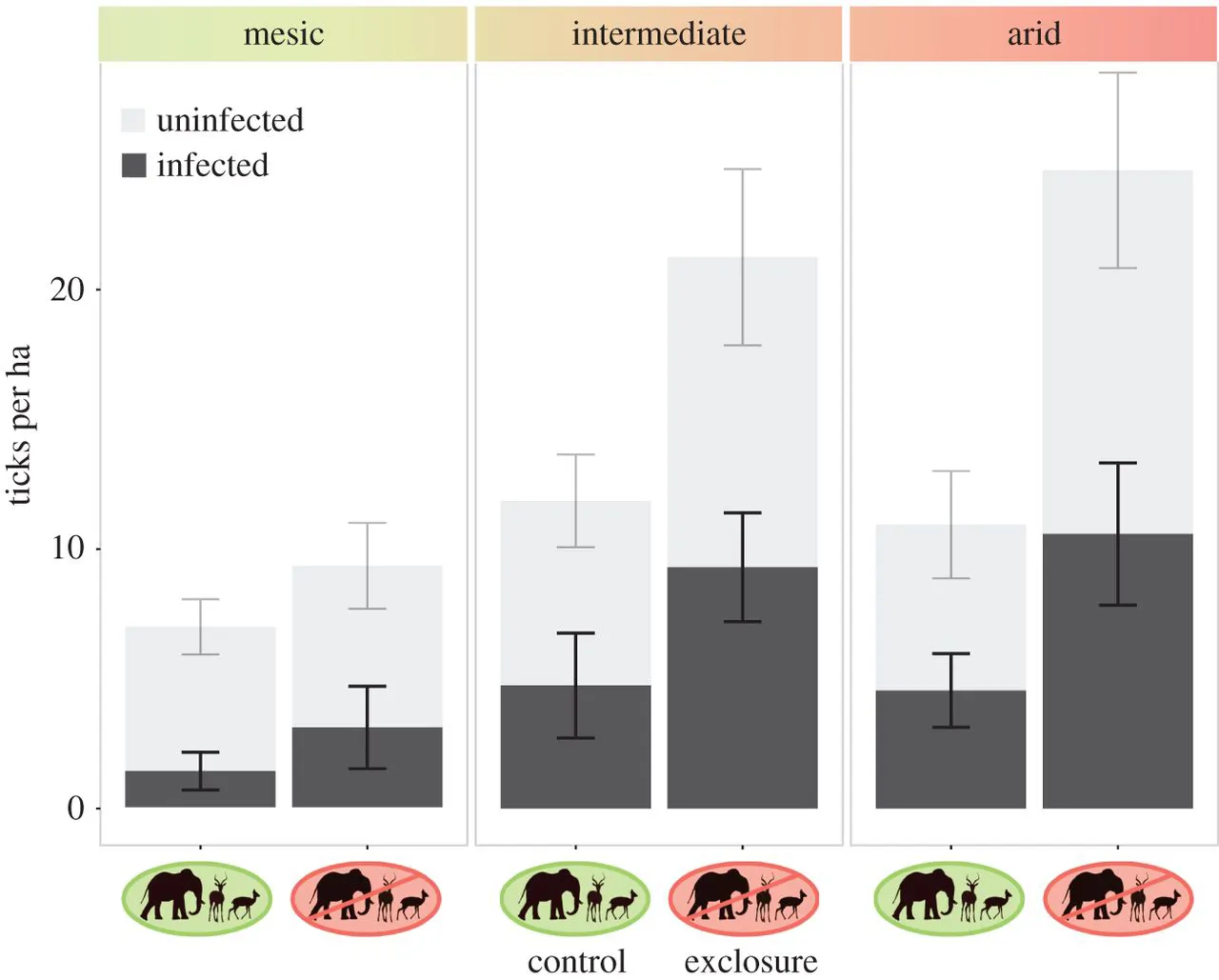 Tick-borne zoonotic diseases are a growing concern worldwide. Lyme disease, Q fever, encephalitis, tularemia, and other spotted fevers have significant impacts on both animal and human health. However, according to the study conducted by the University of California, the abundance of ticks that are vectors for these diseases is expected to increase in the future due to a combination of two factors: the decline in wildlife populations and climate change. Through a large-scale experimental study conducted over a 13-month period in Africa, the synergistic effects of these two phenomena on ticks and their pathogenicity were demonstrated.
The researchers found that the total abundance of ticks and the abundance of ticks infected with Coxiella burnetii and Rickettsia spp. increase significantly in the absence of all large wild mammals, an effect that is further exacerbated in arid, low-productivity areas. On average, the total abundance of ticks doubles in areas where large animals are completely excluded compared to control plots (with no restrictions on which animals enter). Total exclusion of wildlife increases the total abundance of ticks by 130% at sites with moderate humidity and by 225% at drier sites. Thus, the effect of the absence of wildlife on tick abundance increases as aridity increases.
Tick-borne zoonotic diseases are a growing concern worldwide. Lyme disease, Q fever, encephalitis, tularemia, and other spotted fevers have significant impacts on both animal and human health. However, according to the study conducted by the University of California, the abundance of ticks that are vectors for these diseases is expected to increase in the future due to a combination of two factors: the decline in wildlife populations and climate change. Through a large-scale experimental study conducted over a 13-month period in Africa, the synergistic effects of these two phenomena on ticks and their pathogenicity were demonstrated.
The researchers found that the total abundance of ticks and the abundance of ticks infected with Coxiella burnetii and Rickettsia spp. increase significantly in the absence of all large wild mammals, an effect that is further exacerbated in arid, low-productivity areas. On average, the total abundance of ticks doubles in areas where large animals are completely excluded compared to control plots (with no restrictions on which animals enter). Total exclusion of wildlife increases the total abundance of ticks by 130% at sites with moderate humidity and by 225% at drier sites. Thus, the effect of the absence of wildlife on tick abundance increases as aridity increases.
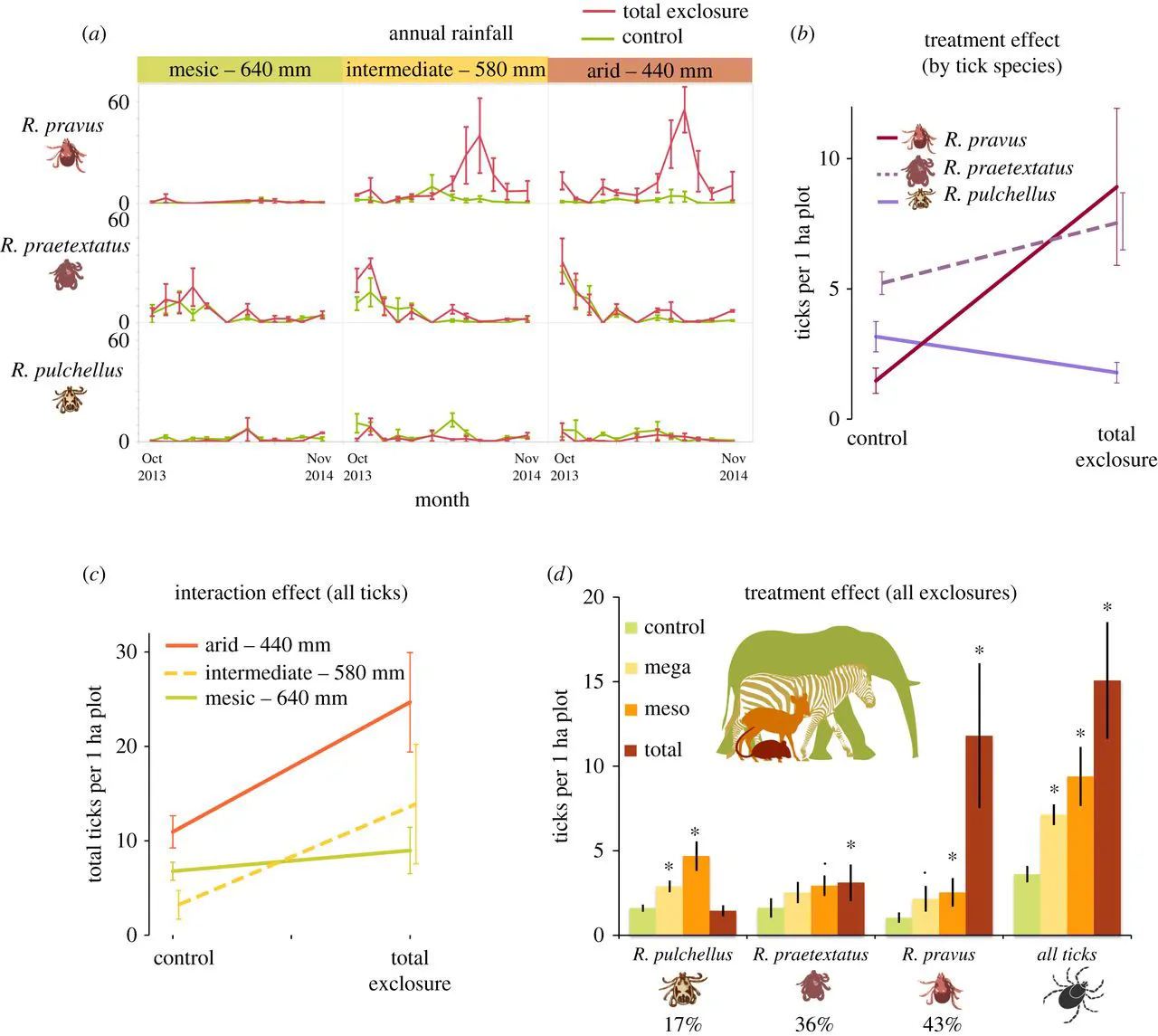 By varying the degree of wildlife exclusion, the total tick abundance ranged from 170% when only large herbivores were absent to 360% when all large wild mammals were excluded. Several other variables and their interactions were tested, such as rainfall, tick species (Rhipicephalus pravus, R. praetextatus, R. pulchellus), their developmental stage, their hosts, etc.
The prevalence of pathogens isolated from ticks did not vary significantly across experimental plots (exclusion zones), precipitation levels, or tick species, suggesting that the risk of exposure to tick-borne pathogens reflects observed trends and estimates of tick abundance.
Beyond these findings, it appears that a decline in populations of wild species leads to a resurgence of local tick populations, potentially increasing the threat of infectious diseases on a global scale. Thus, this study suggests that, in many contexts, the conservation of large mammals could prevent an increase in tick abundance and tick-borne diseases. It also highlights the need to incorporate the ecological context when predicting the effects of wildlife loss on the dynamics of zoonoses.
By varying the degree of wildlife exclusion, the total tick abundance ranged from 170% when only large herbivores were absent to 360% when all large wild mammals were excluded. Several other variables and their interactions were tested, such as rainfall, tick species (Rhipicephalus pravus, R. praetextatus, R. pulchellus), their developmental stage, their hosts, etc.
The prevalence of pathogens isolated from ticks did not vary significantly across experimental plots (exclusion zones), precipitation levels, or tick species, suggesting that the risk of exposure to tick-borne pathogens reflects observed trends and estimates of tick abundance.
Beyond these findings, it appears that a decline in populations of wild species leads to a resurgence of local tick populations, potentially increasing the threat of infectious diseases on a global scale. Thus, this study suggests that, in many contexts, the conservation of large mammals could prevent an increase in tick abundance and tick-borne diseases. It also highlights the need to incorporate the ecological context when predicting the effects of wildlife loss on the dynamics of zoonoses.
Read next
One Health & Zoonoses
10/10/2026
More than half of New York City’s free-roaming cats carry intestinal parasites?
One Health & Zoonoses
10/09/2026
Giardia in cats: large North American study finds 6.3% prevalence and substantial zoonotic potential
One Health & Zoonoses
10/08/2026
Commentaires
No comments yet.
Sign in to comment