

Back to articles
Animal Welfare
AFAAD
Animal welfare
AWF
Equine
Equine welfare
Eurogroup for Animals
Eyes on Animals
Gaia
Hippophagy
Horse
Horse meat
Phenylbutazone
Slaughter
Traceability
TSB
Welfarm
Imported horse meat: A new EU regulation could exacerbate the suffering of horses
V
Vetitude
03/01/2017
4 min read
0 comments
Share:
Six international animal protection organizations* are calling for a ban on imports into Europe and Switzerland of horse meat from horses slaughtered in the Americas. Backed by the Eurogroup for Animals, they denounce the deplorable conditions under which horses intended for the European market are housed, transported, and slaughtered. This trade, a source of considerable suffering, fails to meet the European Union’s animal welfare requirements. In addition to mistreatment, the investigation** conducted in the United States reveals a lack of traceability for slaughtered animals, which facilitates fraud and may pose risks to public health.
Effective today, March 1
, 2017
, a recent European Commission regulation*** takes effect: imported horse meat must now come from “domestic solipeds that have been kept for at least six months”
in the third country prior to slaughter. This quarantine measure, implemented to address the issue of horse traceability and to minimize the risk of drug residues in the meat
, appears inappropriate and risks further exacerbating the dire situation of the approximately 44,000 American horses slaughtered in Canada, as well as Brazilian horses slaughtered in Uruguay for export to the European market.
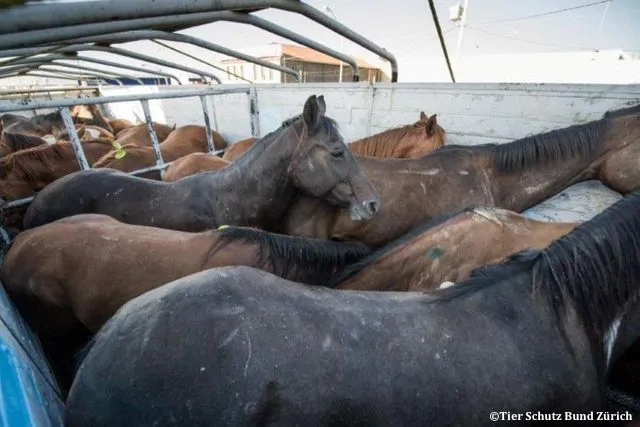 Indeed, the requirement for a six-month waiting period will not make it possible to determine the origin of horses obtained through trafficking (theft in Argentina or smuggling in Uruguay) nor provide guarantees regarding the absence of residues of banned substances in the meat, such as phenylbutazone, after that period. On the other hand, the collection and holding pens for horses destined for slaughter—which are dirty and already overcrowded—will have to keep even more injured, weakened, or even pregnant animals in waiting. For the list of hardships inflicted on horses destined for the international meat trade is long: transport over hundreds of kilometers without water or food in dilapidated trucks, rough handling by unqualified personnel, non-compliant and overcrowded fattening facilities and slaughterhouse pens, virtually nonexistent shelter from extreme weather conditions, lack of care and supervision, appalling slaughter conditions, lack of traceability, etc.
The two-year investigation (2015–2016) conducted in the United States, Canada, Uruguay, and Argentina by the organizations AWF and TSB, Animals’ Angels
USA and FTA, shows that the conditions under which horses raised for slaughter are kept, transported, and slaughtered have not improved since the 2012 investigation. This new investigation reveals cruel practices throughout the entire production chain that violate animal welfare standards in force in Europe and Switzerland, as well as a lack of traceability,
according to Eurogroup for Animals
. While previous investigations led, in particular, to a ban on imports of Mexican horse meat into the European Union in 2015, such a ban has not been applied to countries such as Argentina, Uruguay, and Canada. However, production conditions in certified slaughterhouses in North and South America raise similar concerns regarding equine welfare and consumer protection as those reported in Mexico.
For animal welfare organizations, “the only way to remedy this situation is a European ban on imports of horse meat produced under cruel conditions across the Atlantic.”
They are also calling for country-of-origin labeling—which has become mandatory for beef and pork—to be required for horse meat as well. Currently, there is no requirement to indicate the country of origin on the label.
Of a total horse population of more than one million, France raises less than 10% for horse meat production, more than 90% of which is exported, particularly to Italy
. Conversely, France imports large quantities of meat from adult horses to meet French consumer demand: only 20 to 30% of the horse meat consumed in France comes from domestic production.
Virtually all of the meat sold by major retailers is imported, with half of it coming from horses slaughtered in North America and Latin America. Canada, Argentina, and Uruguay are thus France’s largest suppliers. Meanwhile, all supermarkets in Switzerland and many in the Netherlands and Belgium have stopped selling imported horse meat that does not meet European animal welfare standards.
* The coalition, supported by the Eurogroup for Animals
(Brussels), includes Welfarm (France), the Association for the Humane Slaughter of Animals (Afaad, France), the Animal Welfare Foundation
(AWF, Germany), the Tierschutzbund Zürich (TSB, Switzerland), Eyes on Animals
(Netherlands), Gaia (Belgium), Animals’ Angels
(U.S.), and For the Animals
(FTA, Uruguay).
** https://youtu.be/Jo_G9DXtOx8
*** Commission Implementing Regulation (EU) 2016/1832 of October 17, 2016, amending Regulation (EU) No. 206/2010, in particular the model certificates for the importation into the Union of fresh meat from domestic solipeds and the animal health control conditions regarding residues, http://eur-lex.europa.eu/legal-content/FR/TXT/?uri=celex:32016R1832
See also our previous article: An investigation in Latin America reveals risky slaughter practices and animal abuse
Indeed, the requirement for a six-month waiting period will not make it possible to determine the origin of horses obtained through trafficking (theft in Argentina or smuggling in Uruguay) nor provide guarantees regarding the absence of residues of banned substances in the meat, such as phenylbutazone, after that period. On the other hand, the collection and holding pens for horses destined for slaughter—which are dirty and already overcrowded—will have to keep even more injured, weakened, or even pregnant animals in waiting. For the list of hardships inflicted on horses destined for the international meat trade is long: transport over hundreds of kilometers without water or food in dilapidated trucks, rough handling by unqualified personnel, non-compliant and overcrowded fattening facilities and slaughterhouse pens, virtually nonexistent shelter from extreme weather conditions, lack of care and supervision, appalling slaughter conditions, lack of traceability, etc.
The two-year investigation (2015–2016) conducted in the United States, Canada, Uruguay, and Argentina by the organizations AWF and TSB, Animals’ Angels
USA and FTA, shows that the conditions under which horses raised for slaughter are kept, transported, and slaughtered have not improved since the 2012 investigation. This new investigation reveals cruel practices throughout the entire production chain that violate animal welfare standards in force in Europe and Switzerland, as well as a lack of traceability,
according to Eurogroup for Animals
. While previous investigations led, in particular, to a ban on imports of Mexican horse meat into the European Union in 2015, such a ban has not been applied to countries such as Argentina, Uruguay, and Canada. However, production conditions in certified slaughterhouses in North and South America raise similar concerns regarding equine welfare and consumer protection as those reported in Mexico.
For animal welfare organizations, “the only way to remedy this situation is a European ban on imports of horse meat produced under cruel conditions across the Atlantic.”
They are also calling for country-of-origin labeling—which has become mandatory for beef and pork—to be required for horse meat as well. Currently, there is no requirement to indicate the country of origin on the label.
Of a total horse population of more than one million, France raises less than 10% for horse meat production, more than 90% of which is exported, particularly to Italy
. Conversely, France imports large quantities of meat from adult horses to meet French consumer demand: only 20 to 30% of the horse meat consumed in France comes from domestic production.
Virtually all of the meat sold by major retailers is imported, with half of it coming from horses slaughtered in North America and Latin America. Canada, Argentina, and Uruguay are thus France’s largest suppliers. Meanwhile, all supermarkets in Switzerland and many in the Netherlands and Belgium have stopped selling imported horse meat that does not meet European animal welfare standards.
* The coalition, supported by the Eurogroup for Animals
(Brussels), includes Welfarm (France), the Association for the Humane Slaughter of Animals (Afaad, France), the Animal Welfare Foundation
(AWF, Germany), the Tierschutzbund Zürich (TSB, Switzerland), Eyes on Animals
(Netherlands), Gaia (Belgium), Animals’ Angels
(U.S.), and For the Animals
(FTA, Uruguay).
** https://youtu.be/Jo_G9DXtOx8
*** Commission Implementing Regulation (EU) 2016/1832 of October 17, 2016, amending Regulation (EU) No. 206/2010, in particular the model certificates for the importation into the Union of fresh meat from domestic solipeds and the animal health control conditions regarding residues, http://eur-lex.europa.eu/legal-content/FR/TXT/?uri=celex:32016R1832
See also our previous article: An investigation in Latin America reveals risky slaughter practices and animal abuse
Read next
Animal Welfare
10/06/2026
Bites haven't be an unavoidable part of veterinary work
Animal Welfare
10/05/2026
US animal welfare policy: new federal measures focus on dogs and research while farm animals remain largely outside the framework
Animal Welfare
10/08/2025
Commentaires
No comments yet.
Sign in to comment