

Back to articles
Policy & Regulation
CAP
Equestrian Activities
Equine
Equine industry
European Horse Network
European Parliament
Hippophagy
Horse
Horse Group
Horse meat
Horse racing
Horse Racing Betting
IFCE
Jean Arthuis
PMU
The Future of the Equine Industry: A “Horse” Working Group Is Established Within the European Parliament
V
Vetitude
10/22/2016
4 min read
0 comments
Share:
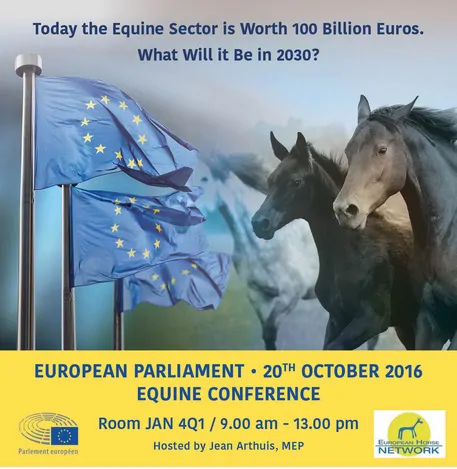
On October 20 in Strasbourg, MEP Jean Arthuis organized a conference focused on the future of the equine sector by 2030. He brought together representatives from the European equine industry to identify the measures needed to ensure the long-term development of equestrian activities. Following the discussions, he announced the creation of a “horse” group within the European Parliament, which could draw on the expertise of the European Horse Network*. Its goal is to identify shortcomings, develop best practices to promote, and compare the various funding models used in the sector. Along with other members of Parliament, he also calls on the equine industry to better communicate its diversity, contributions, and successes.
 The call to action recently launched by the five presidents of the French equine industry in favor of a comprehensive
and ambitious European policy
—urging public authorities to implement “a genuine European equine policy”—
appears to have been heard at the European level.
Throughout Europe, while the horse’s place in society remains significant, it is clear that its role is gradually declining. However, the sustainability of equine-related activities—whether involving horses as athletes, for recreation, or as working animals—will depend on the value we can assign to them, Jean Arthuis emphasized. According to him, “horses need more of Europe and can also help our continent move forward by revitalizing its regions, spreading healthy lifestyles, and reestablishing essential social and community ties.”
Despite the current decline in European horse breeding, the equine industry continues to create jobs and contributes to the revitalization and vitality of rural areas. Equine activities in the European Union meet the criteria of the European rural development policy, and horse breeding remains eligible for aid under the Common Agricultural Policy (CAP). However, all too often, agricultural regulations are not applied consistently, administrative complexity hinders the smooth operation of farms, and the tax system is ill-suited to the sector. Dominique de Bellaigue, president of Trot Français, has notably criticized the fragmentation of equine taxation within the single market.
For Jean Arthuis, “the essential tool for helping the equine industry regain the place it deserves within the agricultural world is undoubtedly its return to the food chain.” We must not “be afraid to lift this taboo and assert that the lifelong exclusion of half of Europe’s horse population is an aberration.”
He therefore advocates fighting this exclusion rule to prevent new scandals involving fraud or mistreatment.
Another issue that must be tackled head-on concerns horse racing betting, which is the sector’s most significant source of funding but is facing significant deregulation. The adoption of rules such as those governing “return to the industry” and the preservation of the integrity of horse racing and equestrian competitions is essential, according to the MEP, to ensure the long-term sustainability of this funding. The development of pari-mutuel betting (PMU), which is currently losing momentum, must be prioritized and debated to better promote horse racing.
Today, the European equine industry is worth some 100 million euros—what will it be like in 2030? The European Parliament’s new “Horse” group will have to answer this question. A meeting is scheduled in six months to examine the sector’s financial sustainability—that is, its ability to remain solvent and secure funding for its activities. Along with his fellow MEPs, Jean Arthuis is also calling on national equine industries to take action and join forces to better communicate their diversity, contributions, and successes. According to Françoise Clément of the French Horse and Riding Institute (IFCE), “the horse will have a bright future on our continent if—and only if—public authorities believe in its qualities, virtues, and value.” “The European level is the only one capable of ensuring the long-term stability of our industry
,”
says Dominique de Bellaigue.
* Founded in 2009 and based in Brussels, the European Horse Network (EHN) brings together 22 European and national organizations representing the various sectors of the equine industry (racing, horse breeding, sports, recreation, research, etc.).
The call to action recently launched by the five presidents of the French equine industry in favor of a comprehensive
and ambitious European policy
—urging public authorities to implement “a genuine European equine policy”—
appears to have been heard at the European level.
Throughout Europe, while the horse’s place in society remains significant, it is clear that its role is gradually declining. However, the sustainability of equine-related activities—whether involving horses as athletes, for recreation, or as working animals—will depend on the value we can assign to them, Jean Arthuis emphasized. According to him, “horses need more of Europe and can also help our continent move forward by revitalizing its regions, spreading healthy lifestyles, and reestablishing essential social and community ties.”
Despite the current decline in European horse breeding, the equine industry continues to create jobs and contributes to the revitalization and vitality of rural areas. Equine activities in the European Union meet the criteria of the European rural development policy, and horse breeding remains eligible for aid under the Common Agricultural Policy (CAP). However, all too often, agricultural regulations are not applied consistently, administrative complexity hinders the smooth operation of farms, and the tax system is ill-suited to the sector. Dominique de Bellaigue, president of Trot Français, has notably criticized the fragmentation of equine taxation within the single market.
For Jean Arthuis, “the essential tool for helping the equine industry regain the place it deserves within the agricultural world is undoubtedly its return to the food chain.” We must not “be afraid to lift this taboo and assert that the lifelong exclusion of half of Europe’s horse population is an aberration.”
He therefore advocates fighting this exclusion rule to prevent new scandals involving fraud or mistreatment.
Another issue that must be tackled head-on concerns horse racing betting, which is the sector’s most significant source of funding but is facing significant deregulation. The adoption of rules such as those governing “return to the industry” and the preservation of the integrity of horse racing and equestrian competitions is essential, according to the MEP, to ensure the long-term sustainability of this funding. The development of pari-mutuel betting (PMU), which is currently losing momentum, must be prioritized and debated to better promote horse racing.
Today, the European equine industry is worth some 100 million euros—what will it be like in 2030? The European Parliament’s new “Horse” group will have to answer this question. A meeting is scheduled in six months to examine the sector’s financial sustainability—that is, its ability to remain solvent and secure funding for its activities. Along with his fellow MEPs, Jean Arthuis is also calling on national equine industries to take action and join forces to better communicate their diversity, contributions, and successes. According to Françoise Clément of the French Horse and Riding Institute (IFCE), “the horse will have a bright future on our continent if—and only if—public authorities believe in its qualities, virtues, and value.” “The European level is the only one capable of ensuring the long-term stability of our industry
,”
says Dominique de Bellaigue.
* Founded in 2009 and based in Brussels, the European Horse Network (EHN) brings together 22 European and national organizations representing the various sectors of the equine industry (racing, horse breeding, sports, recreation, research, etc.).
Commentaires
No comments yet.
Sign in to comment