The American Animal Hospital Association and the American Association of Feline Practitioners have brought together experts to provide new guidelines on feline vaccination.
As an essential tool in the fight against infectious diseases, vaccination remains an indispensable pillar of treatment strategies for cats. It is an essential component of an individualized preventive care plan.
To stay current with recent findings,
new guidelines have been published. These guidelines were developed by a working group of experts convened by the American Animal Hospital Association (AAHA) and the American Association of Feline Practitioners (AAFP).
Based on scientific literature and clinical knowledge, these guidelines provide the most recent information and recommendations regarding feline vaccination, as determined by a working group of experts in feline practice.
It should be noted, however, that this document is intended for informational purposes only and is not an AAHA or AAFP standard of care. These recommendations are just that—recommendations. They may still be incomplete in some respects and should not be interpreted as dictating a single protocol, treatment, or procedure.
Variations in practice may be warranted based on the needs of each cat and the specific resources and limitations of each veterinarian. And because every case is different, veterinarians should base their decisions on the best available scientific evidence in conjunction with their own knowledge and experience.
It is therefore essential to adapt as best as possible based on the available knowledge and information.
A Specific and Tailored Care Protocol
Although feline vaccination is routinely performed by clinics providing primary care, there is no single, identical protocol for all cats. On the contrary, vaccination must be tailored to each cat’s needs and guided by a risk assessment and definition of the benefits and risks based on specific criteria.
Vaccination protocols, specific to each cat, must include the recommended essential vaccines, along with a list of so-called optional vaccines.
Main Vaccines for Pet Cats:
10.1177-1098612X20941784-table2-1098612X20941784
Key Vaccines for Shelter Cats:
10.1177-1098612X20941784-table3-1098612X20941784
"Non-essential" vaccines for pet cats:
10.1177-1098612X20941784-table4-1098612X20941784
Vaccines generally not recommended for pet cats:
10.1177-1098612X20941784-table5-1098612X20941784
These vaccines should be recommended based on an individualized assessment of exposure and prescribing risks, as defined by the cat’s life stage, lifestyle, and living environment, as well as its health status, clinical history, and environmental and epidemiological factors.
Risk assessment variables determining an individualized vaccination plan:
10.1177-1098612X20941784-table6-1098612X20941784
A cat that goes outdoors will not receive the same vaccine regimen as a cat that stays on the couch. And although most cats they see in their practices are house or apartment cats, veterinarians must anticipate the needs of higher-risk cats, such as those from shelters, catteries, or feral cats, for example.
For certain vaccines, veterinarians even have the flexibility to choose different types of antigens—inactivated, attenuated, or recombinant. The cat’s clinical and vaccination status—such as the presence of maternal immunity or a history of adverse reactions to vaccination—are factors that can influence the choice of vaccine type.
Types of Feline Vaccines and Their Characteristics:
10.1177-1098612X20941784-table1-1098612X20941784
However, the risk is never zero. Inevitably, adverse reactions may occur after vaccination in a small percentage of cats.
Due to their neoplastic etiology, feline fibrosarcomas at the injection site occur in the most severe cases. Although rare, their occurrence remains idiosyncratic. It is important to inform owners about these risks and the possibility of hypersensitivity or other reactions in order to minimize their concerns.
Well-informed staff ensure that vaccination protocols are followed
In general, the new guidelines advocate for information sharing and transparency with animal owners. They discuss in detail the importance of staff and client education in implementing vaccination protocols for cats.
Many pet owners, particularly cat owners, associate veterinary care primarily with two events: vaccination and the treatment of acute conditions. Thus, a visit to update vaccinations becomes an opportunity to discuss a comprehensive preventive healthcare strategy more broadly with the animal owner.
A vaccination visit should always include a thorough physical examination and an educational discussion with the animal owner about the role of vaccination as an essential component of appropriate preventive care. The owner must be able to understand how the clinical staff performs the risk assessment and provides recommendations that help ensure a lasting relationship between the owner and the animal.
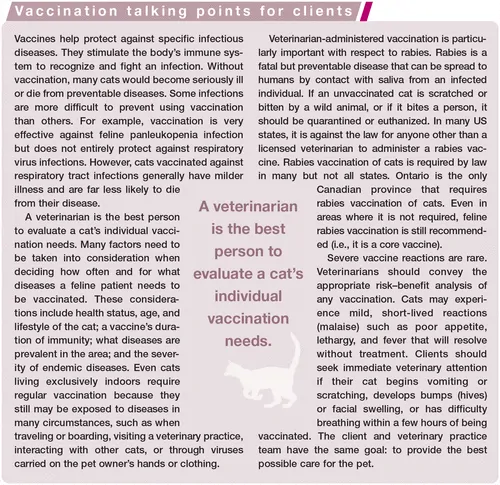
The vaccination visit thus takes place within the context of a practitioner-animal owner discussion about how preventive healthcare forms the foundation for the animal owner to maintain a long and fulfilling relationship with the animal in their care.
It is therefore important that the entire care team, including both clinical and non-clinical staff, be well informed about the importance of cat vaccination. Staff training initiatives should enable the veterinary team to adequately educate and advise clients on best practices for individualized vaccination and adherence to the vaccination schedule.
Vaccination is thus an integral part of a preventive care plan.


Commentaires
No comments yet.
Sign in to comment