

Share:
As temperatures rise in Europe, disease-carrying mosquitoes are becoming established, bringing with them new diseases. West Nile fever is one such disease. This zoonosis is now firmly established in Europe and is steadily spreading northward.
West Nile fever (WNF) is a viral disease that affects certain birds and mammals, including horses and humans. It is an arbovirus of the Flaviviridae family, also known as West Nile encephalitis or West Nile meningoencephalitis, which usually goes unnoticed but, in rare cases, causes lasting neurological sequelae or death.
The virus usually circulates in reservoir bird populations via mosquito vectors. However, infected mosquitoes may occasionally transmit the virus to humans or horses.
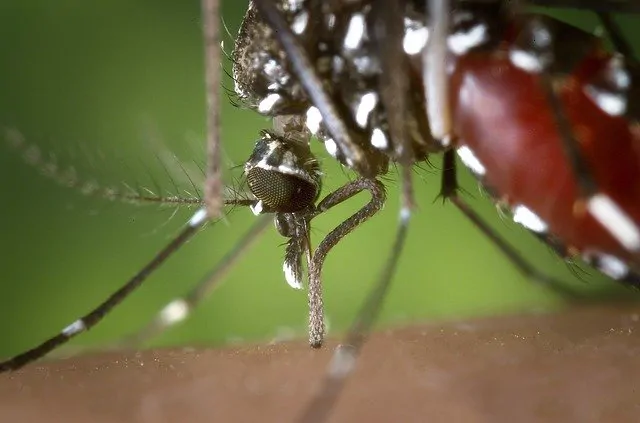 These are referred to as accidental hosts because they are epidemiological dead ends for the virus. It does not appear to be able to replicate sufficiently in the blood to make the individual infectious and transmit the virus to a new mosquito that might bite them.
However, this does not prevent them from exhibiting symptoms. And while 80% of infected individuals remain asymptomatic, the FWN virus can cause a neurological disease that is sometimes fatal in humans and horses. According to the CDC in the United States, approximately one in 150 human infections develops severe symptoms that can sometimes be fatal. To date, there is still no specific antiviral treatment for WNV.
These are referred to as accidental hosts because they are epidemiological dead ends for the virus. It does not appear to be able to replicate sufficiently in the blood to make the individual infectious and transmit the virus to a new mosquito that might bite them.
However, this does not prevent them from exhibiting symptoms. And while 80% of infected individuals remain asymptomatic, the FWN virus can cause a neurological disease that is sometimes fatal in humans and horses. According to the CDC in the United States, approximately one in 150 human infections develops severe symptoms that can sometimes be fatal. To date, there is still no specific antiviral treatment for WNV.
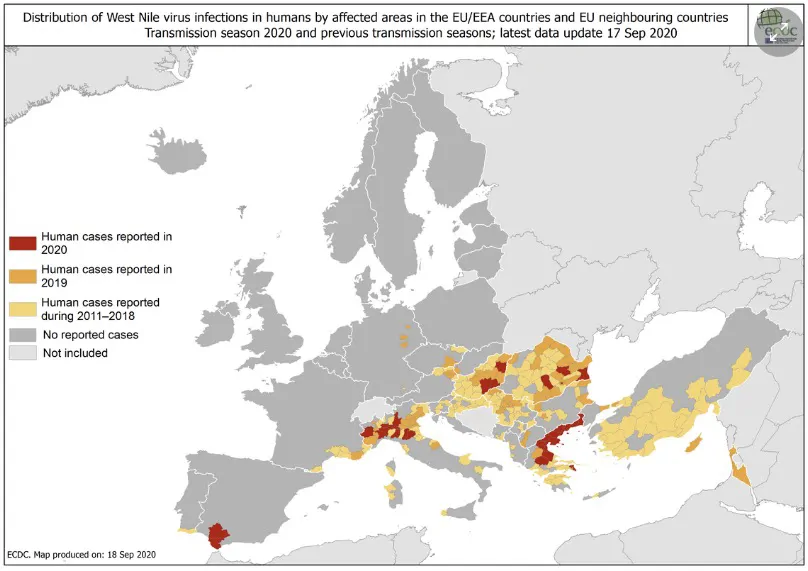
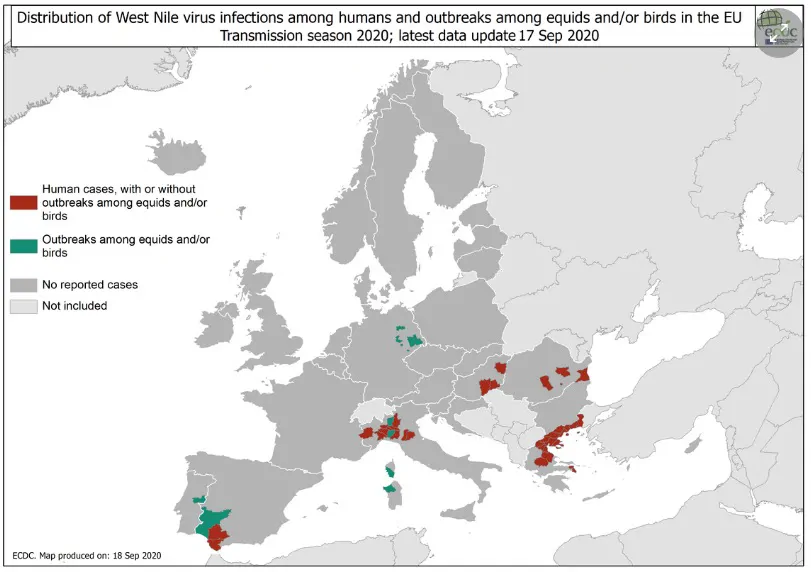 However, it is becoming clear that the outbreak is increasingly spreading across Northern Europe as far as Germany.
 However, the predicted rise in temperatures could alter the behavior of certain mosquitoes in the Aedes genus and shift their breeding areas, particularly that of the notorious “tiger mosquito,” a known vector of diseases. In France, the tiger mosquito is now established in more than 50 departments, even though it has been in mainland France for just sixteen years.
In fact, the warmer it gets, the shorter its development cycle—from egg to adult—becomes. Between 20 and 25°C, it lasts between 6 and 10 days, but at 28°C, it is reduced to just 6 days. The higher the temperature, the faster the mosquito matures into an adult.
As a result, new models predict that the virus will now spread more easily in cooler regions as average summer temperatures rise. The optimal temperature for FWN transmission is believed to be between 23 and 26°C.
Rising temperatures will likely also mean that seasonal transmission of the virus will begin earlier in the spring and end later in the fall.
In addition to temperature, many factors can also contribute to the transmission rates of mosquito-borne viruses, including land use, control measures, and the evolution of the viruses and their vectors. But in the extreme scenario of a 4°C rise in temperatures by 2080, these insects could threaten nearly one billion additional people by the end of the century.
However, the predicted rise in temperatures could alter the behavior of certain mosquitoes in the Aedes genus and shift their breeding areas, particularly that of the notorious “tiger mosquito,” a known vector of diseases. In France, the tiger mosquito is now established in more than 50 departments, even though it has been in mainland France for just sixteen years.
In fact, the warmer it gets, the shorter its development cycle—from egg to adult—becomes. Between 20 and 25°C, it lasts between 6 and 10 days, but at 28°C, it is reduced to just 6 days. The higher the temperature, the faster the mosquito matures into an adult.
As a result, new models predict that the virus will now spread more easily in cooler regions as average summer temperatures rise. The optimal temperature for FWN transmission is believed to be between 23 and 26°C.
Rising temperatures will likely also mean that seasonal transmission of the virus will begin earlier in the spring and end later in the fall.
In addition to temperature, many factors can also contribute to the transmission rates of mosquito-borne viruses, including land use, control measures, and the evolution of the viruses and their vectors. But in the extreme scenario of a 4°C rise in temperatures by 2080, these insects could threaten nearly one billion additional people by the end of the century.
West Nile: A Zoonosis Under Surveillance
Due to its transmissibility and potential severity in both horses and humans, WNV is a high-risk zoonosis with significant public health and economic consequences. The virus is classified as a Category 1 health hazard under Article L.201-1 of the Rural and Maritime Fishing Code, which includes: “health hazards likely to harm public health or seriously jeopardize national production capacity or environmental health. These hazards require preventive, surveillance, or control measures defined and enforced by the State in the public interest. ” In the event of a suspected case, health authorities must therefore be notified. The epidemiology of the West Nile virus is dynamic and difficult to predict. It is influenced by numerous factors, particularly environmental ones. Prevention is therefore essential through a policy of vaccination, protection against mosquitoes, and surveillance of the disease.Infected equines often reveal the presence of the virus in the area without transmitting the disease or posing a risk to humans, and they facilitate surveillance more easily than birds do.They serve as ideal sentinels, especially since they can be protected through specific vaccines and measures to prevent mosquito bites.
West Nile fever is spreading and becoming established in Europe
But despite these efforts, the disease has been spreading in Europe for several years and is becoming established there. First identified in 1937 in Uganda, the virus was introduced to Europe by migratory birds from Africa. After spreading through Africa, the Middle East, Asia, and North America, the virus is now established and endemic in several European regions. Since 2010, there has been increased circulation in Europe, Russia, and the Mediterranean region. The year 2018 saw the most severe outbreak, with the number of cases reported in Europe exceeding the total for the previous seven years combined. Italy was particularly hard hit.In Europe
This year, epidemiological surveillance indicates that the virus has been circulating in Europe since July, with an increase in the number of equine cases in recent weeks. Since the start of the 2020 season (figures as of Sept. 17, 2020), there have already been 69 cases in equines in Spain (51), Italy (8), Germany (8), France (1), and Portugal (1). However, no outbreaks among birds have been reported by the ADNS. As for humans, EU member states have reported 209 cases of infection and 21 deaths , in Greece (109, including 16 deaths), Spain (61, including 5 deaths), Italy (32), Romania (4), and Hungary (3). All cases were reported in areas that had been affected during previous transmission seasons. No cases were reported in countries neighboring the EU.Germany
FWN has been present in Germany for only a few years but is spreading rapidly there. In Germany, the first infected bird was detected as recently as 2018, and following that, on September 3, 2020, German public health authorities reported the first cases of locally acquired human infections in Germany this season. A total of 9 cases were reported in Leipzig (7), Meissen (1), and Berlin (1). Other suspected cases are currently under investigation. Furthermore, since July 2020, the virus has been circulating among bird populations in areas similar to those affected in 2019.Netherlands
This spread toward Northern Europe is becoming evident with the first animal—a warbler—to test positive for the FWN virus in the Netherlands, in the Utrecht region, according to Dutch public health authorities. And this is not likely to be the only case. Warblers are migratory birds; the infected bird tested positive in late summer, so it is very likely that it contracted the virus locally. This theory is supported by the fact that, in recent years, antibodies have been found in several thousand non-migratory birds in the Netherlands, even though they did not have an active infection.Spain
Spain is experiencing a surge in West Nile cases, largely due to mosquito populations that are multiplying rapidly in certain regions. The West Nile virus has been endemic in Andalusia for at least two decades. However, according to data from the “Mosquito Alert” surveillance project, the tiger mosquito population is estimated to have increased by 70% this year compared to last year. The rise in mosquito-borne diseases is only to be expected. As of August 19, Andalusian health authorities had reported 19 cases of viral meningoencephalitis in the province of Seville. At least 17 people have been hospitalized, including 5 in intensive care. Laboratory tests have confirmed West Nile virus infection in 11 of them. The cases are concentrated in the municipalities of Puebla del Río and Coria del Río, which are located in the marshland area along the banks of the Guadalquivir River (a habitat for many mosquitoes).France
In France, West Nile fever first appeared in 2000 and has since remained limited in scope, confined to the Mediterranean coast, specifically in the CAP and Languedoc-Roussillon regions. To date, no cases have been reported in France for the year 2020. However, it is important to remain vigilant. In 2018, the first cases were recorded between August and September, as was the case in 2019, with 13 infected horses in the Gard, Bouches-du-Rhône, Hérault, and Corsica during that period. The network of accredited veterinarians was specifically activated in early September to enhance surveillance (clinical cases in horses), as were members of the SAGIR network (wildlife health surveillance) to monitor bird mortalities. The RESPE (Equine Pathology Epidemiological Surveillance Network) is therefore calling for vigilance , particularly in the southeastern departments (Gard (30), Vaucluse (84), Bouches-du-Rhône (13), Var (83), Alpes-Maritimes (06), and Corsica (20)), through November (the period of highest risk due to the activity of disease-vectors, namely mosquitoes).Warming, which is largely responsible for this increase
The clear expansion of West Nile virus (WNV) cases toward Europe and the North in recent years is driven by the disease’s vectors: mosquitoes.Read next
Outbreaks & Epidemiology
10/07/2026
H5N1 should now be treated as a permanent systemic risk, not a succession of outbreaks
Outbreaks & Epidemiology
10/07/2026
African swine fever progresses faster in wild boar than in domestic pigs
Outbreaks & Epidemiology
10/05/2026
Commentaires
No comments yet.
Sign in to comment