

Back to articles
Horse Welfare: Better Understanding Herd Dynamics in the Pasture
B
bertrand-neveux
04/09/2015
4 min read
0 comments
Share:
The behavior of horses during grazing often seems mysterious to humans. Sometimes, a simple movement of the ear or tail is enough for a horse to “communicate” with the entire herd. Thus, knowing how to interpret these messages makes it possible to form groups that will live together more harmoniously.
Horses use a wide variety of communication methods that may seem more or less subtle to humans. Even in a small domestic group, their behaviors are not always well understood. For example, when a horse has finished drinking, why does it refuse to let another horse approach the water? Or how is it that this chestnut horse enjoys the company of that other chestnut, but consistently chases away the gray one?
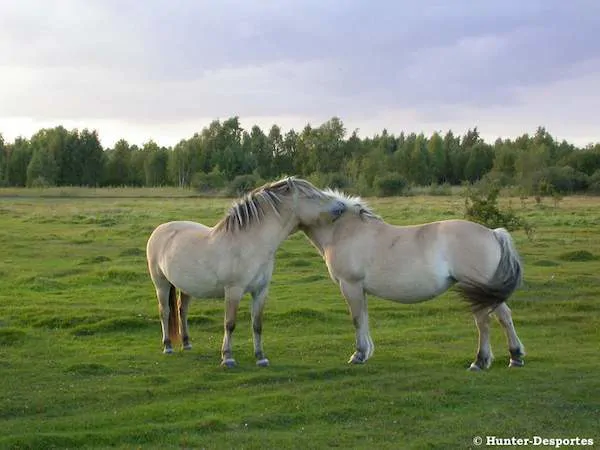 As more and more owners recognize the importance of horse welfare and of providing their animals with social interaction outdoors, it is important to be able to interpret the interactions that bind horses together in a group in order to better understand them and communicate with them more effectively.
Horses convey information—both positive and negative—through sounds, body language, and even scent. Given the diversity of their means of communication, how can we know if horses put together in a pasture will actually get along? According to Danish researchers, the strongest positive sign between two horses is rather underwhelming: it’s simply standing next to one another. Next comes mutual grooming, around the withers, neck, or back. In contrast, negative interactions include whinnying, threats, and even biting, kicking, etc.
However, such aggressive behaviors do not necessarily mean that the horses do not get along. This communication actually serves to establish and maintain a social hierarchy, a completely natural phenomenon within a group. Most horses will resolve their disputes without the need for human intervention.
Dominance and hierarchy are indeed part of equine nature and are often complex. The established social order aims primarily to protect the herd, maintain family bonds, and determine priority access to resources (food, water, and shelter). Sometimes, certain horses are so dominant that they appear to stand guard over resources, even if they do not need them at that moment: they may position themselves at the entrance to the shelter without entering it, or keep their heads above a communal water source. Conversely, however, if the highest-ranking horse is not hungry, it will allow the others to eat first.
As more and more owners recognize the importance of horse welfare and of providing their animals with social interaction outdoors, it is important to be able to interpret the interactions that bind horses together in a group in order to better understand them and communicate with them more effectively.
Horses convey information—both positive and negative—through sounds, body language, and even scent. Given the diversity of their means of communication, how can we know if horses put together in a pasture will actually get along? According to Danish researchers, the strongest positive sign between two horses is rather underwhelming: it’s simply standing next to one another. Next comes mutual grooming, around the withers, neck, or back. In contrast, negative interactions include whinnying, threats, and even biting, kicking, etc.
However, such aggressive behaviors do not necessarily mean that the horses do not get along. This communication actually serves to establish and maintain a social hierarchy, a completely natural phenomenon within a group. Most horses will resolve their disputes without the need for human intervention.
Dominance and hierarchy are indeed part of equine nature and are often complex. The established social order aims primarily to protect the herd, maintain family bonds, and determine priority access to resources (food, water, and shelter). Sometimes, certain horses are so dominant that they appear to stand guard over resources, even if they do not need them at that moment: they may position themselves at the entrance to the shelter without entering it, or keep their heads above a communal water source. Conversely, however, if the highest-ranking horse is not hungry, it will allow the others to eat first.
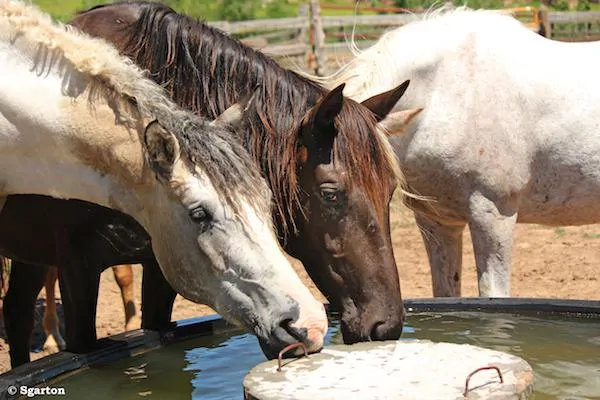 Researchers often identify herd hierarchies through field monitoring that can last up to 15 hours a day. For owners, group dynamics can also be determined through regular observations, although intermittent checks—once or twice a day—will not provide a sufficiently accurate picture. Furthermore, relationships can evolve over the course of weeks, months, and years. A horse is not born dominant and will not remain in that position for its entire life.
Within a herd, horses typically form “subgroups” based on affinity, whose members tend to stay together and maintain close relationships. Similarly, horses of similar color often group together, while those with gray coats seem to be shunned by others, although there is no scientific evidence to support this observation. Experience also influences their choices, leading them to prefer companions similar to those they have interacted with in the past.
Finally, individual personality and temperament likely play a key role in equine relationships. While it is impossible to force them to like one another, the available space must be sufficient to allow subordinate individuals to escape and remain at a distance without feeling trapped. Ideally, an even number of horses should be placed in the pasture to reduce the risk of one becoming isolated. A group of two horses is also somewhat unnatural because they cannot choose each other; each must make do with this imposed partner to meet its social needs.
Thus, horses are social animals that seek the company of others and communicate to establish a strong social order. Recognizing this order within a herd and managing horses according to their natural affinities and needs helps ensure the horse’s welfare in a domestic environment.
Source: The Horse, “Understanding Herd Dynamics,” April 2015.
Researchers often identify herd hierarchies through field monitoring that can last up to 15 hours a day. For owners, group dynamics can also be determined through regular observations, although intermittent checks—once or twice a day—will not provide a sufficiently accurate picture. Furthermore, relationships can evolve over the course of weeks, months, and years. A horse is not born dominant and will not remain in that position for its entire life.
Within a herd, horses typically form “subgroups” based on affinity, whose members tend to stay together and maintain close relationships. Similarly, horses of similar color often group together, while those with gray coats seem to be shunned by others, although there is no scientific evidence to support this observation. Experience also influences their choices, leading them to prefer companions similar to those they have interacted with in the past.
Finally, individual personality and temperament likely play a key role in equine relationships. While it is impossible to force them to like one another, the available space must be sufficient to allow subordinate individuals to escape and remain at a distance without feeling trapped. Ideally, an even number of horses should be placed in the pasture to reduce the risk of one becoming isolated. A group of two horses is also somewhat unnatural because they cannot choose each other; each must make do with this imposed partner to meet its social needs.
Thus, horses are social animals that seek the company of others and communicate to establish a strong social order. Recognizing this order within a herd and managing horses according to their natural affinities and needs helps ensure the horse’s welfare in a domestic environment.
Source: The Horse, “Understanding Herd Dynamics,” April 2015.
Read next
Animal Welfare
10/06/2026
Bites haven't be an unavoidable part of veterinary work
Animal Welfare
10/05/2026
US animal welfare policy: new federal measures focus on dogs and research while farm animals remain largely outside the framework
Animal Welfare
10/08/2025
Commentaires
No comments yet.
Sign in to comment