

Back to articles
Animal Welfare
Anxiety
Diagnosis
Equine Health
Equine veterinarian
Fear
Horse
Pain
Software
Stress
Stress in Horses
UC Davis
Veterinarian
Veterinary medicine
Veterinary school
Equine Health: Software to Detect Signs of Pain in Horses
V
Vetitude
08/31/2017
3 min read
0 comments
Share:
The University of California (UC Davis) Veterinary School has developed a program to monitor horses’ health that uses computer software to interpret facial expressions of pain. The clinical observations obtained are intended to help veterinarians, students, technicians, and owners better detect signs of pain expressed by horses in relation to their condition. This computer-based analysis thus aims to provide objective information about pain perception in order to better treat the underlying condition.
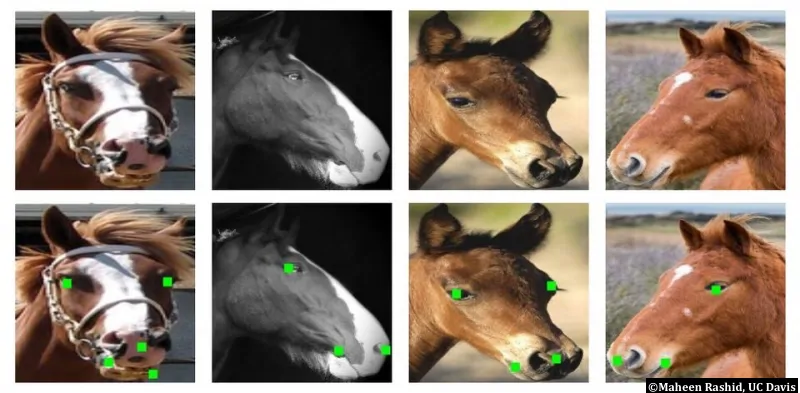 Like humans, horses exhibit involuntary facial expressions that reflect their levels of stress, fear, and pain. A slight change in the shape of the eye, mouth, or nose can thus indicate that the animal is in pain. UC Davis has partnered with a team of Scandinavian veterinarians to find a way to objectively recognize these subtle changes, in order to better understand how horses physically express pain, particularly in cases of chronic conditions.
The team developed software that, using hundreds of videos and photographs, identifies key points on horses’ heads (eyes, nose, mouth)—which vary depending on age and posture—to map equine facial features and capture the characteristics of each expression of pain. The parameters obtained were stored in a computer, which is now ready to “learn” how to read the unconscious signs of pain, as well as stress, fear, boredom, and anxiety in horses. This is just the first step; more data will need to be analyzed to cover all possible expressions and expand the information gathered based on context.
However, this digitization of clinical observations is not intended to replace the veterinarian’s experience in making a diagnosis. Rather, it is a technical tool designed to optimize the clinical examination performed by the veterinary practitioner, not to replace it. However, when combined with the veterinarian’s trained eye, video can capture expressions so subtle that they might otherwise go unnoticed. In the absence of obvious signs of pain, this noninvasive procedure has, in particular, helped reveal unsuspected or more severe health problems. Thus, the combination of technology and experience should benefit equine veterinarians by helping them provide earlier treatment. Ultimately, this computer program for pain detection could be a highly useful tool in clinical practice, enhancing the effectiveness of equine veterinary care. The information provided should help inform decisions regarding which tests to perform and which medications to prescribe, adjust the frequency of administration, and better manage care.
Plans are already underway to expand on this concept and develop programs that will also help identify fear, nervousness, or stress in horses. In addition, similar digitization systems will be developed for veterinarians treating pets, as well as primates, Livestock, and other animals. Thus, the study of pain now benefits from the convergence of cutting-edge technology and veterinary medicine.
Like humans, horses exhibit involuntary facial expressions that reflect their levels of stress, fear, and pain. A slight change in the shape of the eye, mouth, or nose can thus indicate that the animal is in pain. UC Davis has partnered with a team of Scandinavian veterinarians to find a way to objectively recognize these subtle changes, in order to better understand how horses physically express pain, particularly in cases of chronic conditions.
The team developed software that, using hundreds of videos and photographs, identifies key points on horses’ heads (eyes, nose, mouth)—which vary depending on age and posture—to map equine facial features and capture the characteristics of each expression of pain. The parameters obtained were stored in a computer, which is now ready to “learn” how to read the unconscious signs of pain, as well as stress, fear, boredom, and anxiety in horses. This is just the first step; more data will need to be analyzed to cover all possible expressions and expand the information gathered based on context.
However, this digitization of clinical observations is not intended to replace the veterinarian’s experience in making a diagnosis. Rather, it is a technical tool designed to optimize the clinical examination performed by the veterinary practitioner, not to replace it. However, when combined with the veterinarian’s trained eye, video can capture expressions so subtle that they might otherwise go unnoticed. In the absence of obvious signs of pain, this noninvasive procedure has, in particular, helped reveal unsuspected or more severe health problems. Thus, the combination of technology and experience should benefit equine veterinarians by helping them provide earlier treatment. Ultimately, this computer program for pain detection could be a highly useful tool in clinical practice, enhancing the effectiveness of equine veterinary care. The information provided should help inform decisions regarding which tests to perform and which medications to prescribe, adjust the frequency of administration, and better manage care.
Plans are already underway to expand on this concept and develop programs that will also help identify fear, nervousness, or stress in horses. In addition, similar digitization systems will be developed for veterinarians treating pets, as well as primates, Livestock, and other animals. Thus, the study of pain now benefits from the convergence of cutting-edge technology and veterinary medicine.
Read next
Animal Welfare
10/06/2026
Bites haven't be an unavoidable part of veterinary work
Animal Welfare
10/05/2026
US animal welfare policy: new federal measures focus on dogs and research while farm animals remain largely outside the framework
Animal Welfare
10/08/2025
Commentaires
No comments yet.
Sign in to comment