Does organic farming ensure better animal welfare for farm animals?
VVetitude12/08/20218 min read0 comments
Share:
On June 30, 2021, the European Commission responded positively to the 1.4 million citizens who signed the European Citizens’ Initiative (ECI) “End the Cage Age,” announcing that it would put forward a legislative proposal by 2023 aimed at banning the raising of animals in cages. This news represents a significant step forward for these animals, whose freedom of movement and social interactions are limited.
At the European Union (EU) level, where member states must take into account animal welfare as a sentient being, several regulations already establish standards for animal protection.
“Welfare” refers to a state in which an animal is in good health (both physically and mentally) and has the opportunity to express natural behaviors that meet its needs and expectations.
However, these regulations are still insufficient and do not guarantee animal welfare. For example, farmers are not required to provide outdoor access to their animals (though this does not prevent them from doing so if they choose).
In organic farming, specific rules are added to the minimum animal protection standards—and here again, organic farmers can go above and beyond and proactively adopt best practices for their animals. “Contributing to high standards of animal welfare” is one of the goals of organic farming; indeed, the assurance of better animal welfare is one of the motivations for consuming organic products.
However, do the regulations governing organic production ensure an optimal level of animal welfare?
In many respects, these regulations promote—even if not optimally—better animal welfare compared to the laws applicable to conventional livestock farming.
A More Natural Environment
Access to the outdoors is undoubtedly one of the most significant advances in organic farming toward better animal welfare. On many farms, animals no longer have access to the outdoors and spend their lives indoors, preventing them from expressing certain natural behaviors—such as grazing for dairy cows. Yet dairy cows show a very clear preference for and a strong motivation to access grazing.
Unlike conventional farms, which face no requirements in this regard, organic farms must provide outdoor access for their animals as soon as conditions permit. This outdoor space must also meet certain conditions that vary by species—access to a body of water for waterfowl, and access to shelter or a shaded area for land animals.
Isolation, tethering, and cage rearing prohibited
While cage rearing remains permitted in conventional farming, it is prohibited on European organic farms. This represents a significant step forward for many animals, particularly poultry. In France, although the number of caged laying hens has declined sharply in recent years, one-third of them are still raised under these conditions.
So-called “tethered” systems are common in some EU member states, particularly in Sweden and Germany. This practice, which significantly restricts the animals’ freedom of movement, is prohibited in organic farming.
Exceptions are provided for, however, though they remain limited: on certain farms (particularly in mountainous areas), tethering animals remains permissible if the animals have regular access to the outdoors.
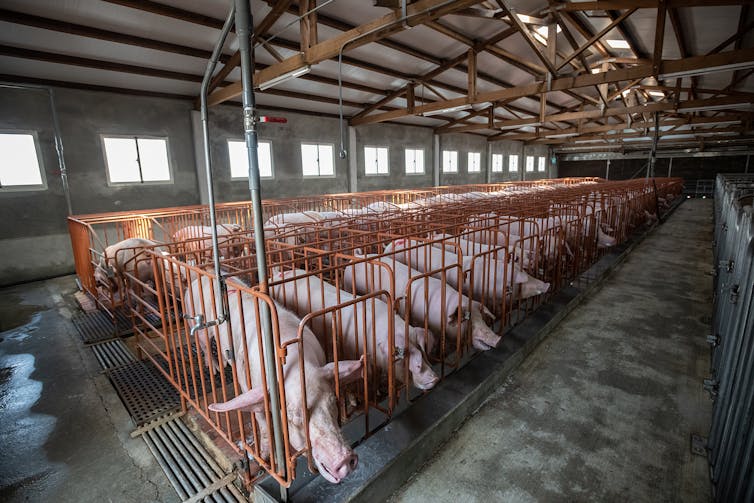
Another exception concerns the freedom of movement of sows. On conventional farms, sows are generally kept in crates where they can only stand up and lie down for long periods (between eight and ten weeks per reproductive cycle).
In conventional farms, sows are generally kept in crates during the first four weeks of gestation, as shown in this photo, the week before parturition, and during the lactation period.We Animals Media
In organic farming, confining sows is permitted only for a short period (eight days around parturition on French farms). This is a significant improvement, although it is regrettable that the use of these cages is not simply banned.
Isolating animals is another practice that is generally prohibited in organic farming but may be authorized in certain cases for a limited time.
Social isolation can seriously compromise the development of young animals such as calves, which are typically housed individually after birth. In organic farming, they may remain alone for only one week, whereas this isolation can last up to eight weeks on conventional farms. The difference is significant, since social contact is important for these animals.
In a recent study, researchers demonstrated that individually housed calves were motivated to join their peers (their motivation was measured by comparing their maximum weight and the frequency with which the calves pushed a weighted door to access either a pen with another calf or an empty pen).
Toward the Elimination of Physical Mutilations?
Organic regulations also aim to limit physical mutilations.
Apart from castration, which is permitted “to ensure product quality and maintain traditional practices,” mutilations such as tail docking in sheep, beak trimming in poultry, and dehorning of calves are permitted only “on an exceptional basis,” “on a case-by-case basis and only when these practices improve animal health, animal welfare, or hygiene of the animals or when worker safety is at risk.”
However, some of these mutilations remain common in practice. This is particularly true of dehorning, as cows that retain their horns are considered more dangerous to farmers.
To minimize animal suffering during these mutilations, organic farming mandates that the animal be anesthetized and/or given pain medication—a step in the right direction, since such mutilations are still too often performed without any pain management.
The legislature could have gone further by requiring the administration of both an anaesthetic and a painkiller, as studies recommend—particularly for dehorning. Above all, it could have imposed stricter regulations on the use of these practices or even banned them outright.
More Frequent Inspections
The specific rules for organic farming include significant advances aimed at improving the lives of farm animals. Farmers’ compliance with these rules is also regularly monitored, which is not the case for conventional farms, which are rarely inspected.
France, like most European Union member states, has entrusted the inspection of organic farms to independent private organizations. French organic farms must be inspected at least once a year by one of the certifying bodies accredited by the National Institute for Origin and Quality (a public agency under the Ministry of Agriculture) and the French Accreditation Committee. This annual inspection may be supplemented by unannounced checks.
End of life: A Lack of Ambition!
While there are numerous rules governing animal husbandry conditions in organic farming, those regarding the end of life—that is, when animals leave the farm to be transported and then slaughtered—are far more limited. When it comes to transport and slaughter, animals—with a few exceptions—face the same challenges, whether they come from organic farms or not.
One—significant—difference concerns stunning. For a product of animal origin to bear the organic logo, the animal must have been stunned before being slaughtered. It was the Court of Justice of the EU, at the urging of the OABA
association, that clarified this requirement in early 2019.
This development is a step toward better animal welfare at the time of slaughter, as stunning is intended to induce a loss of consciousness and sensitivity before the animal is killed.
It is regrettable that little (if anything) has been provided for during animal transport. The regulations governing animal transport—which therefore also apply to animals from organic farms—are inadequate and have been the subject of sharp criticism, including from institutions
.
While, in principle, animals may not be transported for more than eight hours
, this time limit may be extended. In reality, only transport times prior to a rest period or unloading are specified, but the regulations do not set a maximum
transport duration
for the entire journey.
Thus, a pig, for example, may spend twenty-four hours in a truck before being let out—not permanently, but for a twenty-four-hour “rest” period—before setting off again (and so on).
Because transport—especially long-distance transport—places a severe strain on animal welfare, one can only lament the inadequacy of the rules in this area, particularly the organic regulations, which nevertheless claim to aim to minimize animal suffering as much as possible.
As we can see, while the regulations applicable to organic farms are not optimal, they nevertheless guarantee a levelof “animal welfare”
that could serve as a model for improving the conditions of all farm animals.
Eugénie Duval
, Ph.D. in Public Law, Visiting Scientist (Animal Welfare Program, University of British Columbia), associate member at the Center for Research on Fundamental Rights and Legal Developments, University of Caen Normandy
, and Benjamin Lecorps
, Ph.D. in Applied Animal Biology, Postdoctoral Fellow, University of British Columbia
This article is republished from The Conversation
under a Creative Commons license. Read the original
article.


 Eugénie Duval
, Ph.D. in Public Law, Visiting Scientist (Animal Welfare Program, University of British Columbia), associate member at the Center for Research on Fundamental Rights and Legal Developments, University of Caen Normandy
, and Benjamin Lecorps
, Ph.D. in Applied Animal Biology, Postdoctoral Fellow, University of British Columbia
This article is republished from The Conversation
under a Creative Commons license. Read the original
article.
Eugénie Duval
, Ph.D. in Public Law, Visiting Scientist (Animal Welfare Program, University of British Columbia), associate member at the Center for Research on Fundamental Rights and Legal Developments, University of Caen Normandy
, and Benjamin Lecorps
, Ph.D. in Applied Animal Biology, Postdoctoral Fellow, University of British Columbia
This article is republished from The Conversation
under a Creative Commons license. Read the original
article.
Commentaires
No comments yet.
Sign in to comment