The use of antibiotics in veterinary medicine must be monitored, as it raises concerns about the emergence of resistant bacteria and their transmission to humans
Transmission of Antimicrobial Resistance to Humans: Which Bacteria Should Be Monitored in Animals?
VVetitude10/11/20237 min read0 comments
Share:
Bacterial antibiotic resistance, or “antimicrobial resistance,” has become a major cause for concern. According to a British report cited by the World Health Organization (WHO), it is estimated that by 2050, the number of deaths linked to antibiotic resistance could reach 10 million per year worldwide.
In late June, the French Agency for Food, Environmental and Occupational Health & Safety (ANSES) published an advisory regarding the priority list of bacteria-antibiotic family combinations to monitor in animals due to their impact on public health. Here’s what you need to know.
How does resistance develop?
Any use of antibiotics, whether in humans or animals, exerts selection pressure: initially highly effective, antibiotics massively eliminate susceptible bacteria.
However, some bacteria prove capable of resisting them. These survive and, aided by the disappearance of susceptible bacteria, multiply unchecked. This is how resistant populations emerge, against which antibiotics become ineffective.
Such bacteria with antibiotic resistance can develop not only in people being treated with antibiotics, but also in the environment (when it is contaminated by wastewater containing antibiotics) or in farm and pet animals, when antibiotics are used in veterinary medicine.
In the latter case, resistant bacteria can be transmitted to humans either through close contact with these animals or indirectly, via the environment or through the consumption of contaminated food products.
Bacteria/Antibiotic Class Combinations to Be Monitored as a Priority in Animals
Eleven pairs of bacteria-antibiotic families to be monitored as a priority in animals in France are included on the first list compiled by ANSES. Among them, five are classified as high priority:
Enterobacterales/carbapenems: Enterobacterales is a bacterial order that includes several species, such as Escherichia coli and bacteria of the genus Salmonella, commonly found in the intestines of humans and other animals. Various species of Enterobacterales can cause infections, particularly urinary, intestinal, or respiratory infections. However, some of these bacteria have developed antibiotic resistance. This is the case, for example, with strains resistant to carbapenems, which are broad-spectrum antibiotics used exclusively in hospitals to treat the most severe infections. The emergence of carbapenem-resistant Enterobacterales is a major public health problem. These bacteria’s antibiotic resistance can lead to treatment dead ends.
Enterobacteriaceae/third- and fourth-generation cephalosporins (C3G/C4G): Certain strains of Enterobacterales have developed resistance to third- and fourth-generation cephalosporins (C3G/C4G), critically important antibiotics used to treat severe infections in both humans and animals. In veterinary medicine, an antimicrobial susceptibility test must be performed prior to prescribing these antibiotics.
Staphylococcus aureus/methicillin (MRSA):S. aureus (or staphylococcus aureus) is a bacteria that can be found on the skin and in the nasal passages of humans without causing any problems to human health. However, under certain conditions (such as wounds, surgery, or a weakened immune system), it can cause various infections, including skin infections, respiratory tract infections, or even bloodstream infections. Methicillin-resistant Staphylococcus aureus, also known as MRSA, is a strain of Staphylococcus aureus that has developed resistance to several antibiotics, including methicillin. Since methicillin is ineffective against MRSA infections, this limits treatment options.
Enterobacterales/fluoroquinolones: Like C3G/C4G antibiotics, fluoroquinolones are critically important antibiotics for both humans and animals.
Enterobacterales/polymyxins: Colistin is the best-known antibiotic among the polymyxins. It is used in veterinary medicine, particularly in animal production. In human medicine, due to its toxicity, colistin is prescribed only for the treatment of severe human infections caused by resistant bacteria. The resistance of certain strains to colistin is problematic due to the high transmissibility of a resistance gene, mcr-1, which has been identified in animals and humans worldwide.
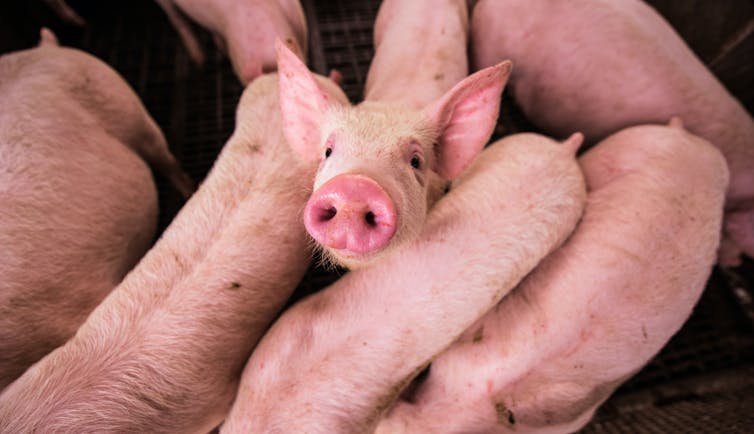
The circulation of methicillin-resistant Staphylococcus aureus must be monitored, particularly in pig farms.Diego San/Unsplash
Trends in Antibiotic Resistance
An analysis of epidemiological data collected in France is now providing a more nuanced understanding of the transmission of bacteria with antibiotic resistance between animals and humans.
Epidemiological surveillance data show that while resistance to carbapenems is occasionally detected in dogs and cats, it is likely linked to contact with humans who carry this resistant bacterium, as this class of antibiotics is not used in veterinary medicine.
Antibiotic resistance in other classes of antibiotics in farm animals (cattle, pigs, poultry) and pets (dogs and cats) has been declining over the past ten years, thanks to efforts to control antibiotic use in the animal sector.
However, vigilance is needed regarding strains of Staphylococcus aureusthat are resistant to methicillin, an important antibiotic in the penicillin family. In 2006, cases of infections in several hospitals in the Netherlands revealed that these resistant bacteria actually originated from pig farms.
In France, a survey conducted at several pig farms showed that levels of this resistance increased significantly between 2008 and 2021, rising from 3% to over 40%. Furthermore, surveillance data reveal high prevalence rates in dogs for the year 2021, with an upward trend since 2018.
In its opinion, ANSES recommends improving this epidemiological surveillance by using sequencing methods that allow for whole-genome analysis of the five high-priority bacteria/antibiotic family pairs, in order to assess the contribution of the animal reservoir to the transmission of such resistant bacteria to humans, and to evaluate the presence of mobile genetic elements that may facilitate the transmission of resistance genes.
Regarding methicillin-resistant Staphylococcus aureus (MRSA), ANSES emphasizes the need to monitor MRSA in the animal sector through the implementation of ad hoc investigations, in order to identify animals that may act as transient carriers and that could be involved in the spread and persistence of MRSA in the human population.
Be cautious with imported foods
In France, the transmission of bacterial resistance between animals and humans is controlled through biosecurity measures on livestock farms, good hygiene practices in veterinary clinics, and by cooking food (heat kills bacteria with antibiotic resistance).
However, international trade and the movement of people, animals, and food products increase the risk of rapid spread of bacteria with antibiotic resistance. This is the case, for example, with farmed shrimp imported from Asia, which may be contaminated with resistant bacteria. To address this, Decision (EU) 2020/1729 mandates the monitoring of antimicrobial resistance, but only in meat imported from countries outside the EU.
ANSES therefore recommends expanding this monitoring to include fishery products, in order to prevent the introduction into France of new resistant bacteria—or even multidrug-resistant bacteria (in other words, those with antibiotic resistance to several classes of antibiotics), which pose a major threat to public health.
Antimicrobial resistance is everyone’s business!
In human medicine, everyone remembers the slogan “Antibiotics aren’t automatic,” used in awareness campaigns aimed at reducing the routine use of antibiotics.
Its counterpart in veterinary medicine, “Antibiotics: the right way, when needed,” has helped draw the attention of professionals in the animal sector to the proper use of veterinary antibiotics.
The issue of antimicrobial resistance is particularly emblematic of the One Health concept, according to which human health, animal health, and environmental health are interconnected and interdependent.
To combat this major problem, it is indeed necessary to strengthen measures to prevent and control the transmission of antimicrobial resistance among humans, animals, and the environment. Only by doing so can we hope to preserve the effectiveness of antibiotics—and thus our ability to combat bacterial infections in the future.
This article was written with the support of Eric Oswald, chair of the ANSES working group on “antibiotic resistance in animals”
, and
Elissa Khamisse
, Scientific Coordinator for Animal Health and Nutrition Expertise at the French Agency for Food, Environmental and Occupational Health & Safety (ANSES
) (ANSES)
This article is republished from The Conversation
under a Creative Commons license. Read the original
article.
https://vetitude.fr/antibiotiques-antibioresistance-est-une-pandemie-silencieuse/
https://vetitude.fr/antibioresistance-bacteries-resistantes-chez-les-veterinaires/
https://vetitude.fr/antibioresistance-antibiotiques-un-indicateur-de-lempreinte-humaine-croissante/
https://vetitude.fr/lantibioresistance-continue-de-gagner-du-terrain/
https://vetitude.fr/antibioresistance-progres-responsible use of antibiotics in animals/


 , and
Elissa Khamisse
, Scientific Coordinator for Animal Health and Nutrition Expertise at the French Agency for Food, Environmental and Occupational Health & Safety (ANSES
) (ANSES)
This article is republished from The Conversation
under a Creative Commons license. Read the original
article.
https://vetitude.fr/antibiotiques-antibioresistance-est-une-pandemie-silencieuse/
https://vetitude.fr/antibioresistance-bacteries-resistantes-chez-les-veterinaires/
https://vetitude.fr/antibioresistance-antibiotiques-un-indicateur-de-lempreinte-humaine-croissante/
https://vetitude.fr/lantibioresistance-continue-de-gagner-du-terrain/
https://vetitude.fr/antibioresistance-progres-responsible use of antibiotics in animals/
, and
Elissa Khamisse
, Scientific Coordinator for Animal Health and Nutrition Expertise at the French Agency for Food, Environmental and Occupational Health & Safety (ANSES
) (ANSES)
This article is republished from The Conversation
under a Creative Commons license. Read the original
article.
https://vetitude.fr/antibiotiques-antibioresistance-est-une-pandemie-silencieuse/
https://vetitude.fr/antibioresistance-bacteries-resistantes-chez-les-veterinaires/
https://vetitude.fr/antibioresistance-antibiotiques-un-indicateur-de-lempreinte-humaine-croissante/
https://vetitude.fr/lantibioresistance-continue-de-gagner-du-terrain/
https://vetitude.fr/antibioresistance-progres-responsible use of antibiotics in animals/
Commentaires
No comments yet.
Sign in to comment