

Back to articles
Research & Diagnostics
Artificial insemination
Blue Tongue
Blue Tongue Disease
Bluetongue
Cyanosis
Embryo Transfer
Epidemic
Genetics
Hyperemia
When Genetics Provides Insights into the Origin of an Outbreak of Blue Tongue
MR
Mia Rozenbaum
05/07/2020
2 min read
0 comments
Share:
Based on the unusual genetic makeup of the bluetongue virus, researchers say that its recent re-emergence in France may have been caused by human activity.
 Bluetongue, or catarrhal fever, is listed in the WOAH’s Terrestrial Animal Health Code. And for good reason. Although it is not contagious and cannot be transmitted to humans, it can nevertheless have serious consequences for domestic ruminants and significant economic and public health repercussions.
Transmitted by insects, the disease may be asymptomatic in many animals, but in others, it manifests as a high fever that can last several days. The virus primarily affects small blood vessels, causing hemorrhage, hyperemia, and edema in the tissues of the lips, mouth, nasal mucosa, and eyelids. The reduced oxygen supply to the tongue causes cyanosis and gives it a characteristic blue appearance.
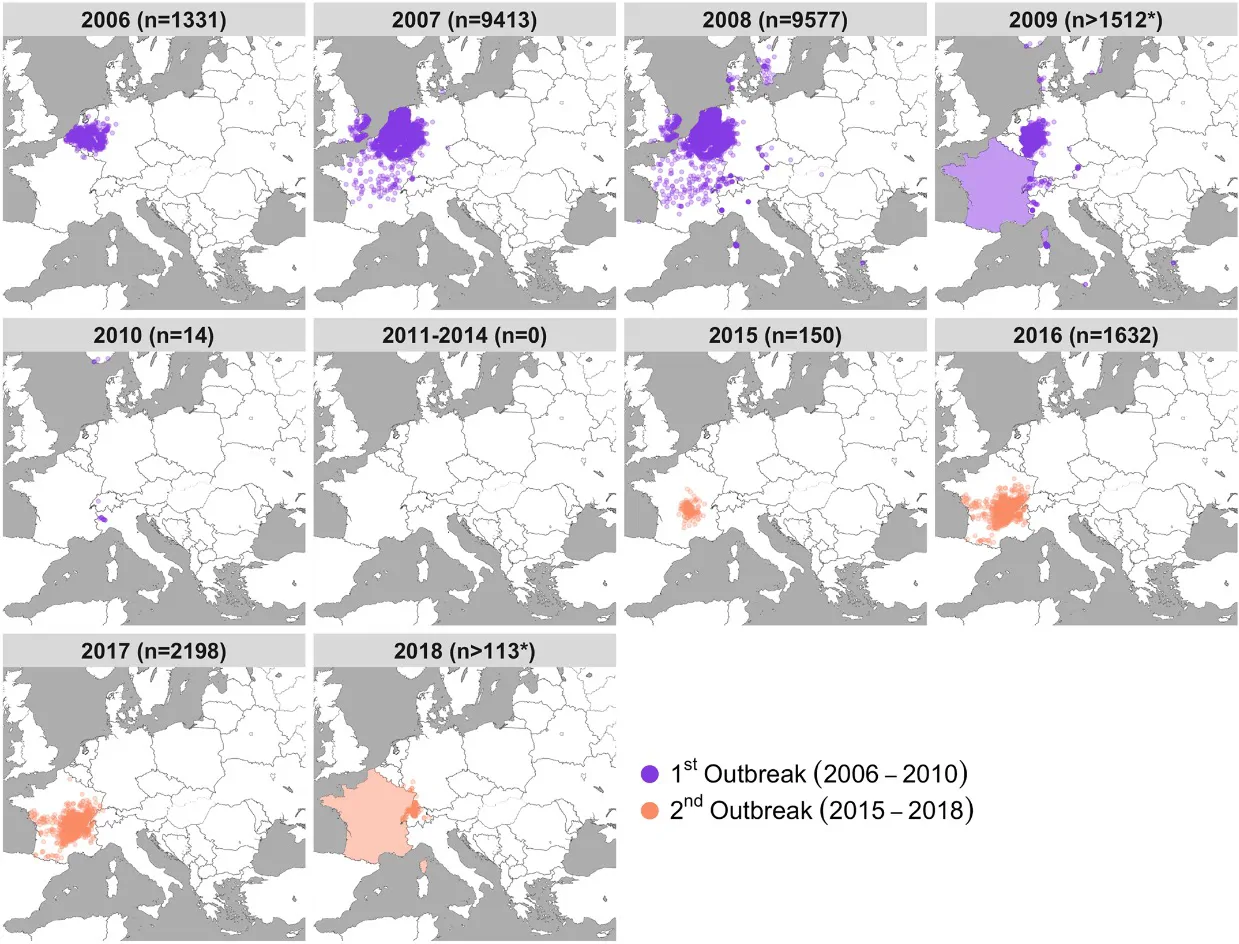
Over the past two decades, bluetongue has caused numerous animal deaths and billions of euros in damage to the European agricultural industry. The outbreak, which first appeared in Europe in 2006 from an unknown source, was brought under control in 2010 through a mass vaccination program. But a few years later, in 2015, the disease suddenly reappeared.
In an effort to better understand the origin of the outbreaks, researchers at the University of Glasgow looked for clues in the virus’s genomics.
By comparing genetic variations before and after its reemergence in France in 2015, the researchers showed that during the 2006 and 2015 outbreaks, the bluetongue virus accumulated natural mutations as expected. However, between these periods, viral evolution appears to have stalled, and the mutations that naturally occur during viral replication no longer accumulate—as if the virus had completely ceased to have viral circulation and replicate during that time.
To survive, spread, and find new hosts, viruses must replicate. New mutations are an inevitable consequence of this. Viruses cannot remain frozen in time.
The genetic similarity between the original and viruses of re-emergence therefore suggests that the 2015 outbreak was caused by infectious material originating directly from the first outbreak. In the absence of normal, natural genetic changes, the study’s authors suggest that the virus resurfaced after being stored in frozen samples.
Artificial insemination and embryo transfer—which require freezing—are widely used in the livestock industry and may have been the source of this new outbreak. This system likely needs to be reviewed to prevent any future viral outbreaks of bluetongue.
Bluetongue, or catarrhal fever, is listed in the WOAH’s Terrestrial Animal Health Code. And for good reason. Although it is not contagious and cannot be transmitted to humans, it can nevertheless have serious consequences for domestic ruminants and significant economic and public health repercussions.
Transmitted by insects, the disease may be asymptomatic in many animals, but in others, it manifests as a high fever that can last several days. The virus primarily affects small blood vessels, causing hemorrhage, hyperemia, and edema in the tissues of the lips, mouth, nasal mucosa, and eyelids. The reduced oxygen supply to the tongue causes cyanosis and gives it a characteristic blue appearance.
Over the past two decades, bluetongue has caused numerous animal deaths and billions of euros in damage to the European agricultural industry. The outbreak, which first appeared in Europe in 2006 from an unknown source, was brought under control in 2010 through a mass vaccination program. But a few years later, in 2015, the disease suddenly reappeared.
In an effort to better understand the origin of the outbreaks, researchers at the University of Glasgow looked for clues in the virus’s genomics.
By comparing genetic variations before and after its reemergence in France in 2015, the researchers showed that during the 2006 and 2015 outbreaks, the bluetongue virus accumulated natural mutations as expected. However, between these periods, viral evolution appears to have stalled, and the mutations that naturally occur during viral replication no longer accumulate—as if the virus had completely ceased to have viral circulation and replicate during that time.
To survive, spread, and find new hosts, viruses must replicate. New mutations are an inevitable consequence of this. Viruses cannot remain frozen in time.
The genetic similarity between the original and viruses of re-emergence therefore suggests that the 2015 outbreak was caused by infectious material originating directly from the first outbreak. In the absence of normal, natural genetic changes, the study’s authors suggest that the virus resurfaced after being stored in frozen samples.
Artificial insemination and embryo transfer—which require freezing—are widely used in the livestock industry and may have been the source of this new outbreak. This system likely needs to be reviewed to prevent any future viral outbreaks of bluetongue.
Read next
Research & Diagnostics
10/09/2026
WHO sets new diagnostic targets for Echinococcus granulosus in humans, dogs and sheep
Research & Diagnostics
10/09/2026
Nipah virus in wastewater: promising for early warning?
Research & Diagnostics
10/01/2026
Commentaires
No comments yet.
Sign in to comment