

Back to articles
Research & Diagnostics
Antioxidants
Apis mellifera
Bee
Beekeeper
Hemolymph
Honey plant
Insect
Mite
Parasite
Tick
Varroa
Vitellogenin
Wax
Varroa destructor: This parasitic mite feeds on the bees' fat reserves, not on their blood
V
Vetitude
01/16/2019
4 min read
0 comments
Share:
Varroa is not a vampire, as was once believed, but rather a werewolf. A new study, conducted by the University of Maryland, challenges long-held theories regarding the feeding habits of the Varroa destructor mite, the number one enemy of honeybees worldwide. This parasite is responsible for massive die-offs among honeybee colonies. By improving our understanding of the relationship between the parasite and its host, the study paves the way for more effective treatments against the Varroa mite.
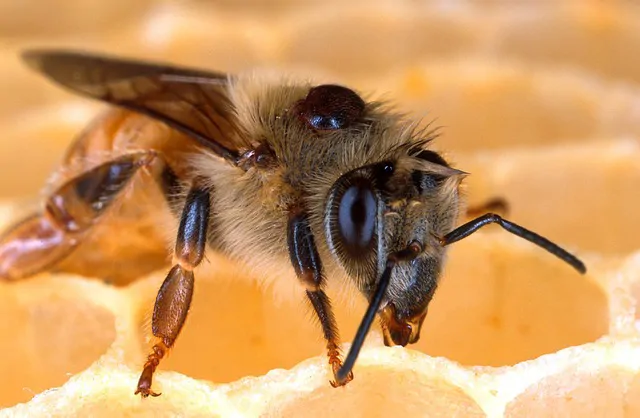 Bee colonies around the world face multiple threats, including pesticides and other insecticides, diseases, predators, food shortages due to the loss and fragmentation of natural habitats, climate change, and more. But recent research suggests that one threat far exceeds all others: the Varroa destructor mite, which specializes in infesting honeybees (Apis mellifera)
. This parasite is a constant concern for beekeepers because, by weakening hives worldwide, it is the leading cause of colony losses.
For decades, researchers assumed that the Varroa
mite fed on blood (hemolymph in insects), like many of its mite and tick relatives. But the new American study shows that Varroa destructor actually has a voracious appetite for the honeybee’s fat stores—
reserves of fat distributed throughout the abdomen in the form of adipose tissue that performs vital functions similar to those of the human liver. This adipose tissue also serves as a storage site for food and vitellogenin, which stimulates the bees’ immune system.
The loss of adipose tissue impairs the bees’ ability to detoxify their bodies—particularly when exposed to pesticides—and deprives them of vital food reserves. Absolutely essential to their survival, these fat reserves—in addition to eliminating toxins and storing nutrients— produce antioxidants, support the immune system, play an important role in the metamorphosis process, and also produce the wax that coats part of the bees’ exoskeletons, preventing the penetration of water and diseases.
For the authors, the hypothesis that Varroa
feeds on blood dates back to the publication of the first article on the subject in the 1960s. Several observations have led them to question this assumption. First, insect hemolymph is very low in nutrients. To grow and reproduce at the mite’s breakneck pace, it would need to extract a quantity of blood far greater than what is available from a single bee. Second, Varroa’s
feces are dry, unlike those resulting from a blood meal. Finally, the mite’s mouthparts are better suited for consuming and digesting soft tissue, unlike those of blood-feeding mites, which are equipped with mouthparts designed to pierce the skin and suck out fluid.
Bee colonies around the world face multiple threats, including pesticides and other insecticides, diseases, predators, food shortages due to the loss and fragmentation of natural habitats, climate change, and more. But recent research suggests that one threat far exceeds all others: the Varroa destructor mite, which specializes in infesting honeybees (Apis mellifera)
. This parasite is a constant concern for beekeepers because, by weakening hives worldwide, it is the leading cause of colony losses.
For decades, researchers assumed that the Varroa
mite fed on blood (hemolymph in insects), like many of its mite and tick relatives. But the new American study shows that Varroa destructor actually has a voracious appetite for the honeybee’s fat stores—
reserves of fat distributed throughout the abdomen in the form of adipose tissue that performs vital functions similar to those of the human liver. This adipose tissue also serves as a storage site for food and vitellogenin, which stimulates the bees’ immune system.
The loss of adipose tissue impairs the bees’ ability to detoxify their bodies—particularly when exposed to pesticides—and deprives them of vital food reserves. Absolutely essential to their survival, these fat reserves—in addition to eliminating toxins and storing nutrients— produce antioxidants, support the immune system, play an important role in the metamorphosis process, and also produce the wax that coats part of the bees’ exoskeletons, preventing the penetration of water and diseases.
For the authors, the hypothesis that Varroa
feeds on blood dates back to the publication of the first article on the subject in the 1960s. Several observations have led them to question this assumption. First, insect hemolymph is very low in nutrients. To grow and reproduce at the mite’s breakneck pace, it would need to extract a quantity of blood far greater than what is available from a single bee. Second, Varroa’s
feces are dry, unlike those resulting from a blood meal. Finally, the mite’s mouthparts are better suited for consuming and digesting soft tissue, unlike those of blood-feeding mites, which are equipped with mouthparts designed to pierce the skin and suck out fluid.
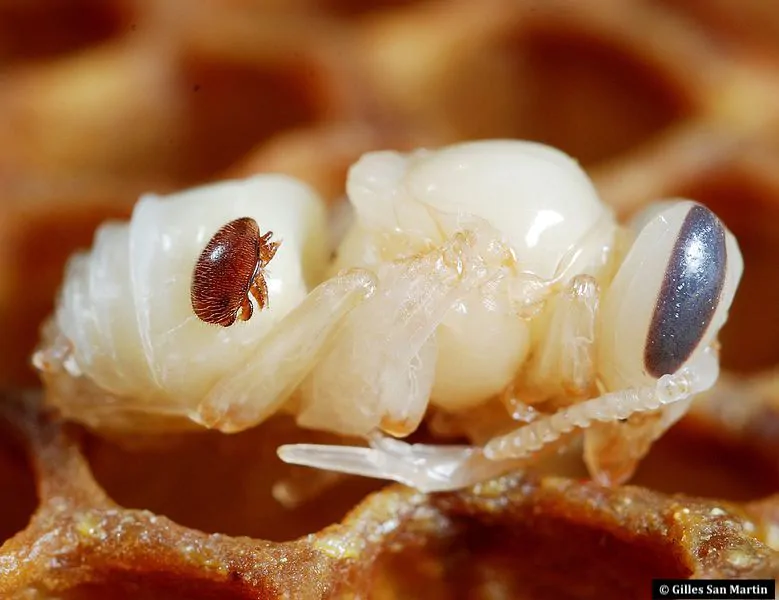 Furthermore, if Varroa
fed on hemolymph—which is distributed uniformly throughout the bee’s body—it would not have developed a preferred attachment site, as is in fact the case. When feeding on immature bees, the mite feeds anywhere on their bodies. But when attacking adult bees, the team observed a strong preference for the underside of the abdomen (where more than 90% of the observed parasites were found)
.
Samuel Ramsey and his team then used
a liquid nitrogen freezing technique to analyze the mites and their bee hosts in action during a feeding session. Using powerful electron microscopes, they were able to visualize the bite wounds and confirm that the parasites were indeed feeding on adipose tissue, revealing digested fragments of fat cells. All that remained was to verify that blood was not also part of the feast.
To confirm their observations, bees were fed a diet containing two fluorescent dyes: uranine, a water-soluble yellow dye, and Nile red, a fat-soluble red dye. If the Varroa mites
consumed hemolymph, their digestive tract should turn a bright yellow after the meal. On the other hand, if they fed on fat, a telltale red coloration would appear.
As soon as the first mite was observed, the proof was there: its digestive tract glowed like the setting sun. For the authors, these mites are therefore not bloodthirsty vampires, but more like werewolves. To drive the point home, they conducted one final experiment. Varroa
mites
were raised in the laboratory and fed a diet consisting of either hemolymph or adipose tissue. The results were striking: the mites fed blood starved to death, while the others thrived and even laid eggs
.
These findings could revolutionize our understanding of the damage caused to bees by the mites. Fats perform many crucial functions in these insects. Gaining a better understanding of the damage suffered by individual bees will help fill in the gaps in our knowledge of how Varroa
infests bee colonies. It also paves the way for the development of new, more effective, and better-targeted treatments to combat this mite.
Furthermore, if Varroa
fed on hemolymph—which is distributed uniformly throughout the bee’s body—it would not have developed a preferred attachment site, as is in fact the case. When feeding on immature bees, the mite feeds anywhere on their bodies. But when attacking adult bees, the team observed a strong preference for the underside of the abdomen (where more than 90% of the observed parasites were found)
.
Samuel Ramsey and his team then used
a liquid nitrogen freezing technique to analyze the mites and their bee hosts in action during a feeding session. Using powerful electron microscopes, they were able to visualize the bite wounds and confirm that the parasites were indeed feeding on adipose tissue, revealing digested fragments of fat cells. All that remained was to verify that blood was not also part of the feast.
To confirm their observations, bees were fed a diet containing two fluorescent dyes: uranine, a water-soluble yellow dye, and Nile red, a fat-soluble red dye. If the Varroa mites
consumed hemolymph, their digestive tract should turn a bright yellow after the meal. On the other hand, if they fed on fat, a telltale red coloration would appear.
As soon as the first mite was observed, the proof was there: its digestive tract glowed like the setting sun. For the authors, these mites are therefore not bloodthirsty vampires, but more like werewolves. To drive the point home, they conducted one final experiment. Varroa
mites
were raised in the laboratory and fed a diet consisting of either hemolymph or adipose tissue. The results were striking: the mites fed blood starved to death, while the others thrived and even laid eggs
.
These findings could revolutionize our understanding of the damage caused to bees by the mites. Fats perform many crucial functions in these insects. Gaining a better understanding of the damage suffered by individual bees will help fill in the gaps in our knowledge of how Varroa
infests bee colonies. It also paves the way for the development of new, more effective, and better-targeted treatments to combat this mite.
Read next
Research & Diagnostics
10/09/2026
WHO sets new diagnostic targets for Echinococcus granulosus in humans, dogs and sheep
Research & Diagnostics
10/09/2026
Nipah virus in wastewater: promising for early warning?
Research & Diagnostics
10/01/2026
Commentaires
No comments yet.
Sign in to comment