

Back to articles
Research & Diagnostics
Blood-feeding
Chagas Disease
Dog
Enzootic disease
Leishmania spp.
Leishmaniasis
Novartis
Parasite
Parasitic Infection
Proteasome
Sandfly
Sleeping Sickness
Tropical disease
Trypanosoma brucei spp.
Trypanosoma cruzi
Trypanosomiasis
Vector-borne diseases
Research: Toward a New Treatment for Three Neglected Parasitic Diseases
V
Vetitude
08/09/2016
3 min read
0 comments
Share:
American researchers have identified a substance capable of killing the parasites responsible for three deadly diseases: leishmaniasis (Leishmania spp.), sleeping sickness (Trypanosoma brucei spp.), and Chagas disease (Trypanosoma cruzi). These three vector-borne parasitic diseases alone affect 20 million people worldwide, primarily in Africa and Latin America, and cause more than 50,000 deaths each year in the absence of effective treatment. The study*, published on August 8 in the journal *Nature*, suggests that a single class of drugs could treat all three of these diseases, which have been neglected by research due to a lack of investment.
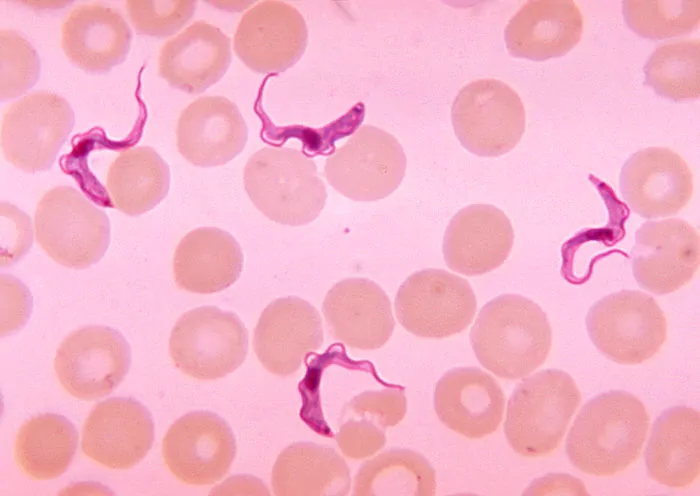 The substance discovered, a proteasome inhibitor named GNF6702, was identified through the screening of some three million molecular compounds by the Genomics Institute of the Novartis Research Foundation
, based in San Diego (United States). It was successfully tested in mice, killing the three similar parasites involved. Similarly, laboratory tests conducted on mammalian cells showed no toxicity for the three infection models, providing a starting point for launching a clinical trial in humans and, ultimately, the development of a new treatment.
The three parasitic diseases targeted by this study are all caused by parasites transmitted to humans via
infected blood-feeding insects (bugs, flies, midges).
> Sleeping sickness, or African human trypanosomiasis,
is caused by the protozoan Trypanosoma brucei,
which penetrates the brain via
the bite of the tsetse fly. Found in 36 countries in sub-Saharan Africa, the infection causes high fever, headaches, joint pain, and itching. Without treatment, the parasite then invades the central nervous system, causing behavioral changes, confusion, sleep disturbances, and coordination problems, among other symptoms. In 98% of cases, the disease is chronic and remains asymptomatic for months or even years until it reaches this advanced stage. Trypanosomiasis affecting domestic animals, particularly livestock, constitutes a major obstacle to economic development in the affected rural areas.
> Chagas disease, or American trypanosomiasis
, is transmitted by a triatomine bug carrying the Trypanosoma cruzi
parasite.
It is most prevalent in Latin America, but for more than a decade, the disease has also been detected on other continents. After many years of silent infection, the disease progresses to a chronic form, causing often fatal heart disease or digestive disorders, and even neurological disorders. There is currently no effective treatment or vaccine against this form of trypanosomiasis, which also affects animals and is known as nagana.
> Leishmaniasis,
caused by a protozoan of the genus Leishmania,
is transmitted through the bite of an infected sandfly. It causes debilitating skin or visceral lesions that can be fatal if left untreated. It is endemic in 98 countries in the Americas, Africa, and Asia. In France, leishmaniasis—particularly the visceral form—is present in the Mediterranean departments, where Leishmania infantum
is prevalent and responsible for the enzootic disease in dogs.
To treat these three neglected parasitic diseases, there is still a long way to go before a single drug—or three separate drugs, depending on the strategic options explored—can be developed. Furthermore, these drugs will need to be affordable to benefit the many affected populations worldwide, who are also among the poorest.
* S. Khare et al.: Proteasome inhibition for the treatment of leishmaniasis, Chagas disease, and sleeping sickness, *Nature*, 2016
.
The substance discovered, a proteasome inhibitor named GNF6702, was identified through the screening of some three million molecular compounds by the Genomics Institute of the Novartis Research Foundation
, based in San Diego (United States). It was successfully tested in mice, killing the three similar parasites involved. Similarly, laboratory tests conducted on mammalian cells showed no toxicity for the three infection models, providing a starting point for launching a clinical trial in humans and, ultimately, the development of a new treatment.
The three parasitic diseases targeted by this study are all caused by parasites transmitted to humans via
infected blood-feeding insects (bugs, flies, midges).
> Sleeping sickness, or African human trypanosomiasis,
is caused by the protozoan Trypanosoma brucei,
which penetrates the brain via
the bite of the tsetse fly. Found in 36 countries in sub-Saharan Africa, the infection causes high fever, headaches, joint pain, and itching. Without treatment, the parasite then invades the central nervous system, causing behavioral changes, confusion, sleep disturbances, and coordination problems, among other symptoms. In 98% of cases, the disease is chronic and remains asymptomatic for months or even years until it reaches this advanced stage. Trypanosomiasis affecting domestic animals, particularly livestock, constitutes a major obstacle to economic development in the affected rural areas.
> Chagas disease, or American trypanosomiasis
, is transmitted by a triatomine bug carrying the Trypanosoma cruzi
parasite.
It is most prevalent in Latin America, but for more than a decade, the disease has also been detected on other continents. After many years of silent infection, the disease progresses to a chronic form, causing often fatal heart disease or digestive disorders, and even neurological disorders. There is currently no effective treatment or vaccine against this form of trypanosomiasis, which also affects animals and is known as nagana.
> Leishmaniasis,
caused by a protozoan of the genus Leishmania,
is transmitted through the bite of an infected sandfly. It causes debilitating skin or visceral lesions that can be fatal if left untreated. It is endemic in 98 countries in the Americas, Africa, and Asia. In France, leishmaniasis—particularly the visceral form—is present in the Mediterranean departments, where Leishmania infantum
is prevalent and responsible for the enzootic disease in dogs.
To treat these three neglected parasitic diseases, there is still a long way to go before a single drug—or three separate drugs, depending on the strategic options explored—can be developed. Furthermore, these drugs will need to be affordable to benefit the many affected populations worldwide, who are also among the poorest.
* S. Khare et al.: Proteasome inhibition for the treatment of leishmaniasis, Chagas disease, and sleeping sickness, *Nature*, 2016
.
Read next
Research & Diagnostics
10/09/2026
WHO sets new diagnostic targets for Echinococcus granulosus in humans, dogs and sheep
Research & Diagnostics
10/09/2026
Nipah virus in wastewater: promising for early warning?
Research & Diagnostics
10/01/2026
Commentaires
No comments yet.
Sign in to comment