Octopuses are intelligent: it would be unethical to farm them
VVetitude04/19/20226 min read0 comments
Share:
An aquaculture project to farm octopuses in the Canary Islands would produce 3,000 metric tons of octopuses per year, which means that nearly 275,000 individuals would be killed each year.
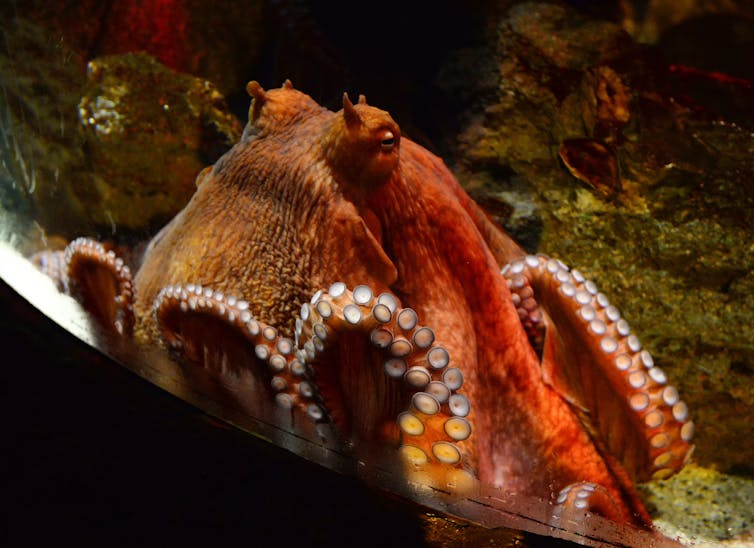
As part of my research, I study animal cognition and animal ethics. The term “octopus culture” may bring to mind Octopolis and Octlantis, two communities of wild octopuses in Jarvis Bay, Australia.
In Octopolis, many octopuses share—and compete for—a few square meters of the seafloor. In these aquatic “cities,” octopuses form dominance hierarchies and develop new behaviors: male octopuses compete for territory—and perhaps for females—by throwing objects at each other and fighting.
Octopus Communities
Biologists were surprised to discover the existence of octopus communities. For a long time, they had considered octopuses to be solitary animals that interacted with one another in only three specific contexts: hunting, fleeing, and mating.
What *Octopolis* allows us to observe is that what happens in the wild also occurs among octopuses in captivity: when they live in an overly crowded captive environment, octopuses form dominance hierarchies.
In their struggle for power, males engage in a series of aggressive behaviors, including throwing scallop shells to defend their lairs and rearing up to resemble a menacing vampire. Submissive octopuses demonstrate their docility by displaying light colors and adopting flattened body postures. In exchange for their efforts, dominant individuals seem to gain access to the best dens and females.
A look at the social life of octopuses by Australian philosopher Peter Godfrey-Smith.
Animal Culture
What can be observed at Octopolis and Octlantis constitutes an “octopus culture.” The idea of animal culture emerged after scientists noted that, in certain groups, animals perform actions that would not be seen in other groups of the same species.
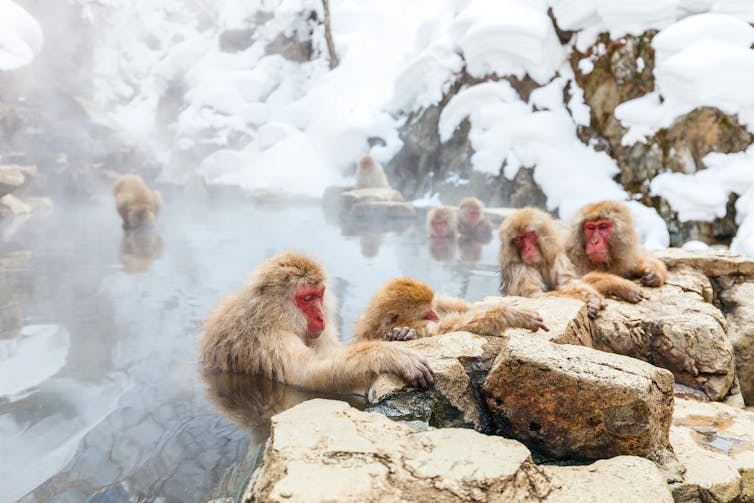
One of the earliest proponents of animal culture was the Japanese primatologist Kinji Imanishi, who, in the 1950s, noticed that a group of Japanese macaques on Koshima Island washed sweet potatoes in water before eating them.
This was a new behavior not seen in other groups of macaques, and observers were fortunate enough to discover its origins. A monkey named Imo was the first to wash a sweet potato in saltwater, and others quickly imitated him, a behavior that was subsequently adopted by the entire community.
The concept of animal culture inspired much of the subsequent work in Japanese primatology, but in Europe and North America, it received little attention until 1999, following the publication of an article on culture among chimpanzees. Since then, evidence of culture—behaviors typical of a group that are socially learned—has been observed throughout the animal kingdom, including among fish, birds, and insects.
Japanese macaques exhibiting social behavior influenced a cultural approach to primatology that subsequently expanded to the study of other macaques.(Shutterstock)
A New Kind of Octopus
The proposal to establish an octopus breeding facility will give rise to a new culture among octopuses, because when cultural animals are brought together, they inevitably create a society. It is also an opportunity to create a new type of octopus: the cultural behaviors associated with the captive environment will constitute a new ecological niche that will determine their future evolution.
The farm animals we know well—such as Angus cattle and Choctaw pigs—have been domesticated and are entirely different from the individuals from which they are descended.
Many of our domestic animals could not survive without human care. Examples include domestic rabbits, which have evolved without the instincts or coat color of wild rabbits—features that protect them from predators— sheep, whose wool becomes too thick if they aren’t sheared regularly; and chickens raised for meat, which cannot walk as adults because their breasts are too heavy.
By starting an octopus farm, you are creating a new type of animal whose existence depends on humans. This is not an idea to be taken lightly, nor is it a project that one can responsibly attempt and then abandon if it proves too difficult or unprofitable.
Managing Octopus Populations
There are many reasons to fear that octopus farms will be difficult to manage. Unlike other farm animals, octopuses need their space. Octopolis is already a battleground for octopuses fighting one another; one can only wonder what it will be like with thousands of them.
Octopuses are sentient beings that feel pain. A report commissioned by the UK Department for Environment, Food, and Rural Affairs analyzed the scientific evidence regarding pain in cephalopods (octopuses, squids, and cuttlefish).
Sentient beings used for food are protected by animal welfare laws and killed in ways that minimize their pain. Current methods for slaughtering octopuses include bludgeoning, brain laceration, and asphyxiation. The report’s authors conclude that none of these methods is humane and recommend against octopus farming.
Octopuses are masters of escape. The type of habitat they require is difficult to provide, especially if it is subject to environmental enrichment, as it will inevitably be full of potential escape routes.
Octopuses are known for their ability to escape from tanks.(Shutterstock)
If an octopus farm is started and then abandoned, the thousands of domesticated octopuses cannot be released into the ocean and expected to survive. The numerous costly attempts to release Keiko, the orca who starred in the movie *Free Willy*
, have taught us that it is not easy to successfully reintroduce a “cultural” animal into the wild. Even after spending 20 million U.S. dollars, Keiko eventually died in captivity
.
The project to bring together thousands of individuals in a megacity of octopuses would undoubtedly cause octopus culture to evolve far beyond what is found in the wild or in captivity. This would create hundreds of thousands of Keikos—aquatic cultural animals captured from the wild and placed in captivity—and force them to live together and develop a new culture in what would certainly be a violent slum.
Now that we know octopuses experience emotions
and have a culture, we are beginning to rethink current intensive farming practices
.
This is not the right time to propose such a project. We must exercise good judgment.
Kristin Andrews
, Professor, Philosophy, York University, Canada
This article is republished from The Conversation
under a Creative Commons license. Read the original
article.


 Kristin Andrews
, Professor, Philosophy, York University, Canada
This article is republished from The Conversation
under a Creative Commons license. Read the original
article.
Kristin Andrews
, Professor, Philosophy, York University, Canada
This article is republished from The Conversation
under a Creative Commons license. Read the original
article.

Commentaires
No comments yet.
Sign in to comment