

Back to articles
Myxomatosis: When Viruses Become More Deadly Over Time
BN
Bertrand Neveux
11/02/2022
3 min read
0 comments
Share:
The course of myxomatosis in rabbits has often been cited as an example to demonstrate that a virus becomes less virulent when it becomes endemic within a population. This is known as the law of decreasing virulence. But is this really the case for this disease?
Myxomatosis is a viral disease that causes skin nodules (myxomas), swelling of the head and eyelids, lesions on the ears, and respiratory problems. Initially, the virus was so virulent that it killed approximately 99.8% of infected rabbits in just two weeks. Over time, however, the virus became attenuated, killing only 60% of infected rabbits over a longer period. Based on this observation, the “law of decreasing virulence” was proposed, suggesting that viruses naturally attenuate over time to ensure they do not kill their hosts before having a chance to be transmitted to other individuals.
The MYXV poxvirus in question was introduced into Australia in the 1950s in an attempt to control invasive populations of non-native rabbits. Scientists studied the virus’s evolution between 2012 and 2015 and examined three variants. It appears that the evolution of these viral lineages has favored the emergence of an amyxomatous phenotype in rabbits, characterized by skin lesions with little or no inflammation but a highly lethal immune collapse syndrome consistent with massive immunosuppression, which is quite different from what was observed during the early decades. The authors interpret this new amyxomatous phenotype as the virus’s adaptive response to overcome the evolution of resistance to infection in the wild rabbit population. This is a classic example of coevolution between viral virulence and host resistance. Effective vector-borne transmission indeed requires high viral titers in skin lesions in hosts that survive long enough to transmit the disease.
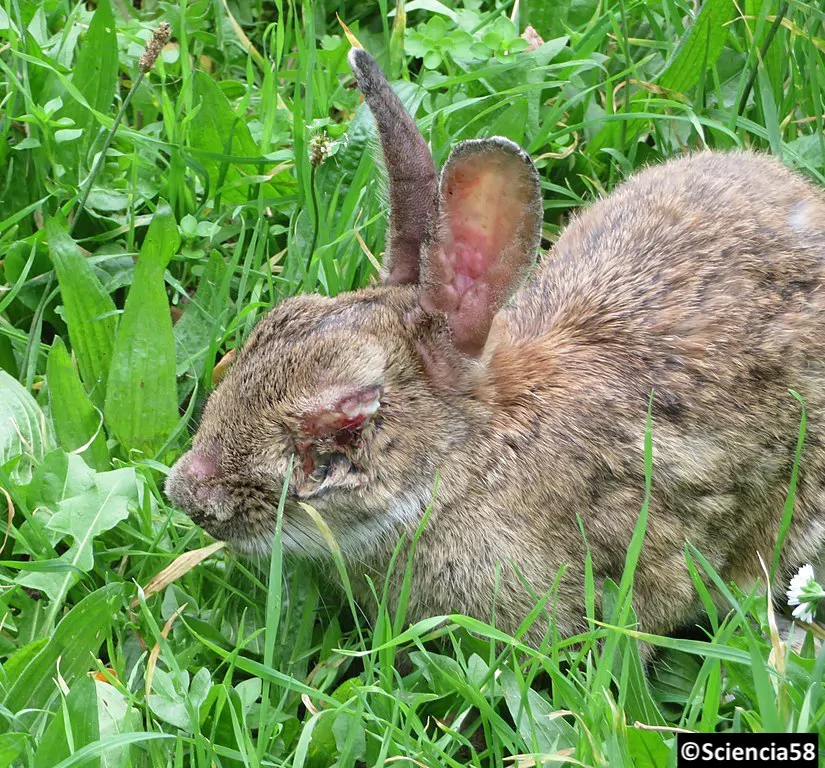 One of the three variants induced a different response in lagomorphs: more pronounced swelling of the skin tissue at the base of the ears and around the eyelids—precisely where mosquitoes are most likely to bite. These areas, accessible to the vector, were found to be extremely rich in virus, which was able to suppress the inflammatory response in situ to ensure significant viral replication. Previous studies have shown that a rabbit that survived the infection was less effective at spreading the virus, as were those that died prematurely. Virus-induced immunosuppression therefore appears to be an evolutionary adaptation of the virus and, more importantly, shows a strong correlation with increased virulence and transmissibility.
So, no, the myxomatosis virus has not weakened in recent decades; it has simply entered a race of evolutionary adaptation with wild rabbit lineages. This explains the resurgence in mortality observed among rabbits over the past twenty years.
One of the three variants induced a different response in lagomorphs: more pronounced swelling of the skin tissue at the base of the ears and around the eyelids—precisely where mosquitoes are most likely to bite. These areas, accessible to the vector, were found to be extremely rich in virus, which was able to suppress the inflammatory response in situ to ensure significant viral replication. Previous studies have shown that a rabbit that survived the infection was less effective at spreading the virus, as were those that died prematurely. Virus-induced immunosuppression therefore appears to be an evolutionary adaptation of the virus and, more importantly, shows a strong correlation with increased virulence and transmissibility.
So, no, the myxomatosis virus has not weakened in recent decades; it has simply entered a race of evolutionary adaptation with wild rabbit lineages. This explains the resurgence in mortality observed among rabbits over the past twenty years.
Read next
Research & Diagnostics
10/09/2026
WHO sets new diagnostic targets for Echinococcus granulosus in humans, dogs and sheep
Research & Diagnostics
10/09/2026
Nipah virus in wastewater: promising for early warning?
Research & Diagnostics
10/01/2026
Commentaires
No comments yet.
Sign in to comment