

Back to articles
Research & Diagnostics
Accredited veterinarian
African swine fever
Anthrax bacillus
Anticholinesterase
Army Health Service
Atropine sulfate
Attack
Bacteriological attack
Bacteriological Weapons
Bernard Vallat
Biological weapons
Bioterrorism
Cholinomimetic
CIA
DGSI
FAO
Food and Agriculture Organization
Foot-and-mouth disease
Health security
Incubation period
Interpol
NSA
Organophosphorus neurotoxins
Parasympathomimetic
Pathogens
Piratox
Practising veterinarian
Sarin gas
Terrorism
Veterinarian
Veterinary services
WOAH
World Organisation for Animal Health
Zoonosis
Health Threats: The Prime Minister Warns of the Risk of an Attack Using Chemical, Bacteriological, or Even Biological Weapons
V
Vetitude
11/20/2015
5 min read
0 comments
Share:
Manuels Valls addressed members of the National Assembly this morning during the debate on extending the state of emergency. On this occasion, he spoke of new methods of operation—ways of inflicting harm and killing—that are constantly evolving in this war that strikes at the very heart of our daily lives. Today, faced with the terrorists’ morbid imagination, it is impossible to rule out anything—and especially not the use of chemical and bacteriological weapons—the Prime Minister had to admit. The threat seems very real, since a decree*, quietly published the day after the Paris attacks, authorizes the emergency production of an antidote to organophosphate nerve agents.
France is facing “a new war, both external and internal, in which terror is the primary goal and the primary weapon,” declared the head of government. In this context, the government is preparing, in particular, for the possibility of a chemical or bacteriological attack. And swift action must be taken, within a timeframe compatible with the organization of the Paris Climate Conference (COP21), which begins in about ten days.
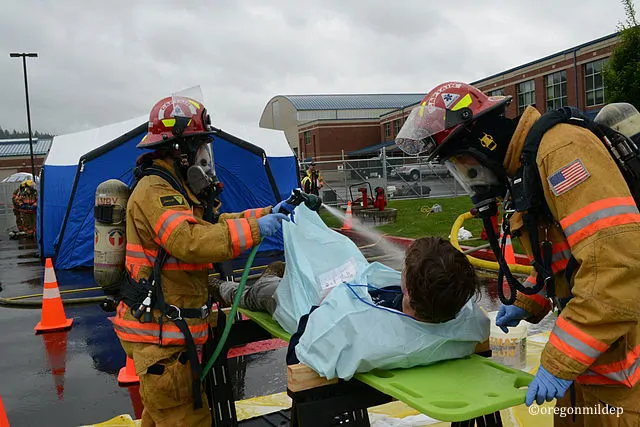 Accordingly, a decree from the Ministry of Health, issued on November 15, 2015, grants a special exemption authorizing the urgent production of atropine sulfate vials by the Central Army Pharmacy. This specific antidote for acute poisoning by anticholinesterase agents (organophosphate insecticides, chemical warfare agents, and carbamates) or by parasympathomimetic and cholinomimetic drugs can thus be procured, stored, distributed, prescribed, dispensed, and administered by healthcare professionals in emergency medical services to treat a potentially large number of exposed individuals. The Armed Forces Health Service is responsible for supplying the Health Emergency Preparedness and Response Agency, which in turn supplies hospitals.
During a chemical attack, such as the sarin gas attack that took place in 1995 in the Tokyo subway in Japan, the release of odorless and volatile organophosphate nerve agents primarily causes respiratory distress in victims. It is therefore essential to act quickly, administering symptomatic treatment with oxygen, as well as implementing early decontamination procedures for patients to limit the risk of contamination, and above all, having access to the atropine sulfate antidote, which is now supplied in large quantities to hospitals.
In such a scenario, the Piratox plan—a specialized component of the Vigipirate plan—is activated in addition to the “red alert” plan. It comprises a “prevention and vigilance” component in response to a chemical terrorist threat, an “emergency plan” component in the event of mass chemical poisoning, and a judicial component involving the search for, identification, and neutralization of the perpetrators of the attack or malicious act. Developed in the late 1970s, the Piratox plan has been revised three times since then to incorporate response measures in the event of an attack, centered on the care and decontamination of exposed individuals.
Accordingly, a decree from the Ministry of Health, issued on November 15, 2015, grants a special exemption authorizing the urgent production of atropine sulfate vials by the Central Army Pharmacy. This specific antidote for acute poisoning by anticholinesterase agents (organophosphate insecticides, chemical warfare agents, and carbamates) or by parasympathomimetic and cholinomimetic drugs can thus be procured, stored, distributed, prescribed, dispensed, and administered by healthcare professionals in emergency medical services to treat a potentially large number of exposed individuals. The Armed Forces Health Service is responsible for supplying the Health Emergency Preparedness and Response Agency, which in turn supplies hospitals.
During a chemical attack, such as the sarin gas attack that took place in 1995 in the Tokyo subway in Japan, the release of odorless and volatile organophosphate nerve agents primarily causes respiratory distress in victims. It is therefore essential to act quickly, administering symptomatic treatment with oxygen, as well as implementing early decontamination procedures for patients to limit the risk of contamination, and above all, having access to the atropine sulfate antidote, which is now supplied in large quantities to hospitals.
In such a scenario, the Piratox plan—a specialized component of the Vigipirate plan—is activated in addition to the “red alert” plan. It comprises a “prevention and vigilance” component in response to a chemical terrorist threat, an “emergency plan” component in the event of mass chemical poisoning, and a judicial component involving the search for, identification, and neutralization of the perpetrators of the attack or malicious act. Developed in the late 1970s, the Piratox plan has been revised three times since then to incorporate response measures in the event of an attack, centered on the care and decontamination of exposed individuals.
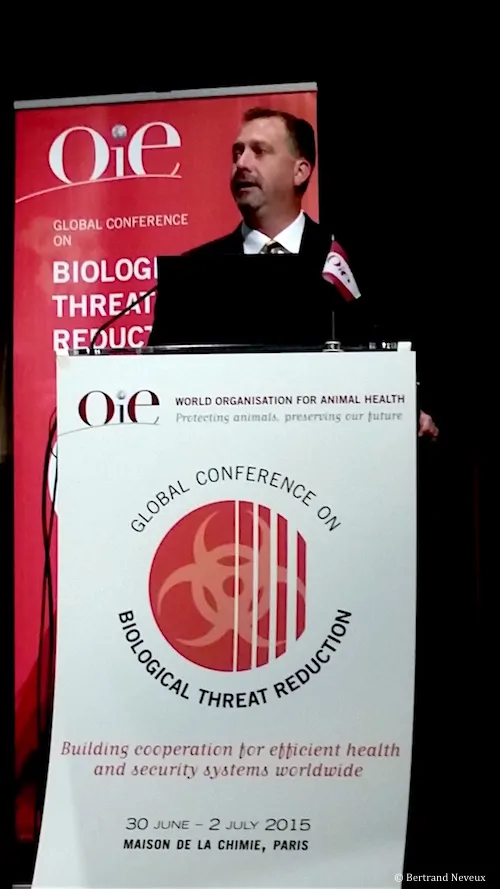 The conference on bioterrorism organized by the WOAH in July 2015 brought together the full spectrum of international intelligence services.[/caption]
Unlike bacteriological and chemical weapons, which cause massive and immediate harm to victims, biological weapons are arguably even more insidious. Invisible, unpredictable, and difficult to detect due to the incubation period before symptoms appear, biological threats also know no borders. All over the world, animal-borne pathogens—including those transmissible to humans—can be used as weapons, and some are readily accessible in endemic areas (such as the foot-and-mouth disease virus, the African swine fever virus, and Bacillus anthrax)..
Aware of this threat, the World Organisation for Animal Health (WOAH)**, under the leadership of its Director General Bernard Vallat and in collaboration with the World Health Organization (WHO), organized the first international conference on biological risks last summer in Paris. This event brought together key stakeholders from the WOAH, the WHO, Interpol, the United Nations Office for Disarmament Affairs, the FAO
, as well as representatives from governments and institutions responsible for defense, security, and health in more than 120 countries (CIA, NSA, DGSI, etc.).
According to one of the conclusions from this global conference, it became clear that the public health and security sectors must improve their collaboration and that national systems must comply with the same intergovernmental standards—two necessary conditions for the early detection and rapid response to any new outbreak of an infectious disease, whether caused by natural, accidental, or intentional means. Participants further emphasized the urgency of investing in the strengthening of public health and animal health surveillance systems outside of times of crisis… Today, the challenge for many countries is to have both the political will, the infrastructure, and the resources (particularly the capacity of national veterinary services to prevent, detect, and address biological threats) and effective governance principles to implement the international standards of the WOAH and WHO, in order to safeguard global health security.
Given the number of potentially available pathogens or toxins, the response to a deliberate or accidental infection therefore relies primarily on early detection and a rapid response to halt the spread of the agent in question. In such a scenario, veterinarians are a vital link in surveillance systems and mechanisms, given that 80% of pathogens that could be used for bioterrorism are of animal origin.
* Order of November 14, 2015, authorizing the use of atropine sulfate, 40 mg/20 ml injectable solution (PCA), as an antidote to organophosphate neurotoxins, published in the Official Journal (J0) on November 15, 2015.**
http://www.oie.int/fr/notre-expertise-scientifique/reduction-des-menaces-biologiques/
WOAH Strategy for the Reduction of Biological Risks: http://www.woah.int/fileadmin/Home/fr/Our_scientific_expertise/docs/pdf/F_Biological_Threat-Reduction_Strategy_jan2012.pdf
WOAH Fact Sheet on Bioterrorism: http://www.oie.int/fileadmin/Home/fr/Current_Scientific_Issues/docs/pdf/BIOTE_FR_FS.pdf
The conference on bioterrorism organized by the WOAH in July 2015 brought together the full spectrum of international intelligence services.[/caption]
Unlike bacteriological and chemical weapons, which cause massive and immediate harm to victims, biological weapons are arguably even more insidious. Invisible, unpredictable, and difficult to detect due to the incubation period before symptoms appear, biological threats also know no borders. All over the world, animal-borne pathogens—including those transmissible to humans—can be used as weapons, and some are readily accessible in endemic areas (such as the foot-and-mouth disease virus, the African swine fever virus, and Bacillus anthrax)..
Aware of this threat, the World Organisation for Animal Health (WOAH)**, under the leadership of its Director General Bernard Vallat and in collaboration with the World Health Organization (WHO), organized the first international conference on biological risks last summer in Paris. This event brought together key stakeholders from the WOAH, the WHO, Interpol, the United Nations Office for Disarmament Affairs, the FAO
, as well as representatives from governments and institutions responsible for defense, security, and health in more than 120 countries (CIA, NSA, DGSI, etc.).
According to one of the conclusions from this global conference, it became clear that the public health and security sectors must improve their collaboration and that national systems must comply with the same intergovernmental standards—two necessary conditions for the early detection and rapid response to any new outbreak of an infectious disease, whether caused by natural, accidental, or intentional means. Participants further emphasized the urgency of investing in the strengthening of public health and animal health surveillance systems outside of times of crisis… Today, the challenge for many countries is to have both the political will, the infrastructure, and the resources (particularly the capacity of national veterinary services to prevent, detect, and address biological threats) and effective governance principles to implement the international standards of the WOAH and WHO, in order to safeguard global health security.
Given the number of potentially available pathogens or toxins, the response to a deliberate or accidental infection therefore relies primarily on early detection and a rapid response to halt the spread of the agent in question. In such a scenario, veterinarians are a vital link in surveillance systems and mechanisms, given that 80% of pathogens that could be used for bioterrorism are of animal origin.
* Order of November 14, 2015, authorizing the use of atropine sulfate, 40 mg/20 ml injectable solution (PCA), as an antidote to organophosphate neurotoxins, published in the Official Journal (J0) on November 15, 2015.**
http://www.oie.int/fr/notre-expertise-scientifique/reduction-des-menaces-biologiques/
WOAH Strategy for the Reduction of Biological Risks: http://www.woah.int/fileadmin/Home/fr/Our_scientific_expertise/docs/pdf/F_Biological_Threat-Reduction_Strategy_jan2012.pdf
WOAH Fact Sheet on Bioterrorism: http://www.oie.int/fileadmin/Home/fr/Current_Scientific_Issues/docs/pdf/BIOTE_FR_FS.pdf
Bioterrorism Is Also a Current Concern
[caption id="attachment_6262" align="alignright" width="302"]Read next
Research & Diagnostics
10/09/2026
WHO sets new diagnostic targets for Echinococcus granulosus in humans, dogs and sheep
Research & Diagnostics
10/09/2026
Nipah virus in wastewater: promising for early warning?
Research & Diagnostics
10/01/2026
Commentaires
No comments yet.
Sign in to comment