

Back to articles
Feline Grimace Scale: A “grimace scale” measures acute pain in cats
V
Vetitude
02/05/2019
3 min read
0 comments
Share:
Marina Cayetano Evangelista, a veterinarian and doctoral student at the University of Montreal, has just developed a scale to better assess acute pain in cats. This work aims to provide a subjective measure of pain based on the evaluation of a cat’s grimaces and facial expressions. The specialized clinical tool, called the Feline Grimace Scale, was developed in Saint-Hyacinthe. When used in conjunction with other indicators, it should enable more accurate detection of acute pain in cats and make it easier for veterinarians to recognize such pain.
 Objective pain measurement, using
clinical parameters such as heart and respiratory rates or pupil diameter, does not correlate with signs of pain in cats. In fact, little research has been conducted on this species, and there are no validated measurement tools available for use with cats. Consequently, the assessment of feline pain is primarily subjective and relies on nonspecific signs.
The approach adopted by the team in Saint-Hyacinthe, Quebec,
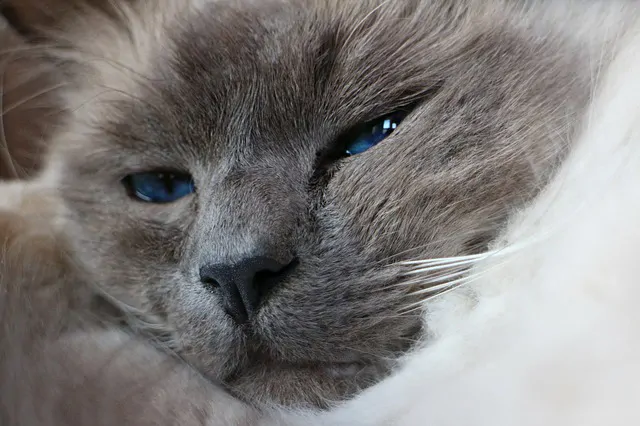
focused on the cat’s head, which is more likely to exhibit measurable signs of pain. A cat in pain typically adopts a characteristic facial expression: the ears are flattened back, the eyes are closed, the forehead is furrowed, the whiskers are turned forward, the nose is pointed, and the head is tucked into the shoulders. However, detecting these signs of pain remains approximate. It is sometimes difficult for both the owner and the veterinarian to know what to make of it, since cats are discreet animals that tend to hide when they are in pain.
As part of a prospective study conducted at the Quebec Faculty of Veterinary Medicine, cats suffering from various illnesses were observed over several months. With the consent of their owners and the care team, 31 cats exhibiting varying degrees of pain were selected and compared with 20 healthy cats. The sick cats were filmed and photographed from multiple angles and at various stages of their treatment, providing sufficient information to develop the new assessment tool, which quickly indicates the extent of an animal’s suffering.
The Feline Grimace Scale
is presented as a chart that the user can fill out after a few minutes of observation. On a scale from 0 (no signs) to 2 (very clear signs), the veterinarian assesses whether the cat’s eyes are open (0), partially closed (1), or closed (2), and whether its head is held upright or tends to droop between its shoulders. The veterinarian also notes the position of the whiskers (stretched out and pointing forward, or flattened against the face, indicating discomfort) and the ears (turned forward and pointed upward, indicating the cat is feeling well). The nose, which is more difficult to observe, forms rounded angles when everything is fine, whereas it is more triangular when the cat is in distress. The closer the overall score is to 10, the more severe the animal’s pain is. Ultimately, the Feline Grimace Scale provides a valuable supplement to the assessment of feline pain.
In the scientific literature, in-depth studies of signs indicating pain, using a similar scale, are well documented for laboratory animals (mice, rats) and horses
, but such studies have never been conducted on domestic cats. In dogs, given the diversity of canine body types and dog breeds, developing such a tool would be much more complex.
Objective pain measurement, using
clinical parameters such as heart and respiratory rates or pupil diameter, does not correlate with signs of pain in cats. In fact, little research has been conducted on this species, and there are no validated measurement tools available for use with cats. Consequently, the assessment of feline pain is primarily subjective and relies on nonspecific signs.
The approach adopted by the team in Saint-Hyacinthe, Quebec,
focused on the cat’s head, which is more likely to exhibit measurable signs of pain. A cat in pain typically adopts a characteristic facial expression: the ears are flattened back, the eyes are closed, the forehead is furrowed, the whiskers are turned forward, the nose is pointed, and the head is tucked into the shoulders. However, detecting these signs of pain remains approximate. It is sometimes difficult for both the owner and the veterinarian to know what to make of it, since cats are discreet animals that tend to hide when they are in pain.
As part of a prospective study conducted at the Quebec Faculty of Veterinary Medicine, cats suffering from various illnesses were observed over several months. With the consent of their owners and the care team, 31 cats exhibiting varying degrees of pain were selected and compared with 20 healthy cats. The sick cats were filmed and photographed from multiple angles and at various stages of their treatment, providing sufficient information to develop the new assessment tool, which quickly indicates the extent of an animal’s suffering.
The Feline Grimace Scale
is presented as a chart that the user can fill out after a few minutes of observation. On a scale from 0 (no signs) to 2 (very clear signs), the veterinarian assesses whether the cat’s eyes are open (0), partially closed (1), or closed (2), and whether its head is held upright or tends to droop between its shoulders. The veterinarian also notes the position of the whiskers (stretched out and pointing forward, or flattened against the face, indicating discomfort) and the ears (turned forward and pointed upward, indicating the cat is feeling well). The nose, which is more difficult to observe, forms rounded angles when everything is fine, whereas it is more triangular when the cat is in distress. The closer the overall score is to 10, the more severe the animal’s pain is. Ultimately, the Feline Grimace Scale provides a valuable supplement to the assessment of feline pain.
In the scientific literature, in-depth studies of signs indicating pain, using a similar scale, are well documented for laboratory animals (mice, rats) and horses
, but such studies have never been conducted on domestic cats. In dogs, given the diversity of canine body types and dog breeds, developing such a tool would be much more complex.
Read next
Research & Diagnostics
10/09/2026
WHO sets new diagnostic targets for Echinococcus granulosus in humans, dogs and sheep
Research & Diagnostics
10/09/2026
Nipah virus in wastewater: promising for early warning?
Research & Diagnostics
10/01/2026
Commentaires
No comments yet.
Sign in to comment