

Back to articles
Research & Diagnostics
Bourbonnais Donkey
CNRS
Cotentin Donkey
Domestic Donkeys
Donkey
Donkey (female)
Donkey Breed
Equine industry
Equine welfare
French Horse and Riding Institute
Grand Noir du Berry
Horse
Horse welfare
IFCE
INRA
Norman donkey
Poitou Donkey
Provençal Donkey
Pyrenean Donkey
Wild donkey
Wild Donkeys of Africa
Wild Donkeys of Asia
Equine Research: Conservation of Wild and Domestic Donkey Breeds Is on Track
V
Vetitude
03/17/2016
3 min read
0 comments
Share:
Researchers at the French National Institute for Agricultural Research (INRA) have succeeded in developing a novel technique for collecting oocytes from female donkeys in vivo*, using ultrasound-guided follicular puncture, which can now be used routinely. The timeline of in vitro maturation of these oocytes was also studied. These advances should make it possible to preserve the genetic heritage of donkey breeds around the world that are at risk of extinction.
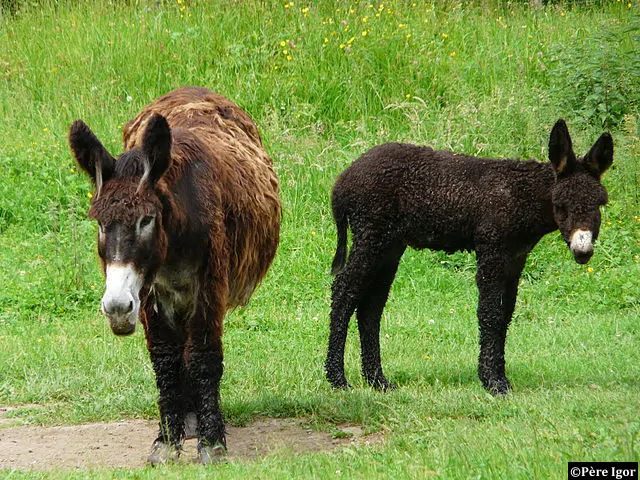 For the first time, INRA has developed a technique for collecting oocytes from live female donkeys via
transvaginal follicular punctures guided by ultrasound. A total of 92 oocytes were collected during 22 punctures. In a second phase, the researchers adapted a technique for the in vitro
maturation of mare oocytes to study the timeline of oocyte maturation in donkeys. Mature donkey oocytes were obtained in 44% of cases after 34 hours of culture.
The INRA research was conducted in partnership with the French Horse and Riding Institute (IFCE)**, the CNRS, and François-Rabelais University in Tours, as part of the “Investments for the Future” program. Further work is underway to develop an in vitro
fertilization technique designed to produce embryos suitable for freezing or embryo transfer into a female recipient.
It was urgent to take action. Indeed, most wild donkey species are endangered, such as the Asian wild ass (Equus hemionus
) and the African wild ass (Equus asinus africanus
), which are listed on the IUCN Red List. Similarly, many domestic donkey breeds are threatened worldwide. In France, of the seven donkey breeds represented, five are near extinction
because they have fewer than 100 breeding females (23 Bourbonnais donkeys, 34 Grand Noir du Berry donkeys, 40 Normandy donkeys, 43 Provence donkeys, 88 Cotentin donkeys) and two are at risk of extinction with fewer than 300 breeding females (136 Pyrenean donkeys, 296 Poitou donkeys), according to 2015 data from the IFCE.
Preserving this genetic heritage involves, in particular, the cryopreservation of oocytes, which must be collected in vivo
. Embryo collection, which requires producing large numbers of embryos from just a few females, is not feasible in vivo
because donkeys produce only one embryo per 26-day cycle. Such production is possible in vitro,
but this requires collecting oocytes from living females. For INRA, this collection is therefore an essential step for the conservation of the female genetic heritage.
* Research published in *Theriogenology*, International Journal of Animal Reproduction.** INRA and IFCE are also co-organizing the 42nd Equine Research Day, which is taking place today, March 17, in Paris. This year’s theme is equine welfare. The event aims to promote the transfer of research advances to socio-professional stakeholders in the equine industry.
For the first time, INRA has developed a technique for collecting oocytes from live female donkeys via
transvaginal follicular punctures guided by ultrasound. A total of 92 oocytes were collected during 22 punctures. In a second phase, the researchers adapted a technique for the in vitro
maturation of mare oocytes to study the timeline of oocyte maturation in donkeys. Mature donkey oocytes were obtained in 44% of cases after 34 hours of culture.
The INRA research was conducted in partnership with the French Horse and Riding Institute (IFCE)**, the CNRS, and François-Rabelais University in Tours, as part of the “Investments for the Future” program. Further work is underway to develop an in vitro
fertilization technique designed to produce embryos suitable for freezing or embryo transfer into a female recipient.
It was urgent to take action. Indeed, most wild donkey species are endangered, such as the Asian wild ass (Equus hemionus
) and the African wild ass (Equus asinus africanus
), which are listed on the IUCN Red List. Similarly, many domestic donkey breeds are threatened worldwide. In France, of the seven donkey breeds represented, five are near extinction
because they have fewer than 100 breeding females (23 Bourbonnais donkeys, 34 Grand Noir du Berry donkeys, 40 Normandy donkeys, 43 Provence donkeys, 88 Cotentin donkeys) and two are at risk of extinction with fewer than 300 breeding females (136 Pyrenean donkeys, 296 Poitou donkeys), according to 2015 data from the IFCE.
Preserving this genetic heritage involves, in particular, the cryopreservation of oocytes, which must be collected in vivo
. Embryo collection, which requires producing large numbers of embryos from just a few females, is not feasible in vivo
because donkeys produce only one embryo per 26-day cycle. Such production is possible in vitro,
but this requires collecting oocytes from living females. For INRA, this collection is therefore an essential step for the conservation of the female genetic heritage.
* Research published in *Theriogenology*, International Journal of Animal Reproduction.** INRA and IFCE are also co-organizing the 42nd Equine Research Day, which is taking place today, March 17, in Paris. This year’s theme is equine welfare. The event aims to promote the transfer of research advances to socio-professional stakeholders in the equine industry.
Read next
Research & Diagnostics
10/09/2026
WHO sets new diagnostic targets for Echinococcus granulosus in humans, dogs and sheep
Research & Diagnostics
10/09/2026
Nipah virus in wastewater: promising for early warning?
Research & Diagnostics
10/01/2026
Commentaires
No comments yet.
Sign in to comment