

Back to articles
Research & Diagnostics
Animal welfare
Barn
Bedding
Dairy cows
Lameness
Rumen
Veterinarian
Wood chip litter
Dairy Cows: Wood-chip bedding has a beneficial effect on hoof and claw health
V
Vetitude
11/22/2016
3 min read
0 comments
Share:
Dairy cows raised exclusively indoors frequently develop foot and hoof disorders due to damp floors and inadequate flooring materials. These disorders, which are often painful, can affect the animals’ fertility or milk production. According to a recent study* conducted by the University of Veterinary Medicine in Vienna (Austria), the use of wood chip bedding in dairy barns, instead of straw, has proven to be particularly beneficial. Compared to other types of housing, wood shavings reduce the incidence and severity of foot lesions and promote natural behaviors in cows.
Lameness in dairy cows is a major animal welfare issue. Foot lesions can cause pain—sometimes severe—contribute to infertility and reduced milk production, generate veterinary costs, and lead to more culls. Awareness of the importance of a healthy musculoskeletal system for the health and well-being of cattle is growing worldwide. Electronic data collection on foot and hoof disorders is expanding in many countries** to ultimately improve livestock management.
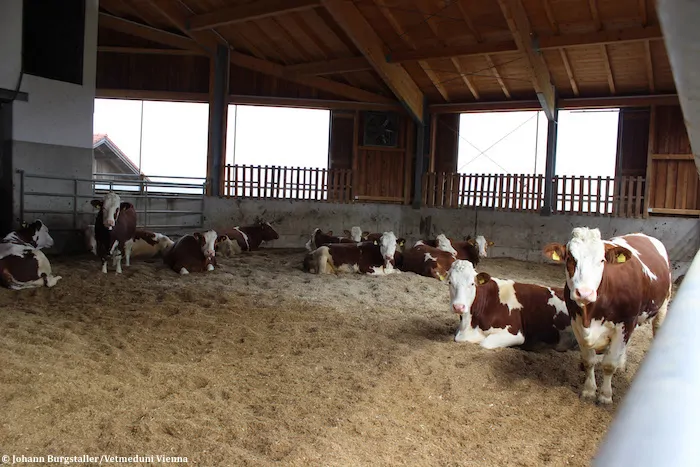 Several international studies have already demonstrated the benefits to hoof health in barns where straw bedding is replaced with wood chips or sawdust. A team from the University of Veterinary Medicine in Vienna, led by Johann Burgstaller, compared for the first time the frequency and severity of foot lesions and lameness based on the type of housing used for cows in Austria.
Five dairy herds housed in open barns on wood chips were compared to five herds housed on straw in a free-stall system (same number of dairy cows, similar flooring type, and similar milk yield). In terms of prevalence, the results clearly favor open housing on wood shavings, with a significantly lower
incidence of white line disease (20.4% versus 46.6% for herds on straw), heel horn erosion (26.9% versus 59.9%), for concavity of the dorsal wall due to chronic laminitis (6.5% versus 15.9%), and for interdigital hyperplasia (0.2% versus 3.1%)
. Similarly, the severity of the lesions appeared to be lower, with grade 2 and 3 lesions rarely observed.
Thus, the open barn with wood-chip bedding—which is better ventilated and has a much drier floor—appears to be a good alternative to the straw-bedded stabling system, with long-term beneficial effects on hoof health as well as on animal welfare. In line with the herd’s social behavior, the cows have a large, stable, non-slip surface on which to move around, lie down, and stand up safely—a definite advantage in cases of milk fever. On the other hand, the lameness rate (18%) is nearly the same for both housing types. However, it remains lower than the rate previously observed in Austria and internationally (25%).
* Johann Burgstaller et al.: “Claw health and prevalence of lameness in cows from compost-bedded and cubicle freestall dairy barns in Austria,” The Veterinary Journal, vol. 216, October 2016, pp. 81–86.**
http://www.icar.org/wp-content/uploads/2016/02/French-translation-of-the-ICAR-Claw-Health-Atlas.pdf
Several international studies have already demonstrated the benefits to hoof health in barns where straw bedding is replaced with wood chips or sawdust. A team from the University of Veterinary Medicine in Vienna, led by Johann Burgstaller, compared for the first time the frequency and severity of foot lesions and lameness based on the type of housing used for cows in Austria.
Five dairy herds housed in open barns on wood chips were compared to five herds housed on straw in a free-stall system (same number of dairy cows, similar flooring type, and similar milk yield). In terms of prevalence, the results clearly favor open housing on wood shavings, with a significantly lower
incidence of white line disease (20.4% versus 46.6% for herds on straw), heel horn erosion (26.9% versus 59.9%), for concavity of the dorsal wall due to chronic laminitis (6.5% versus 15.9%), and for interdigital hyperplasia (0.2% versus 3.1%)
. Similarly, the severity of the lesions appeared to be lower, with grade 2 and 3 lesions rarely observed.
Thus, the open barn with wood-chip bedding—which is better ventilated and has a much drier floor—appears to be a good alternative to the straw-bedded stabling system, with long-term beneficial effects on hoof health as well as on animal welfare. In line with the herd’s social behavior, the cows have a large, stable, non-slip surface on which to move around, lie down, and stand up safely—a definite advantage in cases of milk fever. On the other hand, the lameness rate (18%) is nearly the same for both housing types. However, it remains lower than the rate previously observed in Austria and internationally (25%).
* Johann Burgstaller et al.: “Claw health and prevalence of lameness in cows from compost-bedded and cubicle freestall dairy barns in Austria,” The Veterinary Journal, vol. 216, October 2016, pp. 81–86.**
http://www.icar.org/wp-content/uploads/2016/02/French-translation-of-the-ICAR-Claw-Health-Atlas.pdf
Compost versus Straw
Read next
Research & Diagnostics
10/09/2026
WHO sets new diagnostic targets for Echinococcus granulosus in humans, dogs and sheep
Research & Diagnostics
10/09/2026
Nipah virus in wastewater: promising for early warning?
Research & Diagnostics
10/01/2026
Commentaires
No comments yet.
Sign in to comment