

Back to articles
Conservation: Cats or Biodiversity—Will We Have to Choose?
V
Vetitude
01/04/2017
3 min read
0 comments
Share:
The University of Queensland conducted a comprehensive study on the ecological impact of a formidable predator—the feral cat—in Australia. This animal, which is ubiquitous in Australia and has even colonized urban areas, is wreaking havoc on native wildlife. The study’s findings are worth examining to better understand the role that domestic and feral cats play in the deaths of billions of small wild animals in Europe each year.
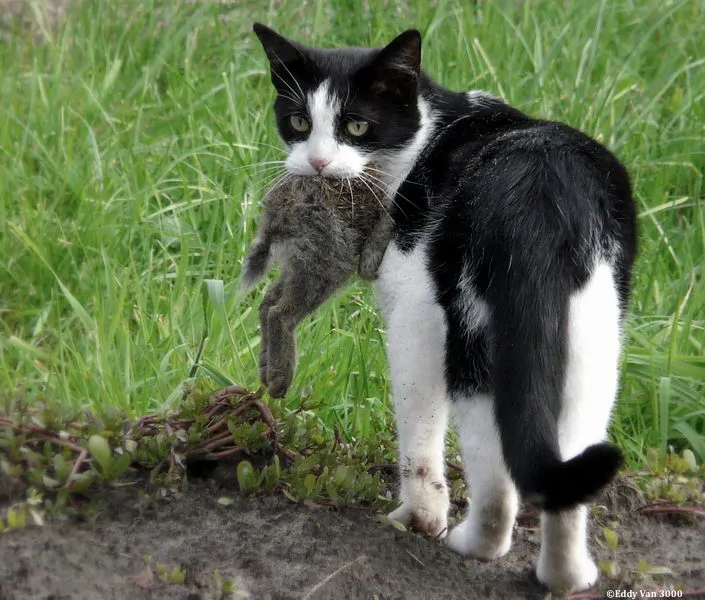 Whether birds, reptiles, or small mammals, cats are indirectly responsible for the extinction of numerous wild species worldwide, particularly on islands. The Australian study*, which involved more than 40 researchers across the country and resulted in about 100 publications, examined the case of feral cats (Felis catus
), which now inhabit 99.8% of Australia’s territory. Depending on climatic conditions, their population fluctuates between 2 million individuals (during droughts) and 6 million (when rain and prey are abundant). This invasion has not spared the country’s islands, where feral cats occupy up to 80% of the land area. It has even been observed that cat density is higher on small islands than on the mainland.
The impact of feral cats on Australian biodiversity is particularly severe. According to estimates, the country has already lost about 20 native mammal species because of them, and the extinctions are not expected to stop there. Furthermore, regional variations in cat density correlate closely with the rate of extinction of native wildlife
. Effective and targeted control of cat populations has therefore become a priority for the country, given that species conservation areas and national parks are not spared from the invasion of invasive species. The entire current strategy for conserving or reintroducing local species—in addition to being costly—is at risk of failure and urgently needs to be revised.
According to Gregory Andrews, Australia’s Commissioner for Endangered Species, “Australia is the only continent on Earth, other than Antarctica, where wild animals have evolved in the absence of cats, which explains why Australian wildlife is so vulnerable today to this predator .”
Thus, even though the overall density of cats in Australia is low compared to that of Europe or North America, their impact on local wildlife is far more devastating. The situation has become critical, and the solution involves, in particular, establishing island refuges through
the implementation of a targeted culling program. The federal government aims to cull 2 million feral cats over five years.
* S. Legge et al. “Enumerating a continental-scale threat: How many feral cats are in Australia?”, Biological Conservation, December 2016
Whether birds, reptiles, or small mammals, cats are indirectly responsible for the extinction of numerous wild species worldwide, particularly on islands. The Australian study*, which involved more than 40 researchers across the country and resulted in about 100 publications, examined the case of feral cats (Felis catus
), which now inhabit 99.8% of Australia’s territory. Depending on climatic conditions, their population fluctuates between 2 million individuals (during droughts) and 6 million (when rain and prey are abundant). This invasion has not spared the country’s islands, where feral cats occupy up to 80% of the land area. It has even been observed that cat density is higher on small islands than on the mainland.
The impact of feral cats on Australian biodiversity is particularly severe. According to estimates, the country has already lost about 20 native mammal species because of them, and the extinctions are not expected to stop there. Furthermore, regional variations in cat density correlate closely with the rate of extinction of native wildlife
. Effective and targeted control of cat populations has therefore become a priority for the country, given that species conservation areas and national parks are not spared from the invasion of invasive species. The entire current strategy for conserving or reintroducing local species—in addition to being costly—is at risk of failure and urgently needs to be revised.
According to Gregory Andrews, Australia’s Commissioner for Endangered Species, “Australia is the only continent on Earth, other than Antarctica, where wild animals have evolved in the absence of cats, which explains why Australian wildlife is so vulnerable today to this predator .”
Thus, even though the overall density of cats in Australia is low compared to that of Europe or North America, their impact on local wildlife is far more devastating. The situation has become critical, and the solution involves, in particular, establishing island refuges through
the implementation of a targeted culling program. The federal government aims to cull 2 million feral cats over five years.
* S. Legge et al. “Enumerating a continental-scale threat: How many feral cats are in Australia?”, Biological Conservation, December 2016
Read next
Research & Diagnostics
10/09/2026
WHO sets new diagnostic targets for Echinococcus granulosus in humans, dogs and sheep
Research & Diagnostics
10/09/2026
Nipah virus in wastewater: promising for early warning?
Research & Diagnostics
10/01/2026
Commentaires
No comments yet.
Sign in to comment