

Back to articles
Research & Diagnostics
Canid
Canine Genetics
Dog breed
Dog breeding
Dog Selection
Genetic disorder
Herding dog
Hereditary disease
Hunting dog
Pedigree dog
Watchdog
Canine Genetics: The Origins and Evolution of 161 Dog Breeds Have Now Been Mapped
V
Vetitude
04/26/2017
4 min read
0 comments
Share:
A comprehensive comparative genomics analysis of the genomes of 1,346 pedigree dogs from 161 breeds across five continents has just been published*. This study, the largest to date, reveals the complexity of dog breed development, sheds light on their origins and the impact of migration on geographically distinct dog breeds, and provides insights into the transmission of certain genetic abnormalities—findings that should help researchers identify pathogenic genes in dogs, as well as in humans. For when human populations migrate, Canis familiaris tags along. In particular, the study traces the genetic lineage of dogs that accompanied early humans as they settled the Americas (hairless dogs from Mexico and Peru).
 There are currently more than 400 breeds of domestic dogs worldwide, each with a unique history and genetic profile. The comprehensive analysis published in *Cell Reports*
sought to unravel the mysteries of the evolution—across time and space—of 161 of these breeds. The comparisons shed light on the origin of these dog breeds, when they emerged, and their paths of diversification.
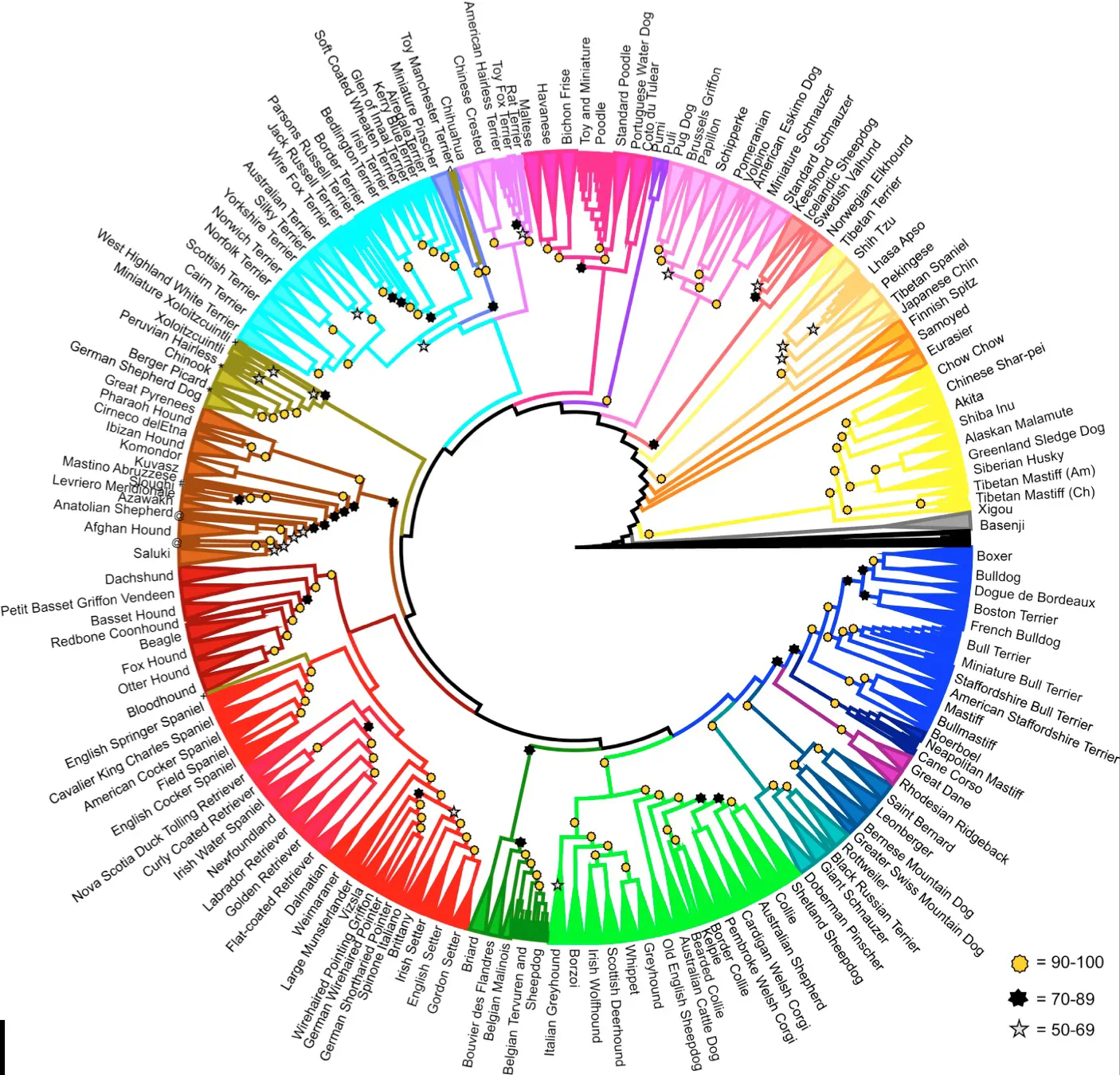
91% of the dog breeds studied and compared were grouped into 23 different genetic clusters. Although genetically distinct, these clades—comprising between 2 and 18 breeds each—include dogs from the same geographic region with similar traits and common ancestors: for example, boxers, bulldogs, and Boston terriers belong to one of these groups, while herding dogs, corgis, and collies are included in another; retrievers, spaniels, and setters in a third; and so on.
The grouping of these different dog breeds, which share common abilities, suggests that thousands of years ago, dog breeding prioritized the selection of specific functions (hunting, guarding, herding, etc.) rather than physical characteristics. More recently, over the past two centuries, these clades have been subdivided into multiple dog breeds, selected based on morphological criteria, and have been extensively crossbred to introduce new physical traits in line with the fashions of the time. Tracking these crossbreeding patterns thus makes it possible to identify the source of mutations across all modern dog breeds.
The study also shows that certain breeds have contributed to the creation of others, as they share DNA from multiple clades. Ultimately, the resulting phylogenetic tree (shown in different colors) traces the relationships among 161 dog breeds that share a common ancestor (indicated by a black line) among the nine current wild species of canids.
There are currently more than 400 breeds of domestic dogs worldwide, each with a unique history and genetic profile. The comprehensive analysis published in *Cell Reports*
sought to unravel the mysteries of the evolution—across time and space—of 161 of these breeds. The comparisons shed light on the origin of these dog breeds, when they emerged, and their paths of diversification.
91% of the dog breeds studied and compared were grouped into 23 different genetic clusters. Although genetically distinct, these clades—comprising between 2 and 18 breeds each—include dogs from the same geographic region with similar traits and common ancestors: for example, boxers, bulldogs, and Boston terriers belong to one of these groups, while herding dogs, corgis, and collies are included in another; retrievers, spaniels, and setters in a third; and so on.
The grouping of these different dog breeds, which share common abilities, suggests that thousands of years ago, dog breeding prioritized the selection of specific functions (hunting, guarding, herding, etc.) rather than physical characteristics. More recently, over the past two centuries, these clades have been subdivided into multiple dog breeds, selected based on morphological criteria, and have been extensively crossbred to introduce new physical traits in line with the fashions of the time. Tracking these crossbreeding patterns thus makes it possible to identify the source of mutations across all modern dog breeds.
The study also shows that certain breeds have contributed to the creation of others, as they share DNA from multiple clades. Ultimately, the resulting phylogenetic tree (shown in different colors) traces the relationships among 161 dog breeds that share a common ancestor (indicated by a black line) among the nine current wild species of canids.
 Practical Applications
These clades should help veterinarians better detect potential genetic problems. For example, until now it was difficult to understand why a hereditary disease known as Collie Eye Anomaly—which affects Collies, Border Collies, Shetland Sheepdogs, and Australian Shepherds—was also observed in the Nova Scotia Duck Tolling Retriever. However, genetic analysis shows that this Canadian breed is descended from the Collie and/or the Shetland Sheepdog, the likely source of the defective gene. Interbreeding between breeds has thus led to the sharing of certain regions of genomics that harbor mutations that cause diseases in pedigree dogs that are very distantly related.
Furthermore, dogs suffer from several diseases that also affect humans (epilepsy, diabetes, kidney disease, cancer, etc.). While the prevalence of these diseases varies greatly—though predictably—among the affected dog breeds, it is more difficult to identify at-risk human populations. By using the data provided by the analysis, it becomes possible to track the migration of alleles for a given disease and predict in which areas they are likely to appear. The dog is thus a major animal model for many conditions
: whenever a pathogenic gene is identified in dogs, it is also found to be significant in humans.
All DNA samples collected by the authors came from dogs whose owners volunteered over the past twenty years. However, more than half of the world’s dog breeds have still not been sequenced, and the researchers intend to continue collecting canine genomes to fill in the gaps. This study is therefore not an endpoint, but a midpoint.
* Heidi G. Parker: “Genomic analyses reveal the influence of geographic origin, migration, and hybridization on modern dog breed development, Cell Reports,” Cell Reports, April 2017, http://www.cell.com/cell-reports/fulltext/S2211-1247(17)30456-4?_returnURL=http%3A%2F%2Flinkinghub.elsevier.com%2Fretrieve%2Fpii%2FS2211124717304564%3Fshowall%3Dtrue
Practical Applications
These clades should help veterinarians better detect potential genetic problems. For example, until now it was difficult to understand why a hereditary disease known as Collie Eye Anomaly—which affects Collies, Border Collies, Shetland Sheepdogs, and Australian Shepherds—was also observed in the Nova Scotia Duck Tolling Retriever. However, genetic analysis shows that this Canadian breed is descended from the Collie and/or the Shetland Sheepdog, the likely source of the defective gene. Interbreeding between breeds has thus led to the sharing of certain regions of genomics that harbor mutations that cause diseases in pedigree dogs that are very distantly related.
Furthermore, dogs suffer from several diseases that also affect humans (epilepsy, diabetes, kidney disease, cancer, etc.). While the prevalence of these diseases varies greatly—though predictably—among the affected dog breeds, it is more difficult to identify at-risk human populations. By using the data provided by the analysis, it becomes possible to track the migration of alleles for a given disease and predict in which areas they are likely to appear. The dog is thus a major animal model for many conditions
: whenever a pathogenic gene is identified in dogs, it is also found to be significant in humans.
All DNA samples collected by the authors came from dogs whose owners volunteered over the past twenty years. However, more than half of the world’s dog breeds have still not been sequenced, and the researchers intend to continue collecting canine genomes to fill in the gaps. This study is therefore not an endpoint, but a midpoint.
* Heidi G. Parker: “Genomic analyses reveal the influence of geographic origin, migration, and hybridization on modern dog breed development, Cell Reports,” Cell Reports, April 2017, http://www.cell.com/cell-reports/fulltext/S2211-1247(17)30456-4?_returnURL=http%3A%2F%2Flinkinghub.elsevier.com%2Fretrieve%2Fpii%2FS2211124717304564%3Fshowall%3Dtrue
Read next
Research & Diagnostics
10/09/2026
WHO sets new diagnostic targets for Echinococcus granulosus in humans, dogs and sheep
Research & Diagnostics
10/09/2026
Nipah virus in wastewater: promising for early warning?
Research & Diagnostics
10/01/2026
Commentaires
No comments yet.
Sign in to comment