

Back to articles
Autism: Having a Pet Is Good for Children and Their Families
V
Vetitude
11/10/2023
7 min read
0 comments
Share:
According to the World Health Organization, one in 100 children is currently diagnosed with an autism spectrum disorder (ASD).
This disorder causes varying degrees of difficulty in communicating and interacting with others. These children struggle to recognize others’ emotions and understand how they feel, as well as to initiate and maintain interactions, engage in conversation, and so on.
They also exhibit behaviors and interests described as “repetitive and/or restricted”: they may become highly skilled in a subject that interests them, prefer that their environment remain unchanged, and engage in repetitive movements such as rocking, flapping their hands, or hopping, etc.
Children with ASD are also often affected by sensory hypersensitivity or hyposensitivity: they may be extremely sensitive and bothered by environmental stimuli, or, conversely, may not react to them at all.
All these difficulties present them with constant challenges, not only in their ability to function and navigate daily life, but also in their ability to form relationships with others. However, a family adopting a pet could improve the situation. Here’s why.
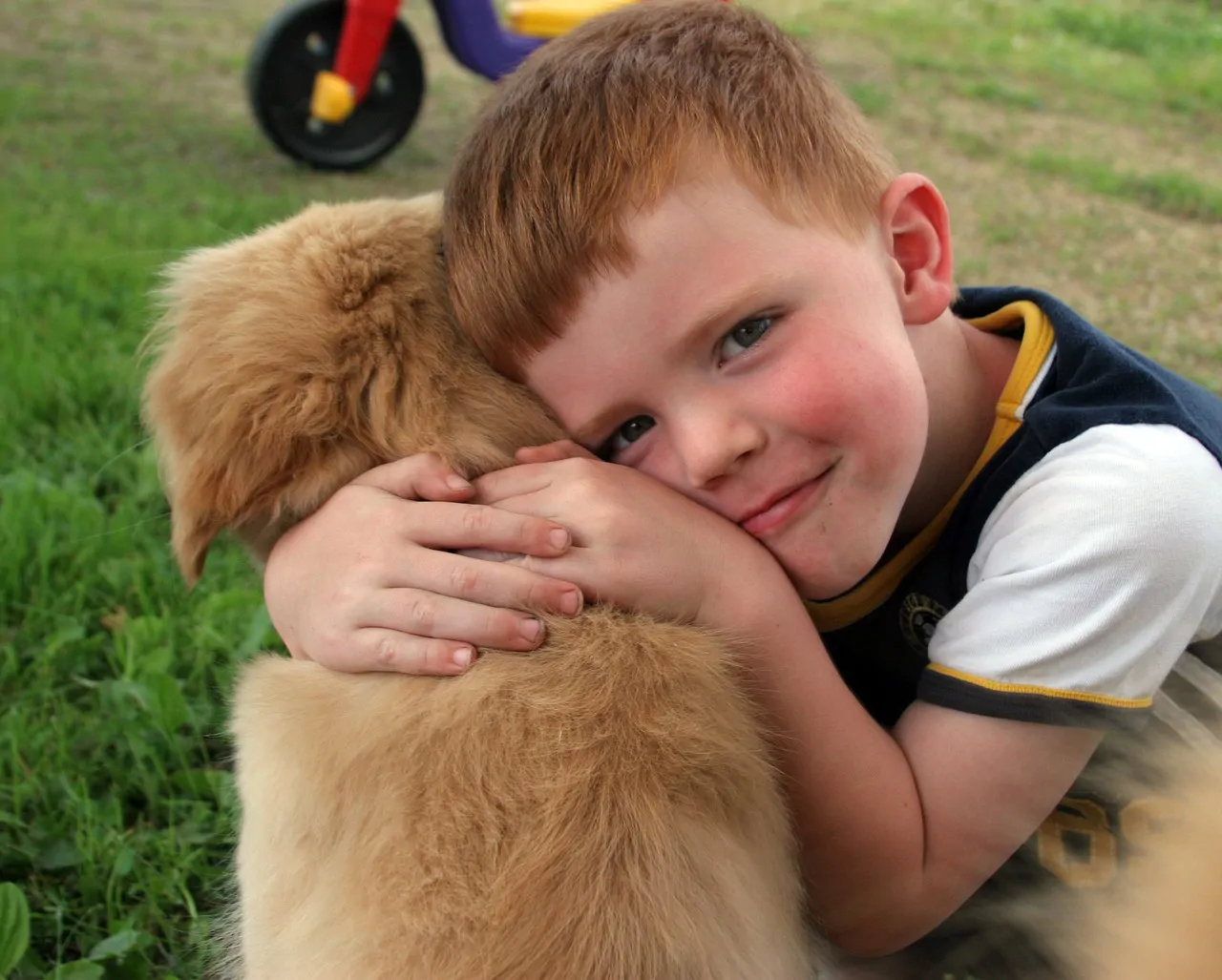 Autism: Having a Pet Is Good for Children and Their Families[/caption]
 Nicolas Dollion
, Associate Professor of Developmental Psychology—researcher at the C2S laboratory (EA 6391), University of Reims Champagne-Ardenne (URCA)
and Marine Grandgeorge
, Ethology, Human-Animal Relationships, animal-assisted intervention, Typical and Atypical Development, University of Rennes 1 – University of Rennes
This article is republished from The Conversation
under a Creative Commons license. Read the original
article.
Nicolas Dollion
, Associate Professor of Developmental Psychology—researcher at the C2S laboratory (EA 6391), University of Reims Champagne-Ardenne (URCA)
and Marine Grandgeorge
, Ethology, Human-Animal Relationships, animal-assisted intervention, Typical and Atypical Development, University of Rennes 1 – University of Rennes
This article is republished from The Conversation
under a Creative Commons license. Read the original
article.
Benefits Recognized for a Long Time
It was in the 1950s that Boris Levinson, an American child psychiatrist, first reported the benefits of having a dog present during the sessions he conducted with a young boy with ASD. Research into the benefits of animals for children with ASD, however, did not begin until the late 1980s. Since then, accumulated knowledge has shown that animals can indeed play a special role for these children. In fact, not only do most children with ASD show a spontaneous attraction to animals, but some of the difficulties they encounter when interacting with humans do not occur when interacting with animals. This is the case, for example, with difficulties in initiating interaction, looking at a person’s face, making eye contact, or recognizing emotions. Incorporating an animal into the daily life of a child with ASD—whether it’s a pet or an assistance dog—can have many positive effects on their development, stemming from the special relationship these children can form with the animal. Studies reveal not only benefits similar to those observed in children without ASD, but also that these benefits may extend beyond them. We can break these down into four main areas: communication and social interactions, well-being, problem behaviors, and judgment and external perceptions.Improved Communication and Social Interaction Skills
First, we must address the benefits in the area of the child’s communication and social interaction skills—an area affected by ASD. Just like any child, growing up with a pet allows a child with ASD to develop alongside a being that serves as a true interactive partner and with whom they can form a meaningful relationship. Research also shows that the presence of a pet can enhance these children’s development. In fact, after a pet joins the family, children with ASD show improvements in communication and language. They are more responsive in their interactions and exhibit more helpful and supportive behaviors toward others. In a study we published in 2022, using an eye-tracking system, we were able to demonstrate that children with ASD who have lived with an assistance dog for several years have better strategies for recognizing emotion when looking at human faces (compared to children with ASD who do not live with an assistance dog). More specifically, this means that they are more likely to look at the mouth to recognize joy and at the eyes to recognize anger.Improved Well-Being
The benefits to the well-being of children with ASD are another important aspect of living with a pet. They can form attachments to their pets, which serve as a source of companionship and comfort, reducing their loneliness and distress. Better yet, research even shows that children with ASD who have a pet not only have a better overall mood but also experience fewer anxiety problems and depressive symptoms. For example, in the weeks following the arrival of an assistance dog in the family, cortisol levels—sometimes called the “stress hormone”—in children with ASD decrease. Having a pet also has a positive impact on these children’s self-confidence and self-esteem. [caption id="attachment_10740" align="alignnone" width="1280"]Reduced Problem Behaviors
ASD is very frequently associated with the expression of “challenging behaviors,” which are behaviors that can be dangerous to the individual or their environment, and/or that interfere with their ability to engage in activities of daily living: outbursts, running away, defiant behaviors, self-stimulatory behaviors, and stereotypic behaviors (such as shaking or flapping the hands, rocking the body, head-banging, biting, hitting certain parts of the body, etc.). The expression of these behaviors is often linked to difficulty coping with a situation—in other words, difficulty understanding it—or to reacting to sensory overload or frustration… It has been shown that the arrival of an animal in the family—particularly an assistance dog—reduces the occurrence of these behaviors. This reduction in problem behaviors also has positive effects on the child’s quality of life.Changes in Others’ Judgments and Perceptions
Because of their atypical behaviors and difficulties adhering to social norms, children with ASD are often judged and excluded. Scientific literature shows that having a pet by a child’s side attracts others to the child and promotes positive social interactions. Furthermore, the distinctive vests or harnesses worn by assistance dogs offer another benefit: they allow those around the child to recognize the invisible disability, which reduces their tendency to judge negatively and encourages kindness toward the child and their atypical behaviors.Benefits for the Entire Family
Beyond these four areas of impact on children with ASD (communication and interactions, well-being, problem behaviors, and external judgment and perceptions), the benefits of having a pet also extend to the rest of the family. In particular, it has been observed that after a pet joins the family , parents experience less anxiety and stress . More generally, the presence of a pet also contributes to better family functioning in households with children with ASD . Despite all these potential benefits, it is important not to view the animal as a “magic pill.” In fact, various studies indicate that these effects depend directly on the attachment and the quality of the relationship that the child with ASD establishes with the animal . However, just as with children without ASD, not all children with ASD are equally drawn to animals, nor do they all develop the same kind of relationship with their pet. The type of interaction that develops, the degree of attachment to the animal, and the child’s ability to care for it independently all vary. Therefore, families of children with ASD who are considering getting a pet should ensure, before taking the plunge, that their child is interested in or wants a pet. It would also be wise to verify that the animal in question is a good fit for their child, both in terms of the animal’s behavior relative to the child’s needs and in terms of personality compatibility. This would maximize the chances of a strong bond forming between the child and the animal, thereby increasing the likelihood of success and the emergence of positive benefits.
Nicolas Dollion
, Associate Professor of Developmental Psychology—researcher at the C2S laboratory (EA 6391), University of Reims Champagne-Ardenne (URCA)
and Marine Grandgeorge
, Ethology, Human-Animal Relationships, animal-assisted intervention, Typical and Atypical Development, University of Rennes 1 – University of Rennes
This article is republished from The Conversation
under a Creative Commons license. Read the original
article.
Read next
Research & Diagnostics
10/09/2026
WHO sets new diagnostic targets for Echinococcus granulosus in humans, dogs and sheep
Research & Diagnostics
10/09/2026
Nipah virus in wastewater: promising for early warning?
Research & Diagnostics
10/01/2026
Commentaires
No comments yet.
Sign in to comment