

Back to articles
Peste des petits ruminants: 70 countries commit to eradicating it by 2030
B
bertrand-neveux
04/03/2015
4 min read
0 comments
Share:
The FAO/WOAH International Conference on Peste des petits ruminants was held in Abidjan (Côte d’Ivoire) from March 31 to April 2, 2015. Its goal: to develop a 15-year global strategy for the control and eradication of the disease. This requires investment in veterinary services, food safety, and poverty reduction.
Peste des petits ruminants causes annual losses estimated at between 1.3 and 1.8 billion euros. In unvaccinated herds, it can kill up to 90% of infected goats and sheep within a few days. This highly contagious viral disease has been spreading for about fifteen years in regions home to some of the world’s poorest populations and is rampant in some 70 countries in Africa, the Middle East, and Asia. There is a risk that it could spread to Europe if it is not brought under control.
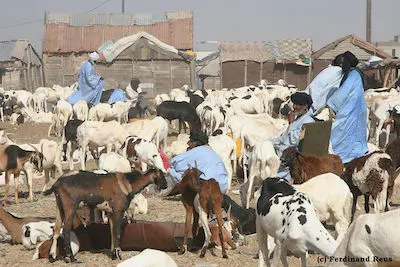 In light of this, the World Organisation for Animal Health (WOAH) and the FAO have decided to jointly manage, through a specific governance mechanism, the resources to be allocated to the eradication of peste des petits ruminants. To this end, the two organizations convened in Côte d’Ivoire—where the peste des petits ruminants virus was first identified in 1942—ministerial delegations from 15 countries and more than 300 participants from every continent. All committed to working together to permanently eliminate this scourge by 2030.
To date, only two diseases have been eradicated worldwide: human smallpox in 1980 and rinderpest in 2011. Now it is the turn of peste des petits ruminants. There are some 2.1 billion goats and sheep worldwide, and 80% live in affected regions. “Livestock farmers are key players in this effort, just as much as veterinary services. We know that without high-quality veterinary services, the number of years needed to successfully eradicate the peste des petits ruminants would likely double. We must therefore take advantage of this joint project to strengthen them worldwide,” emphasized Bernard Vallat, Director General of the WOAH.
In light of this, the World Organisation for Animal Health (WOAH) and the FAO have decided to jointly manage, through a specific governance mechanism, the resources to be allocated to the eradication of peste des petits ruminants. To this end, the two organizations convened in Côte d’Ivoire—where the peste des petits ruminants virus was first identified in 1942—ministerial delegations from 15 countries and more than 300 participants from every continent. All committed to working together to permanently eliminate this scourge by 2030.
To date, only two diseases have been eradicated worldwide: human smallpox in 1980 and rinderpest in 2011. Now it is the turn of peste des petits ruminants. There are some 2.1 billion goats and sheep worldwide, and 80% live in affected regions. “Livestock farmers are key players in this effort, just as much as veterinary services. We know that without high-quality veterinary services, the number of years needed to successfully eradicate the peste des petits ruminants would likely double. We must therefore take advantage of this joint project to strengthen them worldwide,” emphasized Bernard Vallat, Director General of the WOAH.
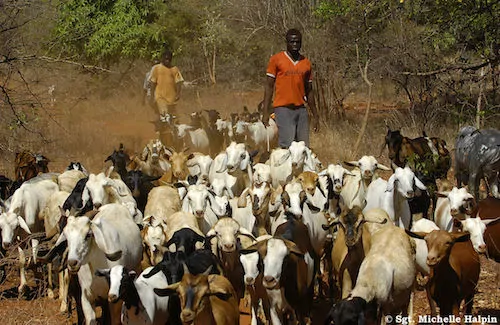 The international control plan developed by the WOAH and the FAO is estimated to cost between 3.6 and 6.4 billion euros over fifteen years. The campaign’s success depends on the political will of countries to provide adequate and well-coordinated financial and human resources, along with a genuine commitment from national authorities, effective involvement of veterinary services, and the cooperation of poor populations in rural areas. “The technical tools needed to achieve eradication are already available. An inexpensive and reliable vaccine exists, as do simple diagnostic tests, for a virus whose infectious phase is relatively short and which does not survive long outside its hosts,” emphasizes Bernard Vallat. “We have the control plan, the tools, the scientific basis, and the partners,” adds José Graziano da Silva, Director-General of the FAO. “The eradication of peste des petits ruminants is not only within our reach, but depends on us. ”
The plan to defeat the peste des petits ruminants consists of four stages:
The international control plan developed by the WOAH and the FAO is estimated to cost between 3.6 and 6.4 billion euros over fifteen years. The campaign’s success depends on the political will of countries to provide adequate and well-coordinated financial and human resources, along with a genuine commitment from national authorities, effective involvement of veterinary services, and the cooperation of poor populations in rural areas. “The technical tools needed to achieve eradication are already available. An inexpensive and reliable vaccine exists, as do simple diagnostic tests, for a virus whose infectious phase is relatively short and which does not survive long outside its hosts,” emphasizes Bernard Vallat. “We have the control plan, the tools, the scientific basis, and the partners,” adds José Graziano da Silva, Director-General of the FAO. “The eradication of peste des petits ruminants is not only within our reach, but depends on us. ”
The plan to defeat the peste des petits ruminants consists of four stages:
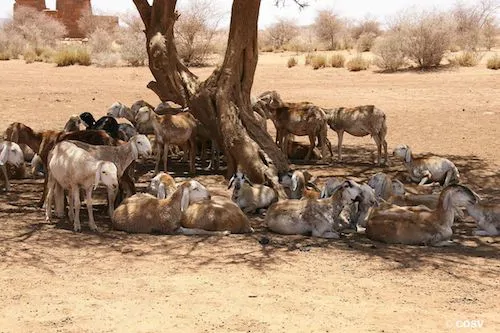
- the assessment phase (counting and locating herds, as well as risk areas), which is expected to last one to three years and encourage voluntary vaccination;
- risk control and management, lasting two to five years, with systematic vaccination;
- final eradication, over two to five years (no cases reported for at least 24 months), and mandatory vaccination;
- the post-eradication phase, lasting one to three years, to achieve disease-free status (no occurrence of the virus or disease without vaccination over a 24-month period).
Read next
Outbreaks & Epidemiology
10/07/2026
H5N1 should now be treated as a permanent systemic risk, not a succession of outbreaks
Outbreaks & Epidemiology
10/07/2026
African swine fever progresses faster in wild boar than in domestic pigs
Outbreaks & Epidemiology
10/05/2026
Commentaires
No comments yet.
Sign in to comment