

Back to articles
Outbreaks & Epidemiology
Animal Transport
ANSES
Arthropod
Breeder
Cattle
Cow
DGAL
Eid al-Adha
Enzootic
Epizootic
Goatpox
Loïc Evain
Lumpy skin disease
Marketing authorisation
Poxvirus
Ruminant Pox
Sheep scab
Slaughter
Vaccine
Veal
Veterinarian
Veterinary services
Lumpy Skin Disease: The Rapid Spread of the Infection Among Cattle in Europe Is a Cause for Concern
V
Vetitude
08/24/2016
4 min read
0 comments
Share:
First detected in Turkey in late 2013, lumpy skin disease subsequently spread to Europe in 2015. With 747 outbreaks reported as of July 31, 2016, this enzootic viral disease currently affects Greece, Bulgaria, Macedonia, Montenegro, Albania, and Serbia. The epidemiological* situation requires all EU member states to be on alert and remain vigilant. To prevent the virus from reaching France, the Direction générale de l'alimentation (DGAL) issued recommendations** on August 11. The disease, which currently affects cattle, is one of the ruminant pox diseases, such as sheep pox or goat pox.
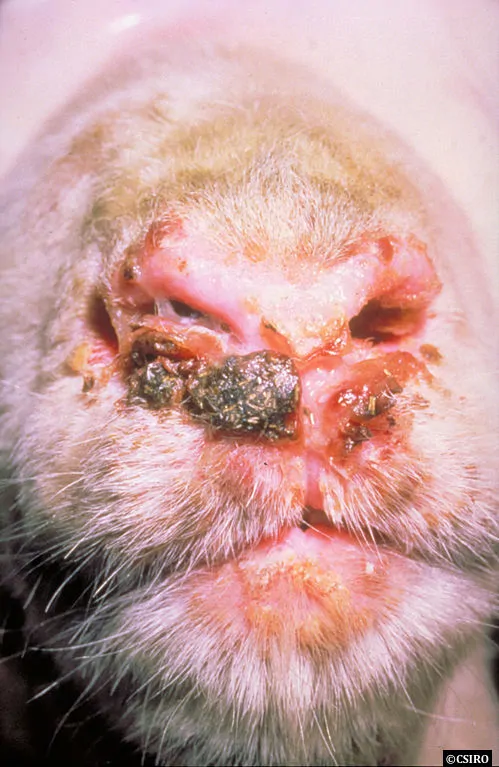 The spread of the contagious bovine lumpy skin disease outbreak in southeastern Europe has been under surveillance for over a year. The virus continues to spread rapidly, with a sharp increase in incidence, despite the control measures implemented in the affected countries: restrictions on animal movements, destruction of products of animal origin from affected farms, insect control, total or partial culling of infected herds, sanitary slaughter or partial culling of infected herds, vaccination campaigns for livestock, etc. Around the infection hotspots, in accordance with EU directives, protection zones (3 km), surveillance zones (10 km), and restricted areas (50 km) have also been established.
Neighboring Balkan countries, such as Romania, are on alert and are preparing for the disease’s arrival on their territory through
preventive measures. At the European level, a strengthening of health surveillance and control measures is being considered, particularly through vaccination.
In particular, the issue of preventive vaccination is being raised. No vaccine against contagious bovine lumpy skin disease has been granted a marketing authorisation (MA) in the European Union, but the Commission authorizes Member States to temporarily use vaccines without a European MA in the event of a serious epizootic disease, which is currently the case.
With peak viral activity observed in the summer (August and September) and at its lowest in the winter and early spring (January through March), the hypothesis that the bovine poxvirus is transmitted by arthropods is considered most likely, although other routes of transmission—whether direct (e.g., between an infected cow and its calf) or indirect (survival in the environment)—are also possible. The disease is characterized by the sudden appearance of hard skin nodules, varying in number and size, located on the head, neck, limbs, flanks, udder, scrotum, perineum, and on internal mucous membranes. These lesions are accompanied by conjunctivitis and keratitis, which can progress to blindness, as well as extensive subcutaneous edema on the limbs, lumbar region, dewlap, and genitalia. This edema may be complicated by deep, suppurating ulcerative lesions. Death is common, often due to respiratory, digestive, and septic complications.
This first outbreak of lumpy skin disease in Europe, given its relatively rapid spread and scale, requires heightened vigilance to closely monitor the spread of the epizootic disease. It is also necessary to characterize the viral strain involved in order to study the history of viral strain circulation in the affected regions. In this context, the DGAL has consulted the French Agency for Food, Environmental and Occupational Health & Safety (ANSES) to assess the risk level of the disease emerging in France, with the goal of establishing a vaccination strategy should the virus not be detected until one month after viral circulation has begun.
This is because the disease is partly asymptomatic. ANSES’s opinion is expected by the end of the year.
The DGAL has already deployed a surveillance system dedicated to lumpy skin disease throughout the country. A monitoring group has been formed to implement this system, with the goal of achieving early detection of the introduction of the disease into France. On August 11, the DGAL also issued a directive intended to inform veterinarians, livestock farmers, as well as commercial operators and live animal transporters.
Another directive, intended for veterinary services, is currently being drafted. Finally, an awareness campaign targeting veterinarians and livestock farmers will be launched this fall.
Loïc Evain, Deputy Director General for Food, is also calling for the utmost vigilance in light of the arrival in France of sheep for the Eid al-Adha holiday, scheduled for September 12. Although small ruminants are rarely affected, they can serve as passive vectors of the virus, as can animal transport vehicles and equipment. In cases of clinical suspicion, the DNCB national reference laboratory has developed specific diagnostic tools (quantitative pan-Capripoxvirus PCR and quantitative DNCB PCR).
* http://bulletinepidemiologique.mag.anses.fr/sites/default/files/M-075%2016%2008%2001%20DNC_Pub%20Ant.pdf
** DGAL Technical Instruction of August 5, 2016, published on August 11, 2016, in the Official Bulletin of the Ministry of Agriculture, https://info.agriculture.gouv.fr/gedei/site/bo-agri/instruction-2016-654
The spread of the contagious bovine lumpy skin disease outbreak in southeastern Europe has been under surveillance for over a year. The virus continues to spread rapidly, with a sharp increase in incidence, despite the control measures implemented in the affected countries: restrictions on animal movements, destruction of products of animal origin from affected farms, insect control, total or partial culling of infected herds, sanitary slaughter or partial culling of infected herds, vaccination campaigns for livestock, etc. Around the infection hotspots, in accordance with EU directives, protection zones (3 km), surveillance zones (10 km), and restricted areas (50 km) have also been established.
Neighboring Balkan countries, such as Romania, are on alert and are preparing for the disease’s arrival on their territory through
preventive measures. At the European level, a strengthening of health surveillance and control measures is being considered, particularly through vaccination.
In particular, the issue of preventive vaccination is being raised. No vaccine against contagious bovine lumpy skin disease has been granted a marketing authorisation (MA) in the European Union, but the Commission authorizes Member States to temporarily use vaccines without a European MA in the event of a serious epizootic disease, which is currently the case.
With peak viral activity observed in the summer (August and September) and at its lowest in the winter and early spring (January through March), the hypothesis that the bovine poxvirus is transmitted by arthropods is considered most likely, although other routes of transmission—whether direct (e.g., between an infected cow and its calf) or indirect (survival in the environment)—are also possible. The disease is characterized by the sudden appearance of hard skin nodules, varying in number and size, located on the head, neck, limbs, flanks, udder, scrotum, perineum, and on internal mucous membranes. These lesions are accompanied by conjunctivitis and keratitis, which can progress to blindness, as well as extensive subcutaneous edema on the limbs, lumbar region, dewlap, and genitalia. This edema may be complicated by deep, suppurating ulcerative lesions. Death is common, often due to respiratory, digestive, and septic complications.
This first outbreak of lumpy skin disease in Europe, given its relatively rapid spread and scale, requires heightened vigilance to closely monitor the spread of the epizootic disease. It is also necessary to characterize the viral strain involved in order to study the history of viral strain circulation in the affected regions. In this context, the DGAL has consulted the French Agency for Food, Environmental and Occupational Health & Safety (ANSES) to assess the risk level of the disease emerging in France, with the goal of establishing a vaccination strategy should the virus not be detected until one month after viral circulation has begun.
This is because the disease is partly asymptomatic. ANSES’s opinion is expected by the end of the year.
The DGAL has already deployed a surveillance system dedicated to lumpy skin disease throughout the country. A monitoring group has been formed to implement this system, with the goal of achieving early detection of the introduction of the disease into France. On August 11, the DGAL also issued a directive intended to inform veterinarians, livestock farmers, as well as commercial operators and live animal transporters.
Another directive, intended for veterinary services, is currently being drafted. Finally, an awareness campaign targeting veterinarians and livestock farmers will be launched this fall.
Loïc Evain, Deputy Director General for Food, is also calling for the utmost vigilance in light of the arrival in France of sheep for the Eid al-Adha holiday, scheduled for September 12. Although small ruminants are rarely affected, they can serve as passive vectors of the virus, as can animal transport vehicles and equipment. In cases of clinical suspicion, the DNCB national reference laboratory has developed specific diagnostic tools (quantitative pan-Capripoxvirus PCR and quantitative DNCB PCR).
* http://bulletinepidemiologique.mag.anses.fr/sites/default/files/M-075%2016%2008%2001%20DNC_Pub%20Ant.pdf
** DGAL Technical Instruction of August 5, 2016, published on August 11, 2016, in the Official Bulletin of the Ministry of Agriculture, https://info.agriculture.gouv.fr/gedei/site/bo-agri/instruction-2016-654
Read next
Outbreaks & Epidemiology
10/07/2026
H5N1 should now be treated as a permanent systemic risk, not a succession of outbreaks
Outbreaks & Epidemiology
10/07/2026
African swine fever progresses faster in wild boar than in domestic pigs
Outbreaks & Epidemiology
10/05/2026
Commentaires
No comments yet.
Sign in to comment