

Back to articles
Outbreaks & Epidemiology
Animal health
Bluetongue
Cattle
Epidemiological Surveillance
Head of Veterinary Services
Serotype 4
Serotype 8
Sheep
Vaccination
WOAH
World Organisation for Animal Health
Bluetongue (BT): Serotype 4 has appeared in Italy; serotype 8 is still circulating in France
V
Vetitude
09/13/2016
3 min read
0 comments
Share:
On September 8, Italian veterinary services reported eight outbreaks of bluetongue (serotype 4) in the Veneto region, in the northeastern part of the country. According to the report submitted to the World Organisation for Animal Health (WOAH), the first outbreak, detected on August 30, 2016, was followed by seven others, affecting a total of 658 sheep (as of September 7). Measures restricting domestic movement, establishing zones, and conducting screening have been implemented. In France, 18 new outbreaks of bluetongue serotype 8, involving 26 infected cattle, were confirmed between mid-August and September 12.
 In the first outbreak in Italy, three ewes from a herd of 500 grazing sheep tested positive via polymerase chain reaction
(PCR) on September 1. In the days that followed, seven new outbreaks were detected, involving 12 sheep out of a total of 158 animals spread across small farms with 3 to 45 sheep. In the most recent reported outbreak, on September 7, the two affected sheep died from the disease.
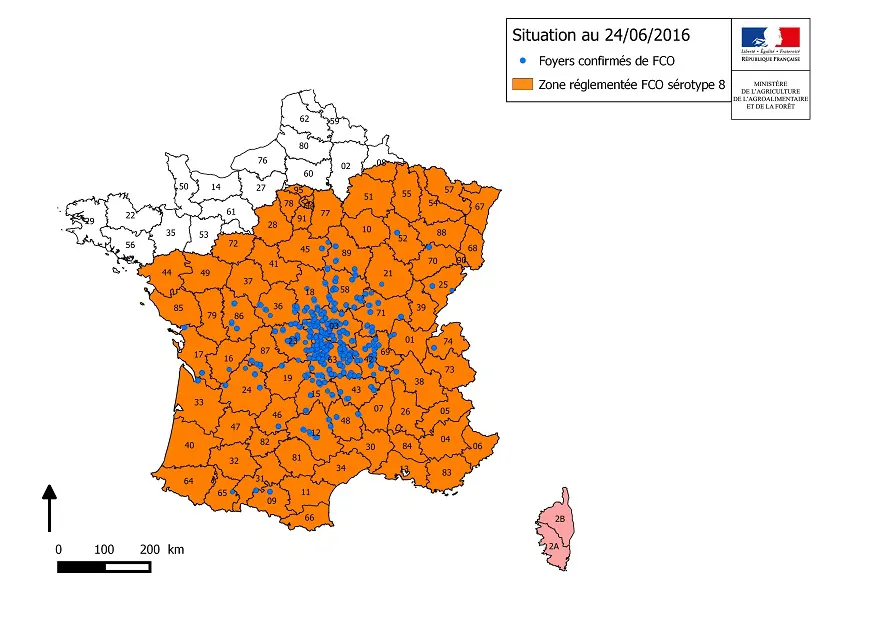
In France, despite the implementation of vaccination* against bluetongue serotype 8—which, as of September 12, had certified 331 vaccinated farms across 12 departments*— the virus was first isolated in mid-August by the national reference laboratory in Maisons-Alfort from the blood of a cow sampled in Tarn-et-Garonne but originating from a herd in Saône-et-Loire. The animal had tested positive by PCR as part of pre-export testing. This result confirms the persistence and resurgence of bluetongue virus circulation in France, as was to be expected following the lull caused by vector inactivity. According to the Animal Health Epidemiological Surveillance Platform, between August 15 and 31, 2016, the virus was isolated by the National Reference Laboratory (LNR) in six cattle that tested positive and had high viral loads. They came from several departments that were already infected by the end of 2015, such as Creuse, Loire, Saône-et-Loire, Puy-de-Dôme, and Haute-Loire.
Since then, between August 29 and September 12, 18 new outbreaks of bluetongue, involving 26 infected cattle, have been confirmed within the affected area (1 in Allier, 6 in Loire, 3 in Haute-Loire, 3 in Puy-de-Dôme, and 4 in Saône-et-Loire) and in Doubs (1 outbreak). All of these outbreaks were detected following tests conducted prior to animals leaving the restricted zone.
Throughout the summer, from May to September 2016, the national entomological surveillance network remained in place, albeit in a scaled-back form (13 departments monitored instead of the 49 covered by the zoning, with monthly trapping), before a likely reinstatement in the fall of a reinforced surveillance system for the winter of 2016–2017.
As of September 12, 2016, a total of 317 cases of bluetongue had been recorded in central France, including 65 cases in Allier, 98 in Puy-de-Dôme, 15 in Creuse, 9 in Cher, 13 in Saône-et-Loire, 20 in Nièvre, 19 in Loire, 6 in Indre, 10 in Cantal, 6 in Aveyron, 8 in Haute-Loire, 2 in the Loiret, 4 in Lozère, 3 in Corrèze, 4 in the Yonne, 1 in Isère, 4 in the Dordogne, 3 in Haute-Vienne, 4 in the Rhône, 1 in Lot, 3 in Vienne, 1 in Charente, 2 in Charente-Maritime, 1 in Gironde, 3 in Ariège, 1 in Haute-Savoie, 1 in Doubs, 2 in Haute-Saône, 1 in Haute-Marne, 2 in Ain, 1 in Côte-d’Or, 1 in Hautes-Pyrénées, and 1 in Haute-Garonne.
* ftp://ftp.agriculture.gouv.fr//Listes_etablissements_SPA_autres/Identification/Exploitation_vaccinee_FCO.pdf
In the first outbreak in Italy, three ewes from a herd of 500 grazing sheep tested positive via polymerase chain reaction
(PCR) on September 1. In the days that followed, seven new outbreaks were detected, involving 12 sheep out of a total of 158 animals spread across small farms with 3 to 45 sheep. In the most recent reported outbreak, on September 7, the two affected sheep died from the disease.
In France, despite the implementation of vaccination* against bluetongue serotype 8—which, as of September 12, had certified 331 vaccinated farms across 12 departments*— the virus was first isolated in mid-August by the national reference laboratory in Maisons-Alfort from the blood of a cow sampled in Tarn-et-Garonne but originating from a herd in Saône-et-Loire. The animal had tested positive by PCR as part of pre-export testing. This result confirms the persistence and resurgence of bluetongue virus circulation in France, as was to be expected following the lull caused by vector inactivity. According to the Animal Health Epidemiological Surveillance Platform, between August 15 and 31, 2016, the virus was isolated by the National Reference Laboratory (LNR) in six cattle that tested positive and had high viral loads. They came from several departments that were already infected by the end of 2015, such as Creuse, Loire, Saône-et-Loire, Puy-de-Dôme, and Haute-Loire.
Since then, between August 29 and September 12, 18 new outbreaks of bluetongue, involving 26 infected cattle, have been confirmed within the affected area (1 in Allier, 6 in Loire, 3 in Haute-Loire, 3 in Puy-de-Dôme, and 4 in Saône-et-Loire) and in Doubs (1 outbreak). All of these outbreaks were detected following tests conducted prior to animals leaving the restricted zone.
Throughout the summer, from May to September 2016, the national entomological surveillance network remained in place, albeit in a scaled-back form (13 departments monitored instead of the 49 covered by the zoning, with monthly trapping), before a likely reinstatement in the fall of a reinforced surveillance system for the winter of 2016–2017.
As of September 12, 2016, a total of 317 cases of bluetongue had been recorded in central France, including 65 cases in Allier, 98 in Puy-de-Dôme, 15 in Creuse, 9 in Cher, 13 in Saône-et-Loire, 20 in Nièvre, 19 in Loire, 6 in Indre, 10 in Cantal, 6 in Aveyron, 8 in Haute-Loire, 2 in the Loiret, 4 in Lozère, 3 in Corrèze, 4 in the Yonne, 1 in Isère, 4 in the Dordogne, 3 in Haute-Vienne, 4 in the Rhône, 1 in Lot, 3 in Vienne, 1 in Charente, 2 in Charente-Maritime, 1 in Gironde, 3 in Ariège, 1 in Haute-Savoie, 1 in Doubs, 2 in Haute-Saône, 1 in Haute-Marne, 2 in Ain, 1 in Côte-d’Or, 1 in Hautes-Pyrénées, and 1 in Haute-Garonne.
* ftp://ftp.agriculture.gouv.fr//Listes_etablissements_SPA_autres/Identification/Exploitation_vaccinee_FCO.pdf
Read next
Outbreaks & Epidemiology
10/07/2026
H5N1 should now be treated as a permanent systemic risk, not a succession of outbreaks
Outbreaks & Epidemiology
10/07/2026
African swine fever progresses faster in wild boar than in domestic pigs
Outbreaks & Epidemiology
10/05/2026
Commentaires
No comments yet.
Sign in to comment