

Back to articles
Avian influenza: A new subtype may facilitate airborne transmission of the H3N8 influenza virus to mammals
BN
Bertrand Neveux
09/06/2023
2 min read
0 comments
Share:
Researchers at the University of Nottingham have discovered a subtype of the H3N8 avian influenza virus—which is endemic in poultry farms in China—that has undergone enough genetic mutations to significantly increase the risk of the disease spreading among mammals.
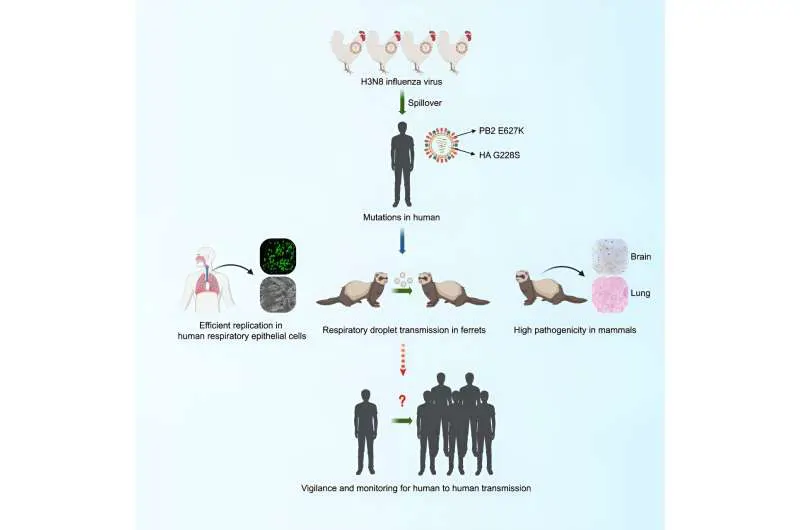
The study focused on a human-derived H3N8 virus, an isolate of which caused a severe form of the disease in mice and ferrets. It was found to be capable of adaptive changes that not only increased the severity of the infection in these two species but also allowed it to be transmitted between animals via the airborne route.
H3N8 infection in humans is known to cause acute respiratory distress syndrome, which can be fatal. The new study has provided a better understanding of the modes of infection and disease progression, as well as its zoonotic characteristics. It appears that the H3N8 virus, which causes severe pneumonia, replicates efficiently in human respiratory epithelial cells. Furthermore, the efficiency of airborne transmission of a human H3N8 isolate among ferrets via respiratory secretions has been demonstrated.
What concerns researchers the most is that H3N8 has acquired a preferential affinity for human receptors and the PB2-E627K mutation necessary for airborne transmission—a major factor in the adaptation of avian influenza viruses to mammals. The human population, even if vaccinated against the H3N2 virus, would be immunologically naive to emerging H3N8 viruses adapted to mammals. This therefore significantly increases the risk of infection and the resulting epidemic—or even pandemic—consequences.
Mutations in H3N8 viruses are therefore being monitored very closely to assess their adaptability and transmissibility not only within the same species but also between species.
HPAI: What are the effects of highly pathogenic avian influenza on canids?
https://vetitude.fr/iahp-effets-de-influenza-aviaire-hautement-pathogene-sur-canides/Influenza A: Transmission of the H1N1 influenza virus between pigs and farmers has been confirmed
https://vetitude.fr/influenza-a-la-transmission-du-virus-h1n1-entre-porcs-et-agriculteurs-est-averee/Read next
Outbreaks & Epidemiology
10/07/2026
H5N1 should now be treated as a permanent systemic risk, not a succession of outbreaks
Outbreaks & Epidemiology
10/07/2026
African swine fever progresses faster in wild boar than in domestic pigs
Outbreaks & Epidemiology
10/05/2026
Commentaires
No comments yet.
Sign in to comment