

Back to articles
One Health & Zoonoses
Animal disease
Animal health
Animal Reservoirs
Bats
Biodiversity
Carnivore
Ebola
Epidemic
Insectivore
Lyme disease
Mammal
Pets
Plague
Rabies
Rodent
SARS
Wild Mammals
Wild ungulates
Zika
Zoonosis
Zoonotic disease
Zoonotic pathogens
Zoonoses: Predicting Future Outbreaks Through Global Modeling in Mammals
V
Vetitude
06/21/2016
4 min read
0 comments
Share:
A team of researchers from the Cary Institute of Ecosystem Studies and the University of Georgia (United States) used real-time medical databases to map the geographic ranges, distribution, and intensity of zoonotic diseases transmitted by mammals around the world. According to these new maps and the research published in *Trends in Parasitology*, it appears that global epidemic hotspots are not where we expected them to be. Predicting epidemics—whether caused by new pathogens or by known pathogens in new regions—is one of the greatest scientific challenges today. The goal is to anticipate these risks in order to adopt a preventive approach.
[caption id="attachment_7265" align="alignright" width="692"]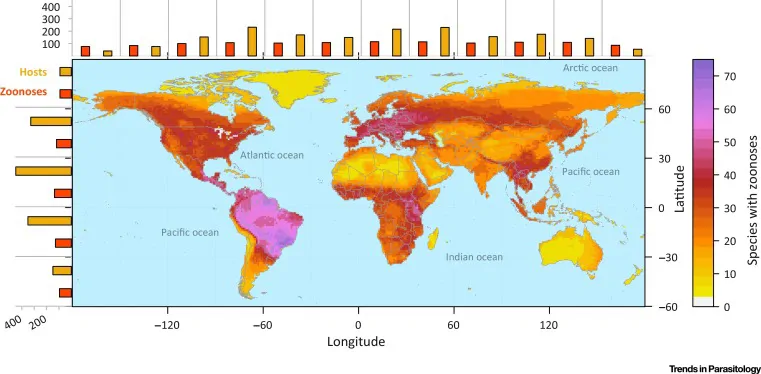 Geographic distribution of zoonotic mammalian hosts. Mammalian reservoirs of zoonotic diseases are distributed globally, with concentrations in the Amazon and Eurasia.[/caption]
Zoonotic diseases have always existed. Today, nearly a thousand zoonoses pose a risk to humans, most of which are viral—such as Ebola, Zika, and SARS—or bacterial—such as Lyme disease, rabies, and the plague. However, despite the fact that most human pathogens are of animal origin and that the majority of emerging diseases originate in mammals, knowledge remains limited
regarding their geographic distribution in relation to animal reservoirs and human populations, as well as their ways of spreading. A better understanding of the global distribution of zoonotic agents and their hosts—wild terrestrial mammals—could help predict future areas where zoonoses might emerge. American researchers therefore examined the types of available data that could serve as the basis for these predictive models.
Surprisingly, the distribution of zoonoses does not correspond to that of areas with high biodiversity
. For example, while there is a great diversity of animal species in tropical regions, one might expect to find more parasites and zoonotic agents there as well. However, while there is indeed a greater abundance of potential vectors in the tropics, zoonotic diseases are primarily concentrated in temperate regions.
This new mapping also illustrates the consequences of conflicts between humans and wild animals, as well as the impacts of intensive agriculture. Not surprisingly, diseases transmitted by wild animals are more common in areas with high biodiversity. In contrast, zoonoses transmitted by domestic animals are strongly linked to human population density, rather than species richness.
Curiously, diseases transmitted by rodents spread in regions with low mammal density.
Geographic distribution of zoonotic mammalian hosts. Mammalian reservoirs of zoonotic diseases are distributed globally, with concentrations in the Amazon and Eurasia.[/caption]
Zoonotic diseases have always existed. Today, nearly a thousand zoonoses pose a risk to humans, most of which are viral—such as Ebola, Zika, and SARS—or bacterial—such as Lyme disease, rabies, and the plague. However, despite the fact that most human pathogens are of animal origin and that the majority of emerging diseases originate in mammals, knowledge remains limited
regarding their geographic distribution in relation to animal reservoirs and human populations, as well as their ways of spreading. A better understanding of the global distribution of zoonotic agents and their hosts—wild terrestrial mammals—could help predict future areas where zoonoses might emerge. American researchers therefore examined the types of available data that could serve as the basis for these predictive models.
Surprisingly, the distribution of zoonoses does not correspond to that of areas with high biodiversity
. For example, while there is a great diversity of animal species in tropical regions, one might expect to find more parasites and zoonotic agents there as well. However, while there is indeed a greater abundance of potential vectors in the tropics, zoonotic diseases are primarily concentrated in temperate regions.
This new mapping also illustrates the consequences of conflicts between humans and wild animals, as well as the impacts of intensive agriculture. Not surprisingly, diseases transmitted by wild animals are more common in areas with high biodiversity. In contrast, zoonoses transmitted by domestic animals are strongly linked to human population density, rather than species richness.
Curiously, diseases transmitted by rodents spread in regions with low mammal density.
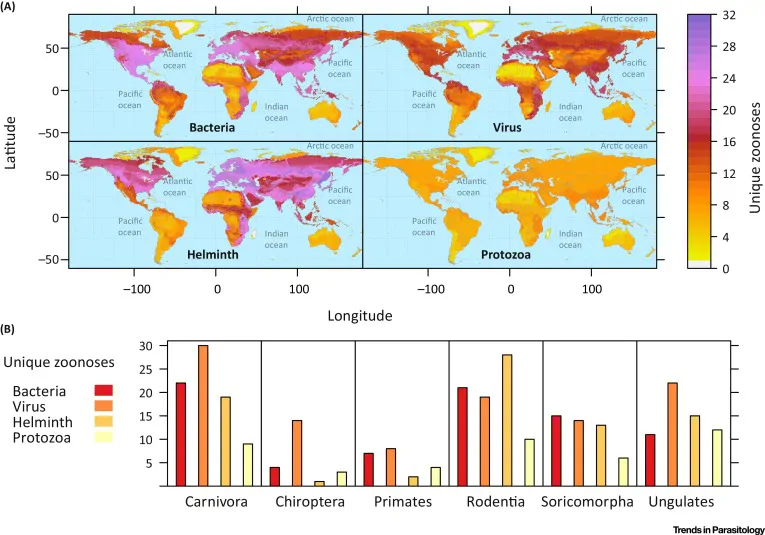 The study also profiles animal vectors in relation to their spatial distribution. While zoonotic agents are geographically widespread, they are unevenly distributed among the different orders of mammals. Rodents top the list, with approximately 10.7% serving as zoonotic hosts (244 species out of 2,220, acting as reservoirs for 85 zoonoses). By comparison, bats harbor far fewer zoonotic agents: 108 species out of 1,100 are hosts for only 27 zoonoses (approximately 9.8%). Among insectivorous mammals, shrews and moles show relatively low zoonotic potential, with about 4% of hosts (19 out of 426 species) carrying 19 zoonoses. Carnivores, with about 49% of host species (139 out of 285), exhibit high zoonotic potential, similar to rodents, and harbor one or more of the 83 identified zoonotic agents. Among wild ungulates, nearly 32% of species (73 out of 247) are zoonotic hosts for 68 zoonoses. Finally, 21% of primate species (77 out of 365) harbor zoonotic agents for at least one of the 63 zoonoses they can transmit. The maps produced show that the global distribution of zoonoses is not closely correlated with that of their host species
.
Ultimately, quantifying, combining, and mapping the various factors underlying zoonoses is a crucial step in determining from which wildlife reservoirs and types of pathogens new human diseases will emerge. Assessing the risk of these zoonoses emerging requires analyzing the current geographic and taxonomic distributions of their hosts. Based on this empirical data, modeling and comparing diseases can help improve predictions regarding the risk of zoonoses in humans via
wild mammals. These comparisons can also reveal geographic regions with low potential for zoonotic diseases, which, by contrast, will help identify the sources and triggers of latent diseases.
* http://www.cell.com/trends/parasitology/fulltext/S1471-4922(16)30010-1
The study also profiles animal vectors in relation to their spatial distribution. While zoonotic agents are geographically widespread, they are unevenly distributed among the different orders of mammals. Rodents top the list, with approximately 10.7% serving as zoonotic hosts (244 species out of 2,220, acting as reservoirs for 85 zoonoses). By comparison, bats harbor far fewer zoonotic agents: 108 species out of 1,100 are hosts for only 27 zoonoses (approximately 9.8%). Among insectivorous mammals, shrews and moles show relatively low zoonotic potential, with about 4% of hosts (19 out of 426 species) carrying 19 zoonoses. Carnivores, with about 49% of host species (139 out of 285), exhibit high zoonotic potential, similar to rodents, and harbor one or more of the 83 identified zoonotic agents. Among wild ungulates, nearly 32% of species (73 out of 247) are zoonotic hosts for 68 zoonoses. Finally, 21% of primate species (77 out of 365) harbor zoonotic agents for at least one of the 63 zoonoses they can transmit. The maps produced show that the global distribution of zoonoses is not closely correlated with that of their host species
.
Ultimately, quantifying, combining, and mapping the various factors underlying zoonoses is a crucial step in determining from which wildlife reservoirs and types of pathogens new human diseases will emerge. Assessing the risk of these zoonoses emerging requires analyzing the current geographic and taxonomic distributions of their hosts. Based on this empirical data, modeling and comparing diseases can help improve predictions regarding the risk of zoonoses in humans via
wild mammals. These comparisons can also reveal geographic regions with low potential for zoonotic diseases, which, by contrast, will help identify the sources and triggers of latent diseases.
* http://www.cell.com/trends/parasitology/fulltext/S1471-4922(16)30010-1
Read next
One Health & Zoonoses
10/10/2026
More than half of New York City’s free-roaming cats carry intestinal parasites?
One Health & Zoonoses
10/09/2026
Giardia in cats: large North American study finds 6.3% prevalence and substantial zoonotic potential
One Health & Zoonoses
10/08/2026
Commentaires
No comments yet.
Sign in to comment