

Back to articles
One Health & Zoonoses
Animal
Animal-assisted therapy
Canine
Canines and Childhood Cancer
CCC
Child with cancer
Childhood Cancer
Dog
Dog breed
Dog breeding
Oncology
Pedigree dog
Therapy dog
Zoetis
Therapy Dogs: Proven Benefits for Children with Cancer
V
Vetitude
10/28/2015
4 min read
0 comments
Share:
Many hospitals that have opened their oncology departments to dogs report that patients benefit from this animal-assisted therapy. However, until now, few scientifically based studies have supported this positive impact. A recent American study*, conducted in five hospitals across the United States, presents the first evidence-based data on the therapeutic benefits of such programs for children with cancer and their families, highlighting the calming effect of dogs.
The study shows that the mere presence of an animal—playing with it or simply petting it—reduces stress, increases physical activity, alleviates depression and anxiety, calms and motivates hospitalized patients, and helps normalize anxiety-inducing situations. As part of animal-assisted therapy, dogs are thus an integral part of the treatment of human patients. The goal of the hospitals that host them is to improve patients’ social, emotional, and mental well-being, as well as their overall quality of life.
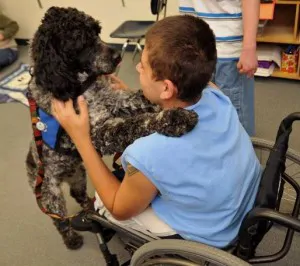 The new study is part of the Canines and Childhood Cancer (CCC) research project managed by the American Humane Association and funded by Zoetis. To assess the effects of animal-assisted therapy on children with cancer, their families, and the assistance dogs involved, several parameters are measured. Blood pressure, heart rate, and anxiety levels are measured in the young patients before and after each weekly visit from the therapy dog. During these visits, the children pet, brush, or talk to the dog, watch it perform tricks and obey commands, look at photos of the animal, and learn about different dog breeds.
Preliminary results show greater blood pressure stability throughout all sessions in the groups where therapy dogs were present, compared to the control group that did not receive these visits. The researchers also observed a higher rate of heart rate variability among patients in the control group than among those who interacted with the dogs. According to the researchers, dogs have a calming effect not only on sick children but also on their families.
Thus, the parents of children in the control group showed a roller-coaster-like fluctuation in anxiety levels, while those in the treatment group exhibited more stable levels and even a slight decrease toward the end of their participation in the study.
To date, the project has included 68 children with cancer, aged 3 to 17. Of these, 39 were assigned to the treatment group and 29 to the control group. The plan is to include roughly the same number of children by the end of the study in 2016. Overall, the children in both groups experienced a decrease in anxiety during their participation in the study.
The researchers are also studying the effect of these visits on the dogs themselves, observing their temperament and behavior during the sessions. This study thus represents an important step toward understanding the vital bond between humans and animals and the benefits it provides. They hope that the final conclusions of their work will lead to increased use of therapy dogs, improved training and handling, and ultimately better outcomes for children and families facing the challenges of childhood cancer.
This new study echoes another, published this year, conducted by Israeli researchers. They demonstrate that therapy dogs improve the emotional well-being of adult cancer patients undergoing complex treatments. Some of these patients, hospitalized in New York, even stated that they would have stopped their treatment early if it weren’t for the presence of a therapy dog.
In the United States, approximately 1 in 285 children is diagnosed with cancer before the age of 20. Survival rates have increased dramatically over the past few decades. As a result, the number of children who die within five years of diagnosis has fallen by more than half between 1975–1977 and 2007–2010. However, this improvement has not been accompanied by solutions to enhance the quality of life for these young patients and their families. This is where therapy animals come in.
* Amy McCullough et al. “The effects of animal-assisted interventions (AAIs) for pediatric oncology patients, their parents, and therapy dogs at five hospital sites,” presented at the American Academy of Pediatrics National Conference & Exhibition, October 25, 2015.
The new study is part of the Canines and Childhood Cancer (CCC) research project managed by the American Humane Association and funded by Zoetis. To assess the effects of animal-assisted therapy on children with cancer, their families, and the assistance dogs involved, several parameters are measured. Blood pressure, heart rate, and anxiety levels are measured in the young patients before and after each weekly visit from the therapy dog. During these visits, the children pet, brush, or talk to the dog, watch it perform tricks and obey commands, look at photos of the animal, and learn about different dog breeds.
Preliminary results show greater blood pressure stability throughout all sessions in the groups where therapy dogs were present, compared to the control group that did not receive these visits. The researchers also observed a higher rate of heart rate variability among patients in the control group than among those who interacted with the dogs. According to the researchers, dogs have a calming effect not only on sick children but also on their families.
Thus, the parents of children in the control group showed a roller-coaster-like fluctuation in anxiety levels, while those in the treatment group exhibited more stable levels and even a slight decrease toward the end of their participation in the study.
To date, the project has included 68 children with cancer, aged 3 to 17. Of these, 39 were assigned to the treatment group and 29 to the control group. The plan is to include roughly the same number of children by the end of the study in 2016. Overall, the children in both groups experienced a decrease in anxiety during their participation in the study.
The researchers are also studying the effect of these visits on the dogs themselves, observing their temperament and behavior during the sessions. This study thus represents an important step toward understanding the vital bond between humans and animals and the benefits it provides. They hope that the final conclusions of their work will lead to increased use of therapy dogs, improved training and handling, and ultimately better outcomes for children and families facing the challenges of childhood cancer.
This new study echoes another, published this year, conducted by Israeli researchers. They demonstrate that therapy dogs improve the emotional well-being of adult cancer patients undergoing complex treatments. Some of these patients, hospitalized in New York, even stated that they would have stopped their treatment early if it weren’t for the presence of a therapy dog.
In the United States, approximately 1 in 285 children is diagnosed with cancer before the age of 20. Survival rates have increased dramatically over the past few decades. As a result, the number of children who die within five years of diagnosis has fallen by more than half between 1975–1977 and 2007–2010. However, this improvement has not been accompanied by solutions to enhance the quality of life for these young patients and their families. This is where therapy animals come in.
* Amy McCullough et al. “The effects of animal-assisted interventions (AAIs) for pediatric oncology patients, their parents, and therapy dogs at five hospital sites,” presented at the American Academy of Pediatrics National Conference & Exhibition, October 25, 2015.
Read next
One Health & Zoonoses
10/10/2026
More than half of New York City’s free-roaming cats carry intestinal parasites?
One Health & Zoonoses
10/09/2026
Giardia in cats: large North American study finds 6.3% prevalence and substantial zoonotic potential
One Health & Zoonoses
10/08/2026
Commentaires
No comments yet.
Sign in to comment