

Back to articles
Mengla: Discovery of a New Ebola-Related Filovirus Transmitted by a Bat
V
Vetitude
01/28/2019
2 min read
0 comments
Share:
A new genus of filovirus has just been identified and characterized in a Rousettus bat in China by researchers from Singapore, in collaboration with a Chinese team. This expands the family of bat-borne filoviruses. Within this viral family, the Ebola and Marburg viruses are among the most virulent pathogens in humans, causing devastating outbreaks in Africa. The new filovirus, named Mengla, is believed to be capable of infecting other species, including humans.
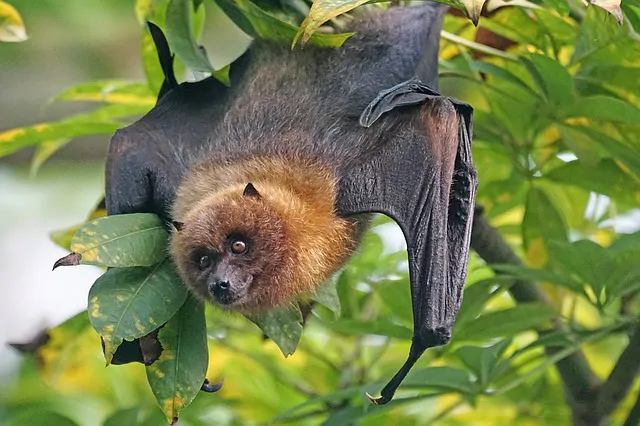 Bat-borne viruses worldwide pose a threat to both human and animal health.
Infection with filoviruses, particularly the Ebola and Marburg viruses, causes hemorrhagic fever that is often fatal in humans and primates. However, the discovery of other filoviruses with broad genetic diversity—with bats as their natural reservoir—increases the risk of future global epidemics.
Researchers report the characterization of a filovirus isolated from a flying fox in Yunnan Province, China, which is genetically distinct and has been named the Mengla virus. The complete genome sequence of this new virus shows that it shares only 32 to 54 percent of its nucleotide sequence with other known filovirus species. Phylogenetic analysis places the Mengla virus between the Ebola virus and the Marburg virus
, suggesting the need to add a new genus to the filovirus family, which already includes three (Ebolavirus, Marburgvirus,
and Cuevavirus
). This new genus, named Dianlovirus,
could include species other than the Mengla virus.
Studying the genetic diversity and geographic distribution of bat-borne filoviruses is essential for risk assessment and the prevention of infectious diseases. With globalization, it is crucial to identify and perform risk assessment on potential epidemics in order to develop effective control strategies and treatments.
The researchers tested the Mengla virus on cell lines from various species (humans, monkeys, dogs, hamsters, and bats) and found that, like other filoviruses, it exhibits broad cellular tropism and therefore poses a high potential risk of interspecies transmission
. To date, the new filovirus has only been identified in Rousettus
bats in China. Further tests will be conducted to perform a risk assessment of the virus spreading to other animal species. The findings, published in the journal *Nature Microbiology*
, already confirm that the Mengla virus is closely related to the Ebola and Marburg viruses in terms of evolution and shares several functional similarities with them.
Bat-borne viruses worldwide pose a threat to both human and animal health.
Infection with filoviruses, particularly the Ebola and Marburg viruses, causes hemorrhagic fever that is often fatal in humans and primates. However, the discovery of other filoviruses with broad genetic diversity—with bats as their natural reservoir—increases the risk of future global epidemics.
Researchers report the characterization of a filovirus isolated from a flying fox in Yunnan Province, China, which is genetically distinct and has been named the Mengla virus. The complete genome sequence of this new virus shows that it shares only 32 to 54 percent of its nucleotide sequence with other known filovirus species. Phylogenetic analysis places the Mengla virus between the Ebola virus and the Marburg virus
, suggesting the need to add a new genus to the filovirus family, which already includes three (Ebolavirus, Marburgvirus,
and Cuevavirus
). This new genus, named Dianlovirus,
could include species other than the Mengla virus.
Studying the genetic diversity and geographic distribution of bat-borne filoviruses is essential for risk assessment and the prevention of infectious diseases. With globalization, it is crucial to identify and perform risk assessment on potential epidemics in order to develop effective control strategies and treatments.
The researchers tested the Mengla virus on cell lines from various species (humans, monkeys, dogs, hamsters, and bats) and found that, like other filoviruses, it exhibits broad cellular tropism and therefore poses a high potential risk of interspecies transmission
. To date, the new filovirus has only been identified in Rousettus
bats in China. Further tests will be conducted to perform a risk assessment of the virus spreading to other animal species. The findings, published in the journal *Nature Microbiology*
, already confirm that the Mengla virus is closely related to the Ebola and Marburg viruses in terms of evolution and shares several functional similarities with them.
Read next
One Health & Zoonoses
10/10/2026
More than half of New York City’s free-roaming cats carry intestinal parasites?
One Health & Zoonoses
10/09/2026
Giardia in cats: large North American study finds 6.3% prevalence and substantial zoonotic potential
One Health & Zoonoses
10/08/2026
Commentaires
No comments yet.
Sign in to comment