

Back to articles
Marburg virus: a deadly zoonosis with various animal reservoirs
BN
Bertrand Neveux
02/12/2026
3 min read
0 comments
Share:
The Marburg virus, the causative agent of a highly fatal hemorrhagic fever with a high case fatality rate, is a classic “One Health” issue: most human outbreaks, which occur most frequently in Africa, begin with the virus circulating in animals and then spread through human-to-human transmission. In this context, a systematic review provides an overview of the prevalence and persistence of the Marburg virus in animals.
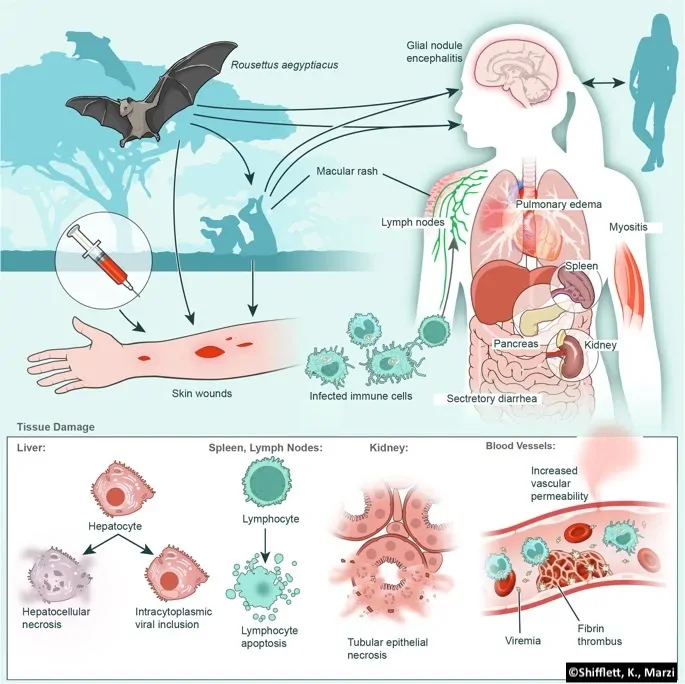 Pathogenesis of the Marburg virus in humans[/caption]
Bats Under Surveillance
The authors of this review selected 30 published studies on the Marburg virus in bats, rodents, non-human primates, and domestic animals (dogs, ruminants, pigs), focusing on three aspects: prevalence as determined by the detection of viral RNA and/or antibodies, the duration of seropositivity, and potential routes of viral shedding. Bats, particularly the Egyptian fruit bat, remain the virus’s primary natural reservoir and are linked to most human outbreaks. In the selected studies, seroprevalence among bats varies widely (from less than 1% to approximately 54%), indicating highly heterogeneous exposure depending on geographic region, the period studied, and the analytical method. At the same time, PCR detection of viral genes is significantly lower (around 0.8 to 3% of samples), which underscores that, in reservoirs, active infection is often brief and more difficult to detect than immunological traces. From an immunological perspective, the review reports that antibodies can persist for up to eleven months in naturally infected bats, whereas experimentally induced or maternally derived antibodies decline more rapidly, generally within less than five months.Zoonotic transmission of the virus
In the selected studies, viral RNA was generally not detected in domestic animals, non-human primates, and rodents. In contrast, antibodies were identified in dogs and livestock, as well as in non-human primates in certain African countries. The detection of antibodies specific to the Marburg virus in domestic animals, particularly those in close contact with humans, raises important questions about public health. Although the presence of antibodies indicates past exposure rather than active infection, it nevertheless suggests that these animals may serve as sentinels during episodes of viral transmission or as potential intermediate hosts in areas where fruit bats—the natural reservoirs of the virus—are abundant. Thus, the possibility that domestic animals may serve as mechanical or biological vectors in zoonotic transmission cannot be entirely ruled out, particularly in rural communities where livestock, dogs, and humans share the same habitat and resources. This underscores the importance of adopting a “One Health” approach to surveillance, integrating data on animal health, human health, and environmental health, in order to understand the dynamics of the Marburg virus. This review synthesizes the available data, identifies gaps in knowledge, and proposes new avenues for research. It confirms the major role of the Egyptian fruit bat in the circulation of the virus, while showing that other apparently healthy bat species, notably the African straw-colored fruit bat, also contribute to it. The recent detection of antibodies in certain livestock and dogs warrants further research into the role of these animals in viral circulation. It is therefore necessary to implement expanded and targeted multi-species surveillance of the Marburg virus in high-risk countries to better understand the role of reservoirs, the distribution of hosts, and the dynamics of viral transmission. [caption id="attachment_11164" align="alignnone" width="685"]Read next
One Health & Zoonoses
10/10/2026
More than half of New York City’s free-roaming cats carry intestinal parasites?
One Health & Zoonoses
10/09/2026
Giardia in cats: large North American study finds 6.3% prevalence and substantial zoonotic potential
One Health & Zoonoses
10/08/2026
Commentaires
No comments yet.
Sign in to comment