

Back to articles
Lyme disease: What if the Solution Lay in the Blood of the White-tailed Deer?
BN
Bertrand Neveux
08/29/2023
3 min read
0 comments
Share:
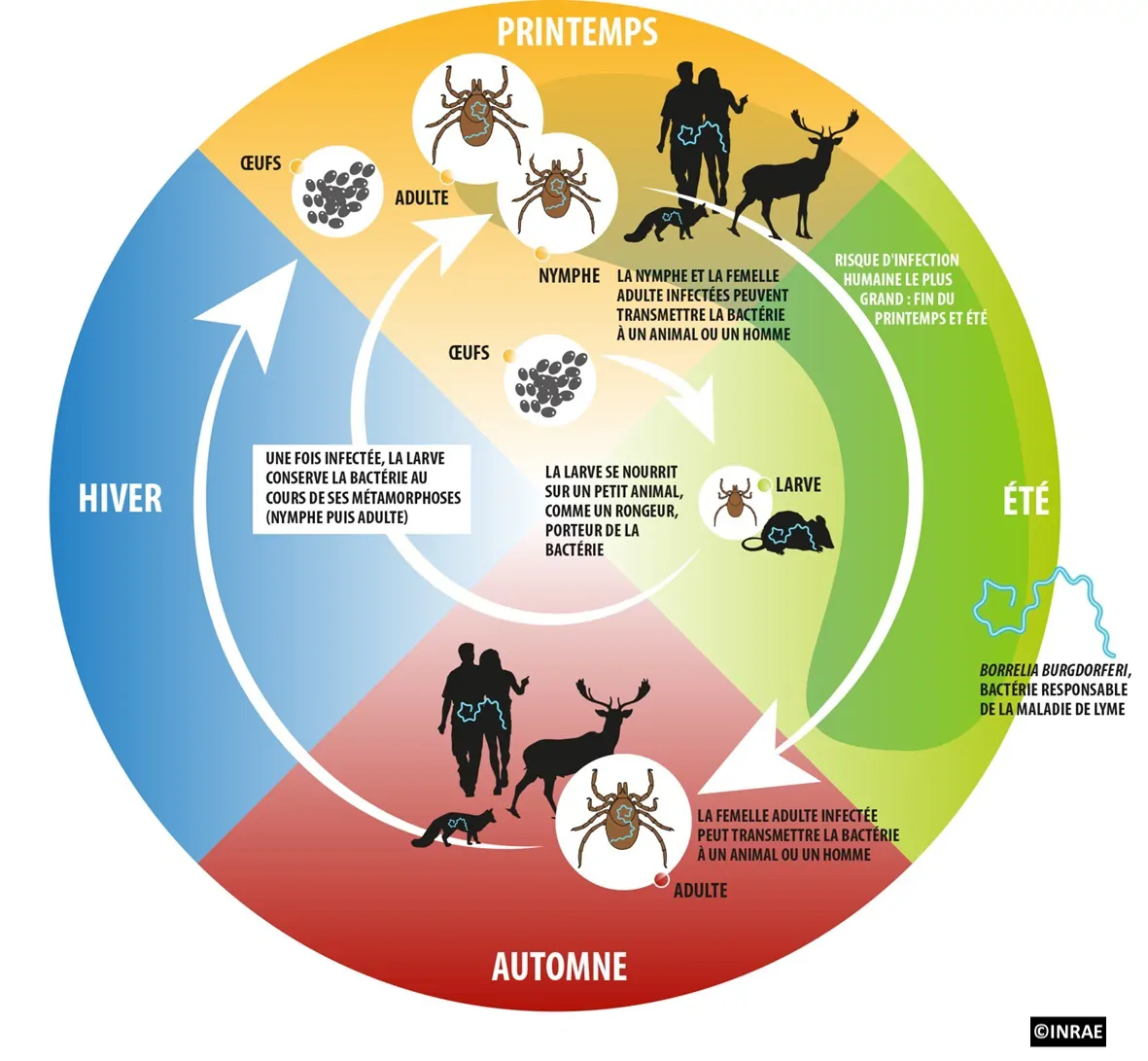
Like many vertebrate hosts, particularly in wildlife, the white-tailed deer can be infected with Borrelia burgdorferi. However, this animal is considered an incompetent reservoir for the causative agent of Lyme disease because it cannot effectively harbor or transmit the pathogenic bacteria. The spirochete does not survive in its blood.
Will the white-tailed deer lead to a new strategy for the prevention and treatment of Lyme borreliosis in humans? This is a fundamental question in the fight against this disease, as humans are not the only ones infected by Borrelia burgdorferi
. Dogs, horses, and cattle can become infected, just as can wildlife. Researchers
have investigated why the white-tailed deer slips through the cracks. Yet the animal plays an important role in the life cycle of the Ixodes
tick,
the disease’s vector. But ticks that feed on them are not infected by the bacteria.
The study revealed that the reason lies in the deer’s serum. A component in its blood simply kills the pathogen. No viable bacteria were detected at the end of the serum sensitivity test. The experiment also showed that the host’s resistance is not linked to a previous infection. This protective reaction is therefore clearly a result of the deer’s innate immunity.
While this study is the first to show that white-tailed deer serum possesses potent bactericidal activity against several genetically distinct strains of B. burgdorferi
, white-tailed deer are not the only species with this property. Previous studies have demonstrated that sera collected from red deer, Japanese sika deer, mule deer, fallow deer, and roe deer are also bactericidal. The next step is to understand the molecular mechanisms that provide this protection to all these deer species.
As a reminder, Lyme disease
is not fatal in humans if antibiotic therapy is initiated early. However, the disease is potentially debilitating and can cause joint, skin, or nervous system symptoms. Without treatment, the bacteria can survive in the body for several years and lead to complications such as arthritis or neurological impairments.
In the United States, 476,000 people are diagnosed each year, making it the most common vector-borne transmission zoonosis across the Atlantic.
In France, 76 cases are diagnosed per 100,000 inhabitants, representing a sharp increase in incidence. Approximately 810 human cases are hospitalized for borreliosis each year
. In more than half of these cases, hospitalized patients exhibit neurological symptoms.
Further Reading:
Ticks, Fleas: Lyme Disease, a Real Time Bomb
https://theconversation.com/tiques-puces-la-maladie-de-lyme-une-vraie-bombe-a-retardement-58748
Lyme disease: The Controversy
https://francelyme.fr/site/mediatiques/maladies-et-tiques/lyme-controverses/
Read next
One Health & Zoonoses
10/10/2026
More than half of New York City’s free-roaming cats carry intestinal parasites?
One Health & Zoonoses
10/09/2026
Giardia in cats: large North American study finds 6.3% prevalence and substantial zoonotic potential
One Health & Zoonoses
10/08/2026
Commentaires
No comments yet.
Sign in to comment