

Back to articles
One Health & Zoonoses
Bats
Chiroptera
COVID-19
Ebola
Filovirus
Hendra
Henipavirus
Marburg
MERS
Nipah
Phylogeny
SARS
Zoonosis
Emerging zoonoses: The risk of a pandemic is correlated with host characteristics
BN
Bertrand Neveux
09/14/2023
3 min read
0 comments
Share:
Why do diseases transmitted by bats—which are the natural hosts of several viruses—result in higher mortality rates in humans than zoonoses spread by other animals? To answer this question, a study modeled the mechanisms underlying the evolution of viral traits in reservoir hosts.
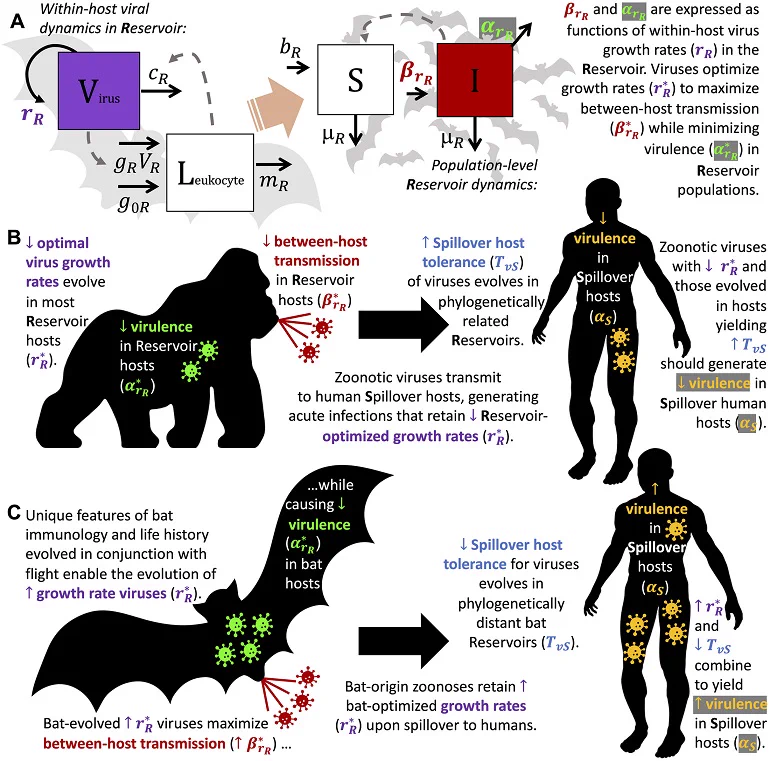
Scientists have developed a model to estimate the virulence of emerging viruses by taking into account several factors related to the reservoir host. While phylogeny has long been the marker of choice, its limitations call for new approaches. In particular, immunology appears better suited to understanding the evolution of viral traits in the host that will, at some point, be responsible for the virulence and adaptation of zoonotic viruses to new host species.
The example of the bat is interesting. Thanks to a combination of mechanisms of resistance and tolerance to viral infections, this animal rarely becomes ill, even though it harbors a number of particularly virulent viruses such as the Ebola and Marburg filoviruses, the Hendra and Nipah henipaviruses, and the coronaviruses responsible for severe acute respiratory syndrome (including SARS-CoV-2, which causes COVID-19) and Middle East respiratory syndrome (MERS). In contrast, viruses transmitted to humans by bats result in significantly higher morbidity and mortality rates than those originating from other mammals. This phenomenon cannot be explained solely by phylogenetic distance.
The study therefore examined variations in human mortality rates in the context of viral zoonoses linked to various animal reservoirs. As anticipated in bats, the impact of the animal’s life cycle and the reservoir host’s tolerance linked to antiviral immunity are the two main factors driving variation in the virulence of emerging zoonotic viruses in humans. Predictive models for zoonotic risk assessment must therefore take phylogeny into account but also be based on more comprehensive comparative immunological data, incorporating, for example, parameters such as leukocyte activation and mortality rates, the virus’s reproduction rate, the host’s tolerance to direct viral infection, and so on.
Added to this is viral tropism, another mechanism by which viral adaptation to reservoir hosts contributes to increased infection of secondary hosts. In bats, SARS-CoV-2 concentrates in the gastrointestinal tract, which is more tolerant to infection, thereby promoting a higher viral growth rate in this host. However, this high viral load increases pathogenicity when vulnerable tissues, such as the respiratory tract, are infected in target hosts like humans. Furthermore, the diversity of bat species also leads to significant variation in the evolution of viral virulence within the same animal genus, which comprises more than 1,400 species and accounts for approximately 20% of all mammals. As more data become available, the modeling proposed in this study can be refined to make more specific predictions, at the species level, regarding the risk of highly contagious zoonoses spreading.
Check out our feature on zoonoses
https://vetitude.fr/dossiers/one-health-et-zoonoses/Read next
One Health & Zoonoses
10/10/2026
More than half of New York City’s free-roaming cats carry intestinal parasites?
One Health & Zoonoses
10/09/2026
Giardia in cats: large North American study finds 6.3% prevalence and substantial zoonotic potential
One Health & Zoonoses
10/08/2026
Commentaires
No comments yet.
Sign in to comment