Does the rise of intensive farming increase the risk of a human pandemic?
VVetitude11/08/20227 min read0 comments
Share:
The global COVID-19 pandemic has brought renewed attention to a long-standing debate about the role of the changes our species has wrought on its natural environment in the emergence of emerging diseases. The impact of so-called intensive farming, in particular, is the subject of heated controversy. This controversy is part of a broader questioning of this farming method, due to its negative impact on animal welfare and the environmental pollution it generates.
However, few scientific arguments are available to support the hypothesis that the intensification of livestock farming contributes to theemergence of pandemics.
Emerging Diseases and Zoonoses
First, we must clarify what we mean by “emerging disease” and “intensive farming.” While it is commonly accepted that more than 60% of such diseases since the mid-20th century have been of animal origin
, the vast majority of the pathogenic agents involved have an animal population as their natural reservoir—that is, they are transmitted primarily among animals and sporadically cause outbreaks of infection in humans that do not result in sustained transmission within the human population.
These diseases are referred to as “zoonoses,” a term that fundamentally encompasses all diseases transmitted from animals to humans. Highly pathogenic avian influenza is probably the most widely publicized example. This emerging zoonosis has become established in livestock populations—specifically, poultry in several Asian and African countries—and now threatens Europe and North America. These influenza viruses cause severe disease but do not persistently spread among humans.
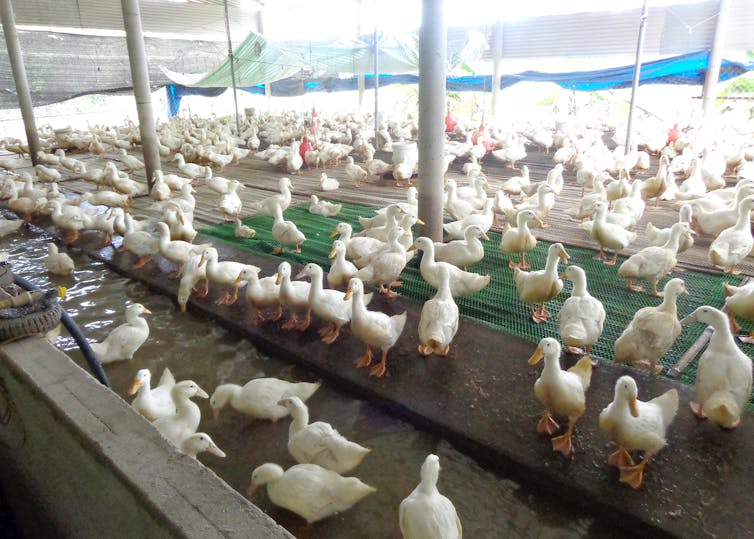
Poultry farms in Asia (here, duck farms in Vietnam) are now chronically affected by outbreaks of avian influenza, an emerging zoonosis that is particularly pathogenic for these animals.Nguyen Van Bo-Alexis Delabouglise, Author provided
In contrast, the emergence of a human disease involves a true species jump: the pathogenic organism must adapt to this new host in such a way that its circulation is sustained outside its initial animal reservoir. This is the case with the SARS-CoV-1 and SARS-CoV-2 coronaviruses, which caused the severe acute respiratory syndrome (SARS) pandemic and COVID-19, respectively, which emerged in 2002 and 2019, likely from a wild animal reservoir. This is also the case for the human immunodeficiency virus (HIV), which was originally a zoonosis transmitted by great apes.
While several ancient human diseases do indeed result from species jumps originating from a domestic animal reservoir—this is the case with measles and whooping cough, in particular— this phenomenon remains extremely rare when viewed in the context of animal domestication, which spans tens of thousands of years.
The Difficulty of Defining Intensive Farming
The concept of intensification in livestock farming is no less complex. While there is no official definition of intensive farming, it is commonly understood to refer to a set of changes in farming practices that have taken place since the end of World War II, first in industrialized countries and later in emerging and low-income countries, aimed at reducing the production costs of food of animal origin.
More specifically, intensification has reduced the amount of farmland and labor required to produce a given quantity of animal products. This increase in productivity has been achieved in several ways, notably through genetic improvement and mechanization.
Intensification is generally accompanied by an increase in the number of animals per farm, specialization of livestock operations in a specific stage of production (genetic selection, breeding, fattening), and their growing integration into complex, globalized commercial networks.
Intensification is not, however, a uniform process and has taken different forms depending on the socioeconomic and institutional contexts in which it has developed. The risk control of health risks in medium- to large-scale commercial livestock operations thus appears to be strongly influenced by the extent to which the government supports livestock farming practices, farmers’ access to credit and veterinary services, and the transparency measures implemented within the livestock sectors.
The Complex Link Between These Two Concepts
Once the definitions have been established, the key question remains: the causal link between the intensification of livestock farming and the emergence of new human diseases. It is clear that proving this causal link seems impossible, given the rarity of human emerging diseases originating from domestic animal reservoirs and the relative newness of the process of livestock intensification.
However, two examples of viral zoonoses shed light on how intensive farming could contribute to future outbreaks:
● The first example is highly pathogenic avian influenza caused by H5N1
, which was first identified in China in 1997 before spreading globally beginning in 2003. The areas where the H5N1 subtype appeared
combine high densities of domestic poultry with landscape features (wetlands) conducive to contact with wild birds. Studies conducted in various Southeast Asian countries demonstrate the role of commercial poultry farms and poultry trade networks in accelerating the spread of the virus among animal populations at various scales.
● Another telling example is Nipah encephalitis, transmitted by domestic pigs
, which emerged in Malaysia in 1998. The combination of pig farms and large-scale mango cultivation facilitated contact between fruit bats—the wild reservoir of the virus—and domestic pigs, and the transmission of the virus was then facilitated by the concentration of large numbers of pigs on farms and the transport of live pigs through commercial networks.
A link between intensive farming practices and increased virulence —that is, the severity of infections—of certain pathogenic organisms has also been documented, notably for Marek’s disease virus, which affects chickens and is not a zoonotic disease.
The mechanisms underlying this adverse selection toward more virulent forms of pathogenic organisms are complex. They are linked in particular to the high-density housing of animals, their shorter lifespans, and the selection of breeding stock based on productivity rather than disease resistance—in contrast to the selection mechanisms at work in more extensive forms of livestock farming.
Pathogens that are more virulent in animals would, in the event of transmission to humans, be more likely to cause severe symptoms in humans as well. This is a hypothesis proposed to explain the severity of infections caused by the H5N1 subtype of highly pathogenic avian influenza, but it has not yet been substantiated.
Finally, large-scale trade in live animals facilitates the exchange of genetic material between distantly related viral strains, thereby promoting the emergence of new strains capable of transmission to humans. These phenomena, known as “viral recombination,” are particularly common and feared in the case of avian and swine influenza
.
Planning to Prevent a Catastrophe
As we can see, the lack of definitive proof of a link between intensive livestock farming and pandemic risk does not dispense us from anticipating and preventing potential future risks.
Industrialized and emerging countries, however, face contrasting situations. In the former, intensive farming practices—which have been in place for a long time—are accompanied by systems designed to closely monitor disease outbreaks
and limit the spread of emerging diseases
.
The latter are experiencing rapid expansion of large-scale livestock farming to meet the demands of accelerated urbanization and a growing demand for animal proteins. This expansion must be supported by government agencies and accompanied by transparency measures and health surveillance protocols that are acceptable to rural communities.
These efforts will ultimately ensure that meeting the growing demand for animal proteins does not
come at the expense of public health
.
Alexis Delabouglise
, Researcher and socio-economist specializing in animal health, CIRAD
; François Roger
, Regional Director for Southeast Asia, veterinarian and epidemiologist, CIRAD
; Marisa Peyre
, Deputy Head of the ASTRE Research Unit, epidemiologist, CIRAD
; and Mathilde Paul
, Professor of Epidemiology, National Veterinary School of Toulouse, INRAE
This article is republished from The Conversation
under a Creative Commons license. Read the original
article.


 Alexis Delabouglise
, Researcher and socio-economist specializing in animal health, CIRAD
; François Roger
, Regional Director for Southeast Asia, veterinarian and epidemiologist, CIRAD
; Marisa Peyre
, Deputy Head of the ASTRE Research Unit, epidemiologist, CIRAD
; and Mathilde Paul
, Professor of Epidemiology, National Veterinary School of Toulouse, INRAE
This article is republished from The Conversation
under a Creative Commons license. Read the original
article.
Alexis Delabouglise
, Researcher and socio-economist specializing in animal health, CIRAD
; François Roger
, Regional Director for Southeast Asia, veterinarian and epidemiologist, CIRAD
; Marisa Peyre
, Deputy Head of the ASTRE Research Unit, epidemiologist, CIRAD
; and Mathilde Paul
, Professor of Epidemiology, National Veterinary School of Toulouse, INRAE
This article is republished from The Conversation
under a Creative Commons license. Read the original
article.
Commentaires
No comments yet.
Sign in to comment