

Back to articles
One Health & Zoonoses
African swine fever
ASF
Bats
BoHV-4
Encephalitic
Encephalitis
Herpesvirus
Nipah
Pork
Vaccine
Zoonosis
A vaccine against the Nipah virus?
MR
Mia Rozenbaum
05/21/2020
2 min read
0 comments
Share:
The Nipah virus, a rare but deadly zoonotic disease, is a major concern for public health and animal health. A new study evaluates the use of bovine herpesvirus (BoHV-4) as a potential vector for vaccination against the virus.
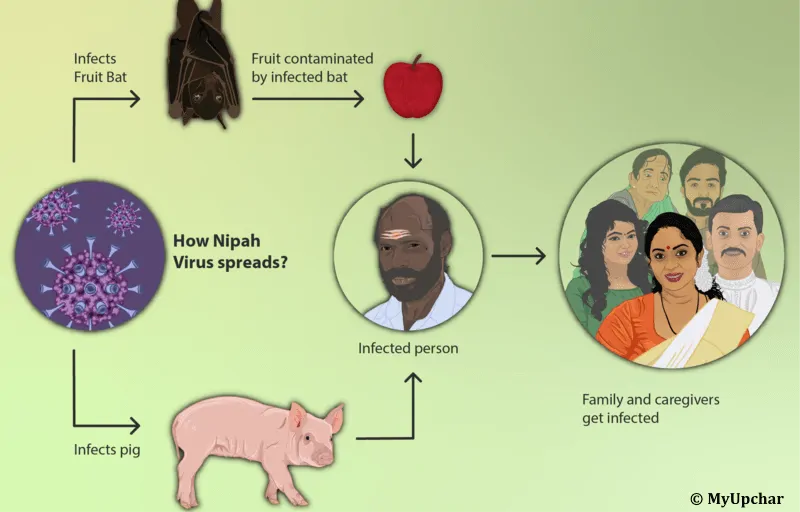 First identified in 1998 in Malaysia in pigs, the Nipah virus—also known as swine encephalitis or “barking pig syndrome”—is a serious emerging zoonotic disease affecting both animals and humans. Dogs, cats, goats, sheep, and horses are at risk.
Naturally present in fruit-eating bat populations in South and Southeast Asia, the virus can spread to pig populations, causing a mild or asymptomatic illness, and then to humans. Pigs appear to play a key role in the virus’s epidemiology by acting as amplifying hosts. The virus replicates in pigs and spreads through them.
Difficult to diagnose, the virus causes a severe and often fatal neurological disease in humans (in up to 60–70% of cases).
To eradicate the first and most devastating Nipah virus outbreak and protect human populations, 40% of Malaysia’s pig population—nearly 1.1 million animals—had to be culled, at a cost of $582 million. This operation took a heavy toll in terms of both lives and economic resources.
Although the virus has since remained rare in both human and pig populations, the public health and animal health stakes remain high. Controlling the spread of the virus in pig populations is crucial.
In the absence of a treatment, vaccination is a major concern. A new study identifies bovine herpesvirus (BoHV-4) as a potential vector for vaccination against the Nipah virus. When engineered to express Nipah virus attachment (G) or fusion (F) glycoproteins, BoHV-4 induces protective immunity in pigs.
In both cases, robust antigen-specific antibody responses are induced. Both vector-based vaccines elicit antigen-specific CD4 and CD8 T-cell responses, which are particularly strong with the vector expressing G. In contrast, only pigs immunized with the virus expressing the F protein have antibodies capable of significantly neutralizing G- and F-mediated cell fusion.
These results highlight the potential of BoHV-4 vectors to induce cell-mediated immunity and antibody activation in pigs against the Nipah virus. Furthermore, the vector’s effectiveness in eliciting T-cell responses suggests its utility for dispensing antigens against other porcine viruses for which T cells play an important role, such as African swine fever or porcine reproductive and respiratory syndrome viruses.
First identified in 1998 in Malaysia in pigs, the Nipah virus—also known as swine encephalitis or “barking pig syndrome”—is a serious emerging zoonotic disease affecting both animals and humans. Dogs, cats, goats, sheep, and horses are at risk.
Naturally present in fruit-eating bat populations in South and Southeast Asia, the virus can spread to pig populations, causing a mild or asymptomatic illness, and then to humans. Pigs appear to play a key role in the virus’s epidemiology by acting as amplifying hosts. The virus replicates in pigs and spreads through them.
Difficult to diagnose, the virus causes a severe and often fatal neurological disease in humans (in up to 60–70% of cases).
To eradicate the first and most devastating Nipah virus outbreak and protect human populations, 40% of Malaysia’s pig population—nearly 1.1 million animals—had to be culled, at a cost of $582 million. This operation took a heavy toll in terms of both lives and economic resources.
Although the virus has since remained rare in both human and pig populations, the public health and animal health stakes remain high. Controlling the spread of the virus in pig populations is crucial.
In the absence of a treatment, vaccination is a major concern. A new study identifies bovine herpesvirus (BoHV-4) as a potential vector for vaccination against the Nipah virus. When engineered to express Nipah virus attachment (G) or fusion (F) glycoproteins, BoHV-4 induces protective immunity in pigs.
In both cases, robust antigen-specific antibody responses are induced. Both vector-based vaccines elicit antigen-specific CD4 and CD8 T-cell responses, which are particularly strong with the vector expressing G. In contrast, only pigs immunized with the virus expressing the F protein have antibodies capable of significantly neutralizing G- and F-mediated cell fusion.
These results highlight the potential of BoHV-4 vectors to induce cell-mediated immunity and antibody activation in pigs against the Nipah virus. Furthermore, the vector’s effectiveness in eliciting T-cell responses suggests its utility for dispensing antigens against other porcine viruses for which T cells play an important role, such as African swine fever or porcine reproductive and respiratory syndrome viruses.
Read next
One Health & Zoonoses
10/10/2026
More than half of New York City’s free-roaming cats carry intestinal parasites?
One Health & Zoonoses
10/09/2026
Giardia in cats: large North American study finds 6.3% prevalence and substantial zoonotic potential
One Health & Zoonoses
10/08/2026
Commentaires
No comments yet.
Sign in to comment